Table of Contents >> Show >> Hide
- The Origin Story: A Recovery Bed, a Pen, and a Long Game
- What “Infinite” Means (and Why It Feels Addictive in a Good Way)
- The Visual Language: Dense Detail, Micro-Stories, and Recurring Motifs
- From Instagram to a Giant Wall: The AR Upgrade
- Why Serial Art Works on Instagram (Even When the Algorithm Is Moody)
- The Unsexy Part: Protecting 49 Feet of Paper
- Want to Start Your Own Endless Drawing? Here’s the Low-Drama Version
- The Takeaway: Patience Is a Medium
- Experiences From the Infinite-Drawing Mindset (About )
Instagram is famous for quick hits: post, swipe, forget. So when a French illustrator decided to create one continuous drawingposted in slices, year after yearit felt like an act of creative rebellion (with excellent pen control). The result, known online as The Infinite Drawing, has passed the 15-meter mark (about 49 feet) and turned “just one more scroll” into an art-viewing habit instead of a doomscrolling reflex.
Below, we’ll unpack the real story behind the project, why the format works so well on social media, how it leapt from a phone screen to an augmented-reality wall experience, and what creators can borrow from the “infinite” mindsetwithout copying anyone’s style or burning themselves out.
The Origin Story: A Recovery Bed, a Pen, and a Long Game
The infinite drawing is closely associated with French illustrator Elly Oldman. Project descriptions say she began in spring 2017 while recovering from an accident and stuck in bed, turning limited mobility into a daily-ish practice: keep the drawing connected, keep it growing, keep sharing it on Instagram.
When the work started being presented as a public project, milestone figures often cited were around 200 Instagram posts and roughly 14–15 meters of connected drawing, with a following in the tens of thousands. Not bad for something that began as “I guess I’ll draw today.”
What “Infinite” Means (and Why It Feels Addictive in a Good Way)
It’s one artwork, delivered as episodes
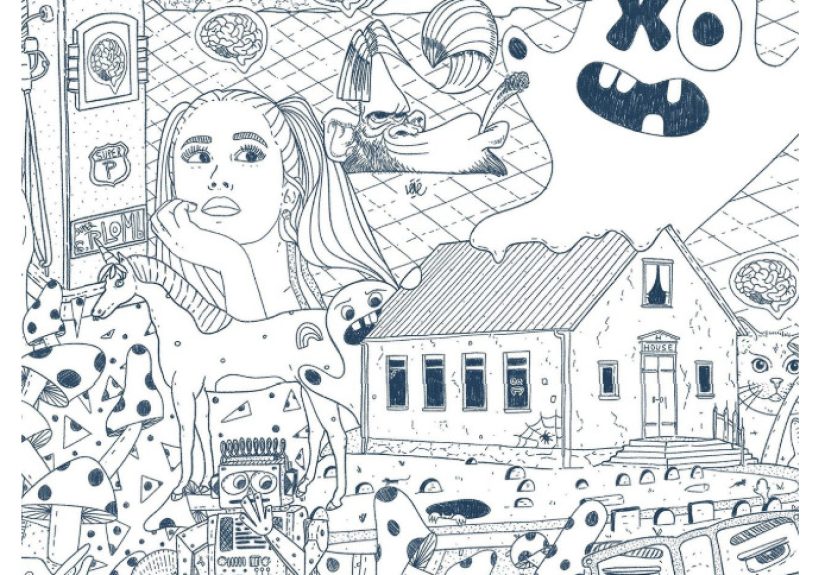
Each post is a cropped “chapter” from the same continuous piece. You can enjoy a single segment, but the magic is realizing every slice is part of a larger, coherent world.
It matches the psychology of infinite scroll
Feeds are built for “just one more.” An endless drawing uses that same itch, but redirects it toward curiosity: viewers look for tiny jokes, hidden characters, and visual callbacks rather than outrage-of-the-day content.
It rewards re-entry
Because the world is detail-rich, you can disappear for weeks and return without feeling lost. It’s less like a single post and more like a place you revisit.
The Visual Language: Dense Detail, Micro-Stories, and Recurring Motifs
Long-running drawings thrive on a few design choices that make each new section satisfying on its own:
- High-density linework so every crop reads like a complete scene.
- Repeat characters and objects to build familiarity without repetition.
- Small “blink-and-you-miss-it” narratives that reward careful looking.
Official descriptions of The Great Story of the Infinite Drawing also emphasize an ecological thread in the story worldproof that “endless” doesn’t have to mean “aimless.” A theme gives the project an emotional backbone, so viewers aren’t only tracking length; they’re tracking meaning.
From Instagram to a Giant Wall: The AR Upgrade
A 15-meter drawing eventually stops being just content and starts being a physical object with real-world demands: storage, exhibition, and how to let people experience it without turning the audience into professional crouchers.
Project materials for The Great Story of the Infinite Drawing describe a giant, evolving fresco that can be explored both as a physical mural and through augmented reality (AR). Store listings for the related app describe scanning parts of the artwork to trigger interactive elements, framed as a playful ecological missionspot plastics in the illustrated wetlands, engage with story characters, and “clean” the scene through the AR layer.
This approach fits a broader shift: public artworks that stay beautiful as static objects while offering an optional second layer through a phone camera. AR can add motion, highlight details, and invite participation without altering the original drawing.
How the exhibition version keeps the “infinite” feeling offline
One clever detail in the project’s official presentations is that the work isn’t treated as “just hang it on a wall and hope for the best.” It’s described as a full installation: the fresco can be experienced in its entirety on a wall, and a version can be reconfigured as a giant, puzzle-like layout on the ground. That matters because it solves a real audience problem. People don’t only want to see a long artworkthey want to move through it, find entry points, and compare distant sections without doing the museum equivalent of speed-walking the length of a hallway.
Pairing the physical piece with AR also changes how viewers behave. Instead of a single “front-facing” viewing angle, the work becomes interactive: you scan, discover hotspots, and the story reveals itself in layers. In many AR mural projects, the goal isn’t to replace the artwork with screen time; it’s to give the audience a reason to look longer and look closer. For a detail-dense, serial illustration, that’s a natural fit.
Why Serial Art Works on Instagram (Even When the Algorithm Is Moody)
Endless projects succeed online when they do three things well:
- Create anticipation: each post is a payoff and a promise of more.
- Invite participation: viewers comment discoveries (“I found the tiny robot!”) and feel like co-explorers.
- Reward attention: the longer you look, the more you seerare currency on fast platforms.
If you’re building a multi-year series, it helps to think like a showrunner. Every so often, create an “onboarding” post: a zoomed-out overview, a simple map, or a carousel that explains how sections connect. New followers need a way in, and longtime followers enjoy a recap the way sports fans enjoy highlight reels.
Also, pay attention to what the platform is explicitly teaching creators. Meta has rolled out creator education and “best practices” guidance inside professional tools, focusing on reach, engagement, and content quality. You don’t have to obey every tip like it’s a law of physics, but it’s useful signal: the platform wants fewer gimmicks and more clearly packaged creative work.
Practically, long-form creators also benefit from what the platform itself now pushes: consistent posting habits, clear packaging (captions that orient newcomers), and an emphasis on content quality over “engagement hacks.” And on the hashtag front, recent coverage has highlighted tighter hashtag limits aimed at reducing spamanother nudge toward fewer, more specific tags and better storytelling.
The Unsexy Part: Protecting 49 Feet of Paper
Behind every “effortless” art post is the reality of paper that creases, fades, and tears. Guidance from major preservation and museum organizations is remarkably consistent: limit light exposure, keep temperature and humidity stable, avoid acidic materials, and handle works on paper in ways that prevent abrasion and bending. Oversize works often benefit from careful horizontal storage in appropriate archival enclosures.
If you’re building something long, build an archival workflow too: digitize sections as you go, store originals with acid-free materials, and consider working in connected panels that align visually but store safely.
Want to Start Your Own Endless Drawing? Here’s the Low-Drama Version
Choose a world that can expand
Pick a setting that naturally growscity blocks, forests, space stations, theme parks, “museum of weird objects.” Expansion should feel like discovery, not like stretching content.
Define the smallest doable installment
Your project lives or dies on the smallest unit. Make it small enough that you can finish it on an ordinary day, not only on your best day.
Plan for “wide shots” and “close-ups”
Detail is your hook, but context is your glue. Alternate tight crops (for intrigue) with occasional wide views (for orientation). If you only post close-ups, new viewers can’t tell what they’re looking at. If you only post wide shots, your tiny jokes get lost.
Make “finding” part of the experience
Hide callbacks. Repeat characters. Plant tiny jokes. You’re building a scavenger hunt with no closing time.
The Takeaway: Patience Is a Medium
The headline feature isn’t the meter countit’s the method. A long piece becomes possible when you commit to small increments and let them accumulate. That’s why people follow: the artwork is great, but the visible persistence is inspiring. It’s proof that you can build big things without chasing viral chaos.
Experiences From the Infinite-Drawing Mindset (About )
Creators who take on long-form, serial art projects often describe an emotional arc that’s strangely predictable. It starts with a burst of adrenalineyour first connected sections feel like you’ve discovered a secret tunnel through the attention economy. You post, people react, and the project feels alive. Then comes the middle stretch, the part nobody screenshots: the weeks when your hand is tired, your brain is convinced you’ve already drawn every possible kind of leaf, and the feed decides to show your masterpiece to approximately three people and a golden retriever.
This is where the “infinite” mindset becomes less about ambition and more about maintenance. Artists talk about building tiny rituals: a specific playlist, a favorite pen that signals “work mode,” a rule that the next installment only needs to be started today, not finished. When the project is huge, momentum matters more than motivation. Motivation is a flaky friend; momentum is the boring coworker who always shows up.
There’s also a practical thrill in solving physical problems. A long drawing forces you to become part artist, part engineer: you learn how to photograph or scan consistently; you learn that paper has opinions about humidity; you learn that “just roll it up” is the beginning of a tragedy. Many creators eventually switch to modular sections, protective interleaving sheets, or custom boxesnot because it’s glamorous, but because one bad crease can feel like a plot hole in your own story.
One of the best experiences is watching viewers become explorers. People comment on micro-details you forgot you drew. They spot running jokes and build theories about characters. Over time, the audience stops being passive; they become your memory. They remind you what happened “back in the swamp chapter,” or where the robot first appeared, or when you introduced that ridiculous little goat. The community turns a personal practice into a shared world.
And thenquietlysomething shifts. The drawing is no longer a project you’re trying to finish. It’s a place you visit. You can have a bad day and still add a small corner. You can have a great day and add a whole new neighborhood. The pressure to be perfect fades, because the scale teaches you perfection is impossible anyway. What matters is coherence: keep the world consistent enough that it feels real, and playful enough that it feels worth returning to.
Another common experience is learning to separate “progress” from “performance.” Some updates will get huge engagement; others will quietly land. Instead of taking that personally, long-form creators learn to measure success by continuity: Did the world expand? Did the story stay coherent? Did you keep the habit healthy? Over time, that mindset is freeing. You stop negotiating with the algorithm and start negotiating with your own staminawhich is the only metric you actually control.
If you’re considering your own “infinite” series, the most honest advice is this: treat it like training for your creative endurance. Your style will improve. Your storytelling instincts will sharpen. Your process will get smarter. But the real win is learning that art can be built the way cities are builtone block at a time, with room for detours, surprises, and a few beautifully weird alleys you didn’t plan.