Table of Contents >> Show >> Hide
- What an Eyeglass Prescription Really Is (and What It Isn’t)
- Eyeglass Prescription Cheat Sheet (Common Terms)
- Step-by-Step: How to Read Your Prescription (Without a Decoder Ring)
- Step 1: Find OD and OS (Right Eye and Left Eye)
- Step 2: Read SPH (Sphere)
- Step 3: Check CYL (Cylinder) and AXIS (Astigmatism Details)
- Step 4: Look for ADD (Reading Boost)
- Step 5: Spot Prism (If It’s There)
- Step 6: Find PD (Pupillary Distance)
- Step 7: Read Any Notes (Lens Type, DV/NV, or Special Instructions)
- A Real Example (Translated Into Plain English)
- Glasses vs. Contacts: Same Person, Different Prescription
- How to Use Your Prescription When Buying Glasses (Online or In-Store)
- Common Questions (And the Non-Scary Answers)
- Important Safety Notes (Friendly, Not Freaky)
- Real-Life Experiences: What It Feels Like to Finally Understand Your Rx (About )
- Conclusion
If you’ve ever looked at your eyeglass prescription and thought, “Ah yes, the secret code that unlocks my vision,” you’re not alone.
Those numbers and abbreviations aren’t a conspiracythey’re a shorthand your eye doctor uses to describe exactly how your lenses should be made.
Once you know what the most common terms mean, reading an eyeglass prescription becomes surprisingly simple… like decoding a menu at a restaurant
you actually want to eat at.
This guide will walk you through the big hittersOD, OS, SPH, CYL, AXIS, ADD, PD, and prismplus a real example you can translate into plain English.
By the end, you’ll know what you’re looking at and what to double-check before ordering glasses online or in-store.
What an Eyeglass Prescription Really Is (and What It Isn’t)
An eyeglass prescription is a set of measurements that tells a lab how to make lenses that bend light in a way that helps your eyes focus.
It’s typically based on a refraction test (the “Which is better, one or two?” part of the exam), and it’s usually written separately for each eye.
What it isn’t: a diagnosis, a “grade” for how good or bad your eyes are, or a contact lens prescription (more on that later).
Think of it as a recipe. The numbers are ingredients and amountsnot a judgment of your eyeballs’ character.
Eyeglass Prescription Cheat Sheet (Common Terms)
Most prescriptions are formatted like a grid with rows for each eye and columns for different measurements.
Here’s the quick translation of what you’ll usually see:
| Abbreviation | What It Means | What It Affects | Example |
|---|---|---|---|
| OD | Right eye (Latin: oculus dexter) | Applies numbers to your right lens | OD: -2.00 |
| OS | Left eye (Latin: oculus sinister) | Applies numbers to your left lens | OS: -1.25 |
| OU | Both eyes (Latin: oculus uterque) | Sometimes used for shared instructions | OU: “anti-reflective” |
| SPH (Sphere) | Main lens power for nearsightedness/farsightedness | Distance clarity (and overall focus) | -3.50 or +1.25 |
| CYL (Cylinder) | Extra power to correct astigmatism | Blur/distortion from uneven cornea/lens shape | -0.75 |
| AXIS | Orientation of astigmatism correction (1–180) | Where the CYL correction is placed | 090, 165 |
| ADD | Extra magnification for near work (reading) | Bifocals/progressives for presbyopia | +2.00 |
| PD (Pupillary Distance) | Distance between your pupils (mm) | Centers lenses so you’re looking through the “sweet spot” | 63 or 31/32 |
| PRISM + BASE | Shifts the image to help eyes align | Double vision/eye teaming | 1.0 BU |
Step-by-Step: How to Read Your Prescription (Without a Decoder Ring)
Step 1: Find OD and OS (Right Eye and Left Eye)
Start with the rows. OD is your right eye and OS is your left eye. If you see RE and LE,
that’s the modern version: right eye and left eye.
Step 2: Read SPH (Sphere)
SPH is the main number that corrects your overall focus.
It’s measured in diopters and typically written in 0.25 steps (like -1.00, -1.25, -1.50).
- Minus (-) = nearsighted (myopia): distance is blurry, close is clearer.
- Plus (+) = farsighted (hyperopia): close work is harder (and sometimes distance too).
- Closer to 0 = milder correction. Farther from 0 = stronger correction.
Example: -4.00 means stronger nearsighted correction than -1.00.
It does not mean your eyes are “four times worse.” Eyes are not smoothies; you can’t measure them in servings.
Step 3: Check CYL (Cylinder) and AXIS (Astigmatism Details)
If you have astigmatism correction, you’ll usually see both a CYL number and an AXIS number.
The rule of thumb: CYL and AXIS travel together like a buddy-cop duo. If one is missing, the other usually is too.
- CYL is also in diopters and may be written with a minus sign (common) or sometimes a plus sign.
- AXIS is a whole number from 1 to 180. It’s not “strength.” It’s directionlike a compass heading for your lens.
Example: CYL -1.25 AXIS 090 means: “Add -1.25 diopters of astigmatism correction oriented at 90 degrees.”
Step 4: Look for ADD (Reading Boost)
ADD is the extra magnification for near tasksreading, phone scrolling, menu squinting, and pretending you’re “just tired.”
It’s commonly used for bifocals and progressive lenses, especially with presbyopia (age-related near-vision changes).
ADD is almost always a plus number (like +1.00 to +2.50 or more). If you have single-vision distance glasses, your ADD may be blank.
Step 5: Spot Prism (If It’s There)
Prism is used when your eyes need help working together (for example, certain types of double vision or alignment issues).
Prism is measured in prism diopters and is usually paired with a base direction.
- BU = base up
- BD = base down
- BI = base in
- BO = base out
Example: 1.0 BU means one prism diopter base up. If you see prism on your Rx, it’s a good idea to order from a place that’s experienced
with prism lenses (and to double-check the entry before you click “Buy Now”).
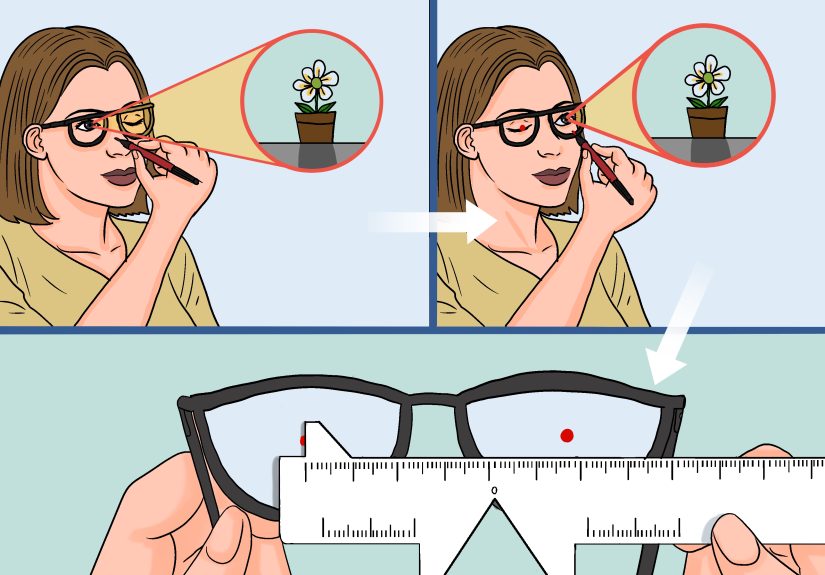
Step 6: Find PD (Pupillary Distance)
PD is the distance between the centers of your pupils in millimeters. It helps position the optical center of each lens so you’re looking
through the correct spot.
You might see:
- Single PD: one number (e.g., 63)
- Dual PD: two numbers (e.g., 31/32), one for each eye
Step 7: Read Any Notes (Lens Type, DV/NV, or Special Instructions)
Some prescriptions include extra notes like:
- DV (distance vision) and NV (near vision)
- VA (visual acuity)
- Lens recommendations (single-vision, bifocal, progressive)
- Coatings (anti-reflective, photochromic), though these are often separate from the Rx itself
A Real Example (Translated Into Plain English)
Here’s a sample prescription format you might see:
| SPH | CYL | AXIS | ADD | PD | |
|---|---|---|---|---|---|
| OD | -2.50 | -0.75 | 180 | +1.50 | 31 |
| OS | -1.75 | -1.25 | 090 | +1.50 | 32 |
What it means in human language:
- Your right eye (OD) is moderately nearsighted (-2.50) with a small amount of astigmatism correction (-0.75) oriented at axis 180.
- Your left eye (OS) is also nearsighted (-1.75) with a bit more astigmatism correction (-1.25) oriented at axis 90.
- You have an ADD of +1.50 for near work, meaning you likely need multifocal support (like progressives or bifocals) to make reading comfortable.
- Your dual PD is 31 mm (right) and 32 mm (left), which helps place the lens centers correctly.
Glasses vs. Contacts: Same Person, Different Prescription
This part saves people a lot of frustration (and returns).
A glasses prescription is not the same as a contact lens prescription.
Contacts sit directly on the eye, so the measurements and required details differ.
A contact lens prescription often includes additional fields like:
BC (base curve), DIA (diameter), lens brand, and sometimes material or replacement schedule.
Even if the numbers look similar, you shouldn’t substitute one prescription for the other.
How to Use Your Prescription When Buying Glasses (Online or In-Store)
1) Make Sure Your Prescription Is Current
Eyeglass prescriptions commonly expire after one to two years (often depending on state rules and your eye health).
If you’re not sure, check the expiration date printed on the Rx or ask your eye doctor’s office.
2) Enter the Numbers Exactly (Signs Included)
When you type your prescription into an online form, enter:
- The plus or minus sign exactly as written
- Decimals exactly (don’t round unless a professional tells you to)
- CYL and AXIS together
- ADD only if you’re ordering progressives/bifocals/reading multifocals
Accidentally flipping a “-” to a “+” is the optical version of putting salt in your coffee. Technically still a beverage, but nobody’s happy.
3) Don’t Guess PD If You Can Avoid It
If your PD isn’t listed, you can request it from your provider or have it measured by an optician.
PD matters more with stronger prescriptions and with progressives, where alignment is especially important.
4) Know Which Lens Type Matches Your Life
- Single-vision distance: for driving, TV, general distance clarity
- Single-vision near: for reading/crafts/close-up work
- Progressives: smooth transition from distance to near (no visible line)
- Bifocals/trifocals: segmented zones (visible line)
5) When to Call Your Eye Doctor Before Ordering
A quick call is worth it if:
- Your prescription includes prism
- You’re switching into progressives for the first time
- Your vision feels off even with the “correct” numbers
- You’re unsure whether the Rx is for distance, near, or multifocal
Common Questions (And the Non-Scary Answers)
“Why are my two eyes different?”
Because you’re a human, not a factory-set appliance. It’s normal for one eye to need more correction than the other.
“Is a higher number always ‘worse’?”
A bigger absolute value usually means a stronger lens prescription. But “worse” isn’t always the right word.
The real question is: “Does this correction help you see clearly and comfortably?”
“My CYL is blankwhat does that mean?”
Often it means you don’t need measurable astigmatism correction in that eye (or it’s so small it’s not included).
“What does AXIS 180 mean?”
It’s just an orientation for astigmatism correctionlike “place the correction along this angle.” It isn’t stronger than AXIS 090; it’s simply different.
“Can I adjust my prescription myself?”
It’s tempting to play optometrist after two espresso shots, but nochanges should be guided by an eye care professional.
Even small shifts can cause headaches, eye strain, or blur.
Important Safety Notes (Friendly, Not Freaky)
If you have new symptoms like sudden vision loss, flashes, a curtain-like shadow, or intense eye pain, don’t troubleshoot with an online quiz or a
“wellness influencer” named Moonbeam. Contact an eye care professional promptly.
And if your glasses feel “wrong” despite matching the prescription, it could be a measurement issue (like PD), lens positioning, frame fit, or a change in vision.
It’s fixablejust not by squinting harder.
Real-Life Experiences: What It Feels Like to Finally Understand Your Rx (About )
Many people describe the first time they really understand their eyeglass prescription as oddly empoweringlike learning what all the buttons do in a new car
instead of just hoping it goes forward. At first, an Rx can feel intimidating because it looks medical and official, and your brain assumes it must be complicated.
But once you learn that SPH is the main power, CYL and AXIS handle astigmatism, and ADD is the reading boost, the mystery shrinks fast.
A common real-world moment: you’re ordering glasses online for the first time. You open the form and it asks for SPH, CYL, AXIS, and PD, and suddenly you’re
staring at your paper prescription like it’s a treasure map drawn by a pirate with a PhD. Knowing how to match your OD row to your right eye and your OS row to
your left eye can turn that moment from stressful to straightforward. People often say their confidence jumps when they realize the signs matter mostgetting the
minus vs plus correct feels like the difference between “clear road signs” and “why is the world in soft focus?”
Another experience that comes up a lot is the first time someone gets an ADD value. It’s not unusual to feel a little offended, as if your eyes are filing a formal
complaint about your age. But many also report that adding progressives or readers is a reliefheadaches from squinting ease up, and close-up work becomes easier.
The emotional shift is real: moving from “I guess the lighting is bad everywhere” to “Oh, I needed near correction” can feel like solving a tiny life mystery.
People with astigmatism often mention that learning about CYL and AXIS helps them understand why “almost right” glasses still feel off. Astigmatism correction isn’t
just about strength; it’s also about alignment. That’s why axis exists. Once you know that axis is a direction (not power), it explains why entering the wrong axis
can cause distortion or that slightly dizzy, “the floor is tilting” sensation for some wearers.
And then there are the “small wins” experiences: recognizing that your two eyes don’t match and realizing it’s normal; understanding why PD matters when your
stronger prescription feels weird in a new frame; noticing that your last pair of glasses worked better because the optical center was placed correctly; or finally
being able to ask a smarter question at the optician (“Should my ADD be the same in both eyes?” or “Is this prescription for distance or computer?”).
The overall pattern is the same: once you can read your prescription, you stop feeling like vision care is something that happens to youand start feeling
like an informed partner in getting the clearest, most comfortable results.
Conclusion
Reading an eyeglass prescription doesn’t require perfect eyesight, a medical degree, or the ability to pronounce Latin without sweating.
Start with OD/OS, translate SPH for nearsighted vs farsighted correction, pair CYL with AXIS for astigmatism, add ADD for near vision support, and confirm PD for
proper lens alignment. Once you know what the numbers mean, ordering glasses (and asking the right questions) becomes a whole lot easier.