Table of Contents >> Show >> Hide
Isosceles triangles are fascinating shapes that appear in a variety of everyday objects, from architectural designs to road signs. But how do you calculate the area of an isosceles triangle? Fortunately, it’s simpler than you might think. This guide will walk you through the process step-by-step, using easy-to-understand concepts and pictures to make the math clearer. Let’s dive into how you can find the area of an isosceles triangle!
What Is an Isosceles Triangle?
Before we jump into the formula, let’s briefly define an isosceles triangle. An isosceles triangle is a triangle with at least two sides of equal length. These two sides are called the legs, and the third side, which is of a different length, is called the base. The angles opposite the equal sides are also the same. This symmetry makes the isosceles triangle a unique and easy-to-visualize shape in geometry.
Formula for the Area of an Isosceles Triangle
The formula for the area of any triangle is straightforward:
However, with an isosceles triangle, the height can be a bit tricky to calculate if it’s not given. So, let’s break it down.
Step 1: Identify the Base and Height
The base is simply the third side of the triangle, the one that is not equal to the other two. The height is the perpendicular distance from the base to the apex (the top point where the two equal sides meet).
In many problems, the height might not be directly provided. In this case, you’ll have to calculate it using the Pythagorean theorem or other geometric methods.
Step 2: Use the Pythagorean Theorem to Find the Height
If the height is not given, you can use the Pythagorean theorem to calculate it. The Pythagorean theorem states that in a right triangle, the square of the hypotenuse (the longest side) is equal to the sum of the squares of the other two sides. To apply this to an isosceles triangle, you first split the triangle in half vertically. This gives you two right triangles, each with one leg as half the base of the isosceles triangle, and the hypotenuse as one of the equal legs of the original triangle.
Here’s how you can use the Pythagorean theorem:
Solving for the height, we get:
Once you’ve calculated the height, plug it into the formula for the area of a triangle.
Step 3: Calculate the Area
Now that you know both the base and the height, you can easily calculate the area by using the formula:
Substitute your values into the formula, and you’ve got the area of your isosceles triangle!
Example Problem
Let’s go through a simple example to make things clearer.
Suppose you have an isosceles triangle with a base of 10 units and each of the equal sides (legs) measures 13 units. To find the area:
- First, use the Pythagorean theorem to find the height.
- We know that the base is 10, so half of it is 5. The leg is 13. Apply the Pythagorean theorem:
Now that we know the height is 12, we can calculate the area:
The area of the isosceles triangle is 60 square units.
Visualizing the Process
For those who learn better through images, here’s a simple illustration:

This picture shows the base, height, and the two equal legs of the triangle. The height is the line drawn from the apex, perpendicular to the base, which splits the triangle into two congruent right triangles. You can use the steps above to calculate the area using this diagram.
Alternative Methods to Find the Area
There are alternative methods for calculating the area of an isosceles triangle depending on the information you have. Some methods include:
- Using Heron’s Formula: If you know the lengths of all three sides of the triangle, you can use Heron’s formula to calculate the area. Heron’s formula is particularly useful if the height is not known.
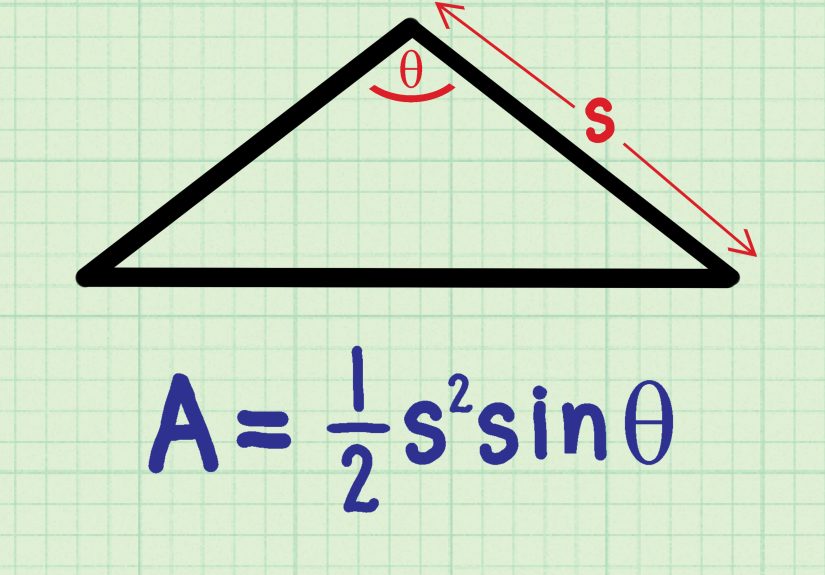
- Using Trigonometry: If you have the angle between the two equal sides, you can use trigonometric functions such as sine or cosine to calculate the height and, from there, the area.
Conclusion
Finding the area of an isosceles triangle doesn’t have to be complicated. By using the basic formula for the area of a triangle and applying the Pythagorean theorem when necessary, you can easily calculate the area. Whether you’re a student working on geometry homework or just someone trying to figure out a real-life triangle, this method will guide you to success.
So next time you encounter an isosceles triangle, remember to look for the base and height, and don’t forget to use the Pythagorean theorem if the height isn’t given. With these tools, you’ll be able to tackle even the most tricky triangle problems with confidence.
Additional Insights: My Experience with Isosceles Triangles
As someone who spent years tutoring geometry, I’ve encountered many students who get tripped up by the idea of an isosceles triangle. The equal sides and the base symmetry often throw them off. But once you break down the problem into smaller steps, it becomes much easier to grasp.
One key piece of advice I would give is to always draw the triangle. Many times, students try to solve problems in their heads without creating a visual representation. Seeing the shape in front of you helps in understanding the relationship between the sides and the height, making it easier to apply formulas correctly.
Another tip is to practice problems with varying levels of complexity. Start with simple isosceles triangles with given heights and bases. Then, move on to more complicated ones where the height is unknown. Gradually, you’ll be able to solve these problems faster and more efficiently. The more you practice, the more comfortable you’ll become with the process.
One memorable experience I had while teaching this concept was when a student struggled to understand the Pythagorean theorem. After we broke the triangle into smaller right triangles, the student had an “aha” moment. That moment of understanding when everything clicks is truly rewarding, and it’s a part of the learning process that makes teaching geometry so enjoyable.
Overall, with a bit of practice and patience, finding the area of an isosceles triangle becomes second nature. Whether you’re solving textbook problems or dealing with real-world applications, this skill will serve you well.