Table of Contents >> Show >> Hide
- Why Decimal Division Feels Harder Than It Really Is
- How to Divide Decimals in 8 Steps
- Step 1: Write the problem in long-division form
- Step 2: Check whether the divisor is already a whole number
- Step 3: Make the divisor a whole number
- Step 4: Place the decimal point in the quotient correctly
- Step 5: Divide as if you are working with whole numbers
- Step 6: Add zeros if needed
- Step 7: Round only if the problem tells you to
- Step 8: Check your answer with multiplication and estimation
- A Full Example from Start to Finish
- Common Mistakes to Avoid
- Tips for Getting Better at Decimal Division
- Final Thoughts
- Extra Experience and Real-Life Practice with Decimal Division
- SEO Tags
Dividing decimals has a reputation problem. The moment a decimal point shows up, people act like the math just walked into the room wearing a fake mustache. But here is the good news: decimal division is not a different species of math. It is mostly regular division with one extra jobkeeping track of place value without letting the decimal point wander off like a toddler in a supermarket.
Once you understand the logic, the process becomes much less scary. You do not need magic. You do not need a calculator for every little problem. And you definitely do not need to whisper, “I was never a math person,” as if the decimals can hear you. In this guide, you will learn how to divide decimals in 8 clear steps, see specific examples, avoid common mistakes, and build the kind of confidence that makes long division feel a lot less dramatic.
Why Decimal Division Feels Harder Than It Really Is
Most people are comfortable dividing whole numbers because the setup feels familiar. Decimals add one more layer: place value. When you divide a decimal by a whole number, you need to put the decimal point in the quotient in the correct spot. When you divide by a decimal, you usually rewrite the problem so the divisor becomes a whole number first.
That sounds like a lot, but it is really just a clean system. The biggest secret is this: you are allowed to change the division problem as long as you change both numbers in a way that keeps the quotient the same. That single idea makes the whole topic much easier.
How to Divide Decimals in 8 Steps
Step 1: Write the problem in long-division form
Start by identifying the dividend and the divisor. The dividend is the number being divided. The divisor is the number you are dividing by.
For example, in 12.6 ÷ 0.3, the dividend is 12.6 and the divisor is 0.3. Write it like this in long division: 0.3 ) 12.6.
This first step may seem obvious, but it matters. Many decimal mistakes start before the math even begins, when the numbers are placed in the wrong positions. So yes, the setup deserves respect.
Step 2: Check whether the divisor is already a whole number
If the divisor is a whole number, your life gets easier. You can usually divide almost the same way you would with whole numbers. For example:
7.2 ÷ 3
Since 3 is already a whole number, you do not need to move any decimal points around first. You can go straight into the division process.
If the divisor is a decimal, do not panic. It just means you need one quick cleanup step before dividing.
Step 3: Make the divisor a whole number
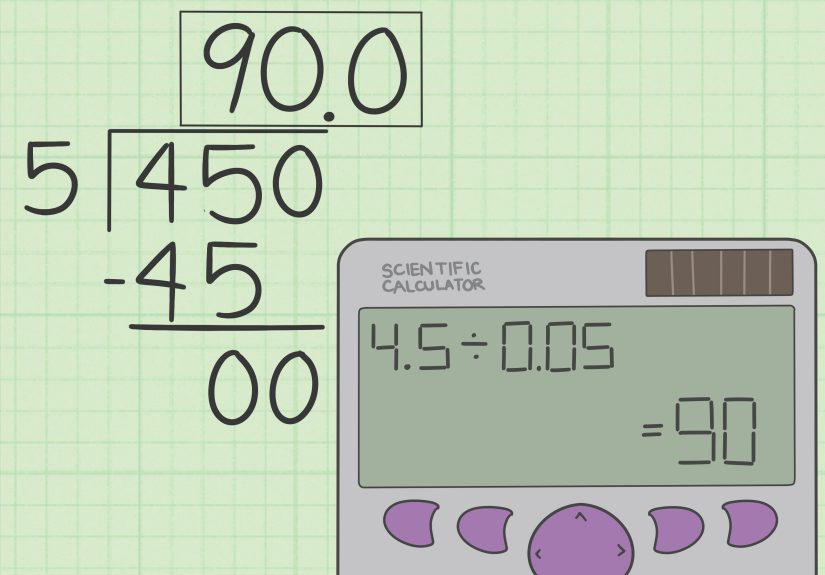
If the divisor has a decimal, move its decimal point to the right until it becomes a whole number. Then move the decimal point in the dividend the same number of places.
Example:
12.6 ÷ 0.3
Move the decimal in 0.3 one place to the right, and it becomes 3. Move the decimal in 12.6 one place to the right too, and it becomes 126.
Now the problem becomes:
126 ÷ 3
That is much friendlier. Same quotient, less nonsense.
Step 4: Place the decimal point in the quotient correctly
Now that the divisor is a whole number, begin dividing. If the decimal is still visible in the dividend, place the decimal point in the quotient directly above it.
Example:
4.68 ÷ 1.2
Move both decimals one place to the right:
46.8 ÷ 12
When you work the long division, the decimal point in the quotient goes straight above the decimal point in 46.8.
This is one of the most common places students trip up. The decimal point is not decorative. It is doing an actual job.
Step 5: Divide as if you are working with whole numbers
Once the divisor is whole, use regular long division.
Let us continue the example:
46.8 ÷ 12
12 goes into 46 three times, because 12 × 3 = 36. Subtract to get 10. Bring down the 8, and now you have 108. 12 goes into 108 nine times, because 12 × 9 = 108.
So the answer is 3.9.
That means:
4.68 ÷ 1.2 = 3.9
Step 6: Add zeros if needed
Sometimes the division does not come out evenly, or you need to keep going to get a more precise answer. In that case, add a zero to the end of the dividend after the decimal point.
Example:
5 ÷ 0.4
Make the divisor a whole number by moving both decimals one place to the right:
50 ÷ 4
4 goes into 50 twelve times with a remainder of 2. Add a decimal point and a zero to continue: 20 ÷ 4 = 5.
So the answer is:
12.5
This is a great reminder that whole numbers can be written as decimals too. 5 is the same as 5.0, 5.00, or even 5.000. Math is flexible like that.
Step 7: Round only if the problem tells you to
Not every decimal division problem ends neatly. Some answers keep going. When that happens, you may need to round to the nearest tenth, hundredth, or another place value.
Example:
2.5 ÷ 0.6
Move both decimals one place to the right:
25 ÷ 6
That gives 4.1666…
If the problem asks for the nearest hundredth, the answer is 4.17.
Always check the directions. A teacher, textbook, or worksheet may want an exact decimal, a rounded answer, or even a remainder depending on the context.
Step 8: Check your answer with multiplication and estimation
The fastest way to check a decimal division answer is to multiply the quotient by the divisor.
Example:
If you found that 4.68 ÷ 1.2 = 3.9, test it:
3.9 × 1.2 = 4.68
Perfect. Case closed.
It also helps to estimate before or after solving. For example, 12.6 ÷ 0.3 should be bigger than 12.6, because you are dividing by a number less than 1. If your answer were 4.2, that would be a giant red flag waving wildly in the wind.
A Full Example from Start to Finish
Let us solve 3.36 ÷ 0.8.
- Write it in long-division form: 0.8 ) 3.36
- The divisor is not a whole number, so move the decimal one place right in both numbers.
- The new problem is 8 ) 33.6
- Put the decimal point in the quotient directly above the decimal in 33.6
- 8 goes into 33 four times, which gives 32
- Subtract to get 1, then bring down the 6 to make 16
- 8 goes into 16 two times
- The answer is 4.2
Quick check: 4.2 × 0.8 = 3.36. That confirms the answer.
Common Mistakes to Avoid
Moving only one decimal point
If you make the divisor a whole number, you must move the decimal in the dividend the same number of places. Doing it for one number but not the other changes the value of the problem.
Putting the decimal point in the quotient in the wrong place
When using long division, the quotient’s decimal goes directly above the decimal in the dividend after rewriting the problem. Misplacing it can turn a correct process into a wildly incorrect answer.
Forgetting to add zeros
If the division does not end and you still need more digits, add zeros to the right of the decimal in the dividend. This is legal. It is not cheating. It is place value.
Ignoring whether the answer makes sense
If you divide by a number smaller than 1, the answer often gets larger. If you divide by a number larger than 1, the answer often gets smaller. A quick estimate can save you from avoidable mistakes.
Tips for Getting Better at Decimal Division
Practice with a mix of problems: decimal by whole number, whole number by decimal, and decimal by decimal. Say the steps out loud if it helps. Write neatly. Keep your place values lined up. And always check whether your answer feels reasonable before moving on.
It also helps to understand why the method works. Moving the decimal point in both the divisor and dividend is really the same as multiplying both by the same power of 10. That creates an equivalent division problem, not a new one. Once that clicks, decimal division becomes much more logical.
Final Thoughts
Learning how to divide decimals is less about memorizing a bunch of random rules and more about learning a reliable pattern. Set up the problem correctly, make the divisor a whole number when necessary, divide carefully, and check your answer. That is the whole game.
With enough practice, decimal division stops feeling like a trap and starts feeling like a tool. And that is exactly what it should be: a useful skill for math class, money problems, measurement, science, shopping, cooking, and everyday life. Not bad for a tiny little dot with a massive attitude.
Extra Experience and Real-Life Practice with Decimal Division
One of the best ways to get comfortable with dividing decimals is to connect it to real experiences instead of treating it like a weird worksheet ritual. Think about everyday situations. Maybe a 2.5-liter bottle of juice is poured equally into 5 glasses. That is 2.5 ÷ 5, which equals 0.5 liters per glass. Maybe a runner finishes 4.8 miles in 0.8 hours and wants to know the average miles per hour. That is 4.8 ÷ 0.8, which equals 6. Suddenly, decimal division is not just math class business. It becomes a way to answer real questions.
Students often say decimal division feels easier once they stop rushing. That makes sense. A lot of mistakes happen because people try to do all the steps in their heads at once. They move the decimal, divide, place the quotient’s decimal, and estimate all in one blur. A better approach is to slow the process down. First rewrite the problem. Then make the divisor whole. Then divide. Then check. Separating the steps reduces confusion fast.
Teachers also notice that students improve more quickly when they say what they are doing out loud. For example: “I am moving the decimal one place in the divisor, so I move it one place in the dividend too.” That short sentence reinforces the logic. It turns a mysterious rule into a reasoned action. And once learners understand the reason, they usually remember the process much better.
Another useful experience comes from comparing answers before solving. For example, if you look at 8.4 ÷ 0.2, you should expect a fairly large answer because you are dividing by a small number. In fact, the answer is 42. But if you look at 8.4 ÷ 2, you expect something smaller, and the answer is 4.2. This kind of number sense acts like a built-in error detector. It helps you catch answers that look polished but are actually wrong.
It is also completely normal to struggle at first with problems that do not divide evenly. When students see an answer like 4.1666…, some immediately assume they made a mistake. Not true. Some decimal quotients terminate, some repeat, and some need rounding depending on the directions. That is part of the process, not a sign of disaster. In real life, people round all the time when dealing with prices, distances, rates, and measurements.
The most encouraging experience is this: decimal division gets easier much faster than most people expect. After a few careful examples, the pattern becomes familiar. After a few more, it becomes automatic. And eventually, what once felt confusing starts to feel satisfying. You see the divisor, fix it into a whole number, divide with confidence, and move on with your day like the decimal never had a chance to intimidate you in the first place.