Table of Contents >> Show >> Hide
- First, Choose Your Leg of Lamb Like a Pro
- The Flavor Blueprint: Seasoning That Never Fails
- Prep Steps That Actually Matter
- Two Foolproof Ways to Roast Leg of Lamb
- Leg of Lamb Temperature Guide (The Part That Saves Dinner)
- How Long to Cook a Leg of Lamb (Planning Cheat Sheet)
- Resting: The Most Ignored Step That Makes Lamb Juicy
- Carving a Leg of Lamb Without Panic
- Sauces and Sides That Make It a Feast
- Leftovers: Don’t You Dare Waste That Lamb
- Kitchen Notes: of Real-World Experience (So Your Feast Feels Effortless)
- Final Thoughts
Leg of lamb is the kind of centerpiece that makes people sit up straighter at the table. It’s dramatic without being fussy, fancy without being fragile, and it smells like you hired a personal chefwhen really you just used a thermometer and a little confidence.
In this guide, you’ll learn exactly how to cook a leg of lamb so it’s juicy, deeply flavorful, and worthy of your best serving platter. We’ll cover buying the right cut, seasoning options, roasting methods (classic and “wow”), leg of lamb temperature targets, carving, and a few side-and-sauce ideas that make the whole meal feel like a celebration.
First, Choose Your Leg of Lamb Like a Pro
Bone-in vs. boneless: which is better?
- Bone-in leg of lamb: Great presentation and often a little more flavorful. It can cook a bit more unevenly (the bone affects heat), but it’s forgiving if you rest it well.
- Boneless leg of lamb: Easier to carve and season throughout. It’s typically rolled and tied, which helps it cook evenlyperfect for first-timers.
How much lamb per person?
- Bone-in: plan about 3/4 to 1 pound per person (bone adds weight).
- Boneless: plan about 1/2 pound per person.
If you want leftovers for sandwiches, salads, or “I’m just going to stand by the fridge with a fork” moments, round up.
Tools that make this ridiculously easier
- Instant-read thermometer or probe thermometer (this is the cheat code)
- Roasting pan + rack (or a sheet pan with a sturdy wire rack)
- Kitchen twine (especially for boneless)
- Sharp carving knife
The Flavor Blueprint: Seasoning That Never Fails
When people say lamb tastes “special,” they usually mean “it tastes like garlic and herbs had a party and invited lemon.” The classic profile works for a reasonand you can still make it your own.
Classic garlic-rosemary-lemon rub
- Garlic (lotsbe brave)
- Fresh rosemary (or rosemary + thyme)
- Lemon zest + a squeeze of juice
- Olive oil
- Kosher salt + black pepper
Pro move: Salt the lamb ahead of time (even just a few hours) for better seasoning and juicier texture. If you can manage an overnight rest in the fridge, your future self will be impressed.
Three fun variations (same easy method)
- Mustard-herb crust: Dijon + garlic + herbs + breadcrumbs for a savory coating.
- Mediterranean vibe: oregano + lemon + garlic + a little cumin; serve with tzatziki.
- Warm spice rub: cumin + coriander + paprika + a pinch of cinnamon; serve with yogurt and mint.
Prep Steps That Actually Matter
1) Don’t “temper” for hoursdo this instead
Leaving a big roast out to “come to room temp” doesn’t help as much as people think. For better results, focus on salting ahead and roasting with a thermometer. If the lamb is ice-cold, 20–30 minutes on the counter while you prep is plenty.
2) Pat dry, score the fat, and season aggressively
Pat the surface dry so it browns well. If there’s a fat cap, lightly score it (shallow cuts) to help render fat and let seasoning cling. Rub seasoning all overyes, including awkward corners.
3) If it’s boneless, tie it
A rolled boneless leg cooks more evenly when it’s tied every 1.5–2 inches. It’s like giving your lamb a supportive hug. A delicious, edible hug.
Two Foolproof Ways to Roast Leg of Lamb
There’s more than one correct way to roast a leg of lamb, but there’s only one rule that never changes: cook to temperature, not time. Time estimates are training wheels. Your thermometer is the steering wheel.
Method 1: Classic roast (the “holiday standard”)
- Preheat the oven to 425°F.
- Place lamb on a rack in a roasting pan. Add aromatics underneath if you want (onion wedges, lemon slices, extra herbs).
- Roast at 425°F for 20–30 minutes to kick-start browning.
- Reduce heat to 350°F and continue roasting until your target internal temperature is reached (see temperature guide below).
- Rest 15–30 minutes before carving.
About timing: Many recipes land around 20–25 minutes per pound at moderate roasting temperatures, but thickness, shape, and bone structure change everything. Use minutes-per-pound as a planning estimatenot a finish line.
Method 2: Low-and-slow + blast (reverse-sear style)
This method is a secret handshake among people who want evenly rosy meat and a bold crust. It takes longer, but it’s extremely consistent.
- Preheat oven to 275°F.
- Roast lamb on a rack until it reaches about 10°F below your desired final doneness.
- Rest the lamb 20–30 minutes.
- Crank oven to 500°F and roast 10–15 minutes to deepen browning.
- Rest 5–10 minutes, then carve.
Why it works: gentle heat cooks evenly; the final blast gives you a crust without overcooking the center. It’s the best of both worldslike wearing sweatpants with a blazer, but for meat.
Leg of Lamb Temperature Guide (The Part That Saves Dinner)
Here’s where things get deliciously precise. Different charts use slightly different “doneness” definitions, and carryover cooking (temperature rising as meat rests) is real. So you’ll often pull the lamb a few degrees early.
Food safety note
For safety, official guidance commonly lists 145°F with a 3-minute rest for lamb roasts and chops. If you’re serving kids, pregnant people, older adults, or anyone immunocompromised, stick with that safer endpoint.
Practical doneness targets
- Medium-rare: pull at 125–130°F, rest to 130–135°F
- Medium: pull at 135–140°F, rest to 140–145°F
- Well-done: pull at 150°F+, rest higher (juiciness decreases)
Where to temp it: Insert the thermometer into the thickest part, avoiding bone and big pockets of fat. For boneless roasts, aim for the center of the roll.
How Long to Cook a Leg of Lamb (Planning Cheat Sheet)
Use this for scheduling your feast. It’s intentionally a range because lamb legs are shaped like… well, legs.
At 350°F (after an initial high-heat sear)
- 4–5 lb boneless: ~1 hr 15 min to 2 hr (depending on thickness and target temp)
- 6–7 lb bone-in: ~1 hr 45 min to 2 hr 45 min
- 8–9 lb bone-in: ~2 hr 15 min to 3+ hr
Build in resting time: Add 20–30 minutes for resting (and extra time for making gravy, setting the table, and pretending you’re totally calm).
Resting: The Most Ignored Step That Makes Lamb Juicy
Resting isn’t optionalit’s part of cooking. As the lamb rests, juices redistribute and the internal temperature often rises several degrees (especially with larger roasts). Tent loosely with foil. Don’t wrap it tight like a baked potato; you want the crust to stay proud, not steamed.
Carving a Leg of Lamb Without Panic
Boneless (rolled) leg of lamb
- Remove twine.
- Slice across the roast into 1/4- to 1/2-inch slices.
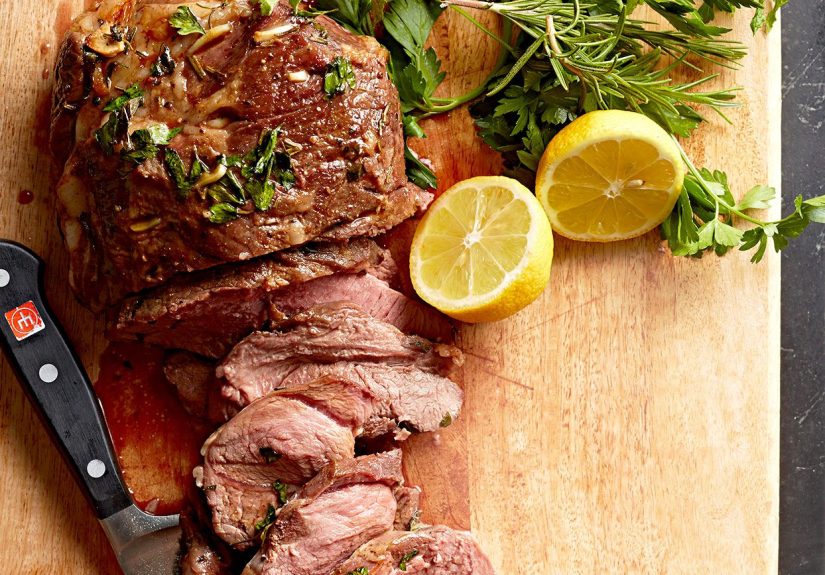
- Cut against the grain for tenderness.
Bone-in leg of lamb
- Find the bone and slice along it to remove large muscle sections.
- Slice those sections across the grain.
- If you hit resistance, you’re probably slicing with the grainrotate and try again.
Serving tip: Arrange slices on a warm platter, spoon a little pan juice or sauce over the top, and watch people “casually” go back for seconds.
Sauces and Sides That Make It a Feast
Fast pan gravy (no stress version)
- Pour off excess fat from the roasting pan (leave the browned bits).
- Add stock (or wine + stock) and scrape up the fond.
- Simmer until slightly reduced. Season with salt, pepper, and a squeeze of lemon.
Bright sauces that love lamb
- Mint chimichurri: mint + parsley + garlic + olive oil + vinegar
- Garlic yogurt sauce: Greek yogurt + lemon + garlic + cucumber + dill
- Red wine pan sauce: wine reduction + stock + a knob of butter
Side dish ideas
- Roasted potatoes with rosemary and lemon
- Springy green salad with vinaigrette
- Roasted carrots or asparagus
- Buttery couscous or herbed rice
Leftovers: Don’t You Dare Waste That Lamb
- Lamb sandwiches: crusty bread, mustard, arugula, leftover pan juices
- Lamb pita: yogurt sauce, cucumbers, tomatoes, herbs
- Breakfast upgrade: chopped lamb in an omelet with feta
- Quick soup: lamb + broth + barley + greens
Kitchen Notes: of Real-World Experience (So Your Feast Feels Effortless)
Ask ten people how to roast a leg of lamb and you’ll get twelve opinionsbecause once you cook it a few times, you start noticing little patterns that no recipe headline can fully capture. For starters: shape matters more than weight. Two roasts can both be “6 pounds,” but if one is long and skinny and the other is shorter and thicker, they won’t cook at the same pace. That’s why a probe thermometer feels like a superpowersuddenly you’re cooking the lamb you actually have, not the lamb an internet chart imagined.
Another thing home cooks learn quickly: the crust is negotiable, the interior is not. It’s easy to get hypnotized by “deep golden brown” photos and push the roast too far. In practice, you can always add browning at the end (a quick blast of high heat or a short broil), but you can’t un-cook an overdone center. When in doubt, prioritize your target internal temperature and let a finishing step handle the looks.
Then there’s the seasoning reality: lamb can handle bold flavors. People often under-season big roasts because they’re afraid of “too much,” but a leg of lamb is a thick piece of meat with surface area that needs help. The most common “meh” outcome isn’t too garlickyit’s not salty enough. A generous salting ahead of time makes the meat taste more like itself (just… the best version of itself). If you’ve ever had lamb that tasted oddly bland in the middle, it wasn’t your imagination. It just needed time and salt to do their thing.
On the social side, leg of lamb has a funny effect: it makes the meal feel like an occasion even if you’re wearing sneakers and your table setting is “whatever clean plates we found.” That’s why it’s worth planning your timing backward. Decide when you want to serve, subtract resting time, subtract estimated oven time, and give yourself a buffer. Your goal is not to yank lamb out of the oven while guests watch you sweat. Your goal is to have it resting calmly while you look mysteriously relaxedlike someone who definitely planned this and didn’t just read the thermometer three times to make sure it was real.
Finally, the carving lesson: carve smaller than you think. Thin slices stay tender and feel elegant; thick slabs cool fast and can chew a little tougher. With boneless roasts, it’s straightforward. With bone-in, you’ll get better results if you treat it like a few muscle groups rather than one giant mystery. Slice along the bone, separate the big sections, then cut across the grain. And if you mess up a slice or two? Put those on your own plate. Chef’s privilege.
Final Thoughts
If you remember only three things, make them these: season early, use a thermometer, and rest before carving. Do that, and your roasted leg of lamb will be juicy, aromatic, and genuinely feast-worthywhether it’s a holiday, a dinner party, or a random Tuesday that deserved better.