Table of Contents >> Show >> Hide
- First: Know What “Ceramic” Cookware Actually Is
- Quick Rules Before You Start Cleaning
- Daily Cleaning: The “Don’t Let It Turn Into a Science Project” Method
- How to Remove Stuck-On Food Without Damaging the Coating
- How to Remove Brown Stains and Sticky Residue (The “Why Is It Tacky?” Mystery)
- Cleaning the Outside and Bottom of Ceramic Cookware
- Dishwasher: Safe vs. Smart
- What NOT to Do (If You Want Your Pan to Like You)
- Prevention: Keep Ceramic Cookware Cleaner for Longer
- Troubleshooting: Common Ceramic Pan Problems (and Fixes)
- A Simple “Ceramic Pan Cleaning” Checklist
- Real-Life Kitchen Stories: Ceramic Pan Cleaning Wins (and Fails)
- Conclusion
Ceramic cookware has a reputation: it’s the “easygoing friend” of the kitchen. It’s slick, pretty, and usually
cooperativeuntil one day you flip an egg and it clings like it just heard a breakup playlist. Suddenly your once-silky
pan looks like it auditioned for a crime show: brown stains, sticky spots, and that mysterious “halo” around the center.
The good news: most ceramic pans can look (and cook) better again with gentle, smart cleaning. The bad news: your pan is
not a cast-iron skillet that enjoys being bullied with steel wool. Ceramic coatings prefer a spa day, not a cage match.
Below is an in-depth, step-by-step guide to cleaning ceramic pans and cookware the right wayplus how to prevent the
gunk from returning like an uninvited sequel.
First: Know What “Ceramic” Cookware Actually Is
Most modern “ceramic pans” are metal pans (often aluminum) with a ceramic-based nonstick coating. That coating is tough
enough for daily cooking, but it can degrade faster if it’s exposed to high heat, harsh detergents, abrasive tools, or
sudden temperature changes. Translation: treat it like a nice sweaterwash it gently, don’t set it on fire, and it’ll
last longer.
Quick Rules Before You Start Cleaning
- Let it cool first. Don’t run cold water over a hot pan. That sudden temperature shift can stress the pan and coating.
- Skip the “metal meets rage” approach. Avoid steel wool, scouring pads, and harsh abrasives.
- Hand-washing is usually your best friend. Even if your pan says dishwasher-safe, hand-washing typically helps it last longer.
- Don’t mix strong chemicals. Especially never mix bleach with vinegar or other acids.
Daily Cleaning: The “Don’t Let It Turn Into a Science Project” Method
If you clean ceramic cookware soon after cooking, you’ll prevent most staining and sticky buildup. This is the
easiest routine for ceramic pan care.
Step-by-step daily wash
- Cool down. Let the pan sit until it’s warm or room temperature.
- Rinse with warm water. Warmnot icywater helps loosen oils and food bits.
- Add mild dish soap. A small amount is enough; you’re cleaning a pan, not trying to summon bubbles for a foam party.
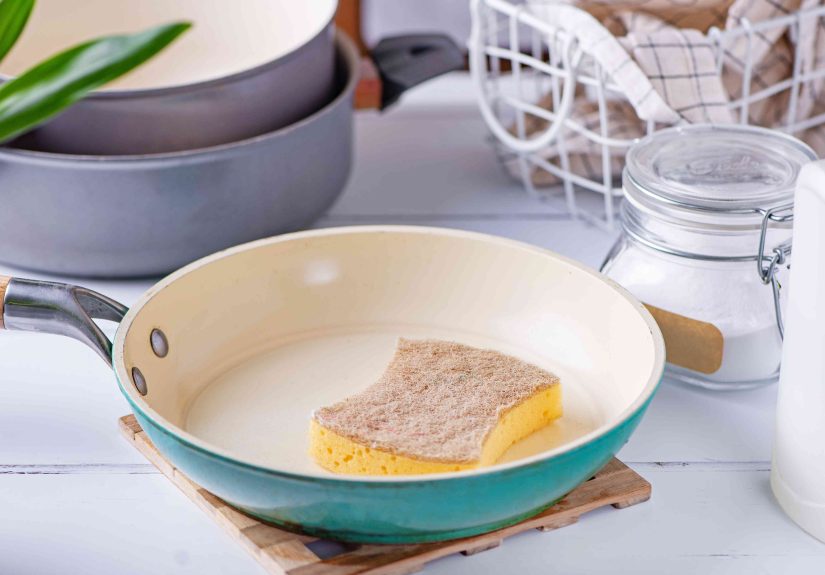
- Use a soft sponge or cloth. Gently wipe the cooking surface, then the sides and bottom.
- Rinse thoroughly and dry. Dry with a soft towel or air-dry fully before stacking or storing.
Pro tip: If you stack pans, place a soft towel, felt protector, or even a clean dishcloth between them
so the coating doesn’t get scratched in storage.
How to Remove Stuck-On Food Without Damaging the Coating
Burnt bits happen. Maybe you got distracted. Maybe the dog made eye contact and you emotionally blacked out. Either way,
you can usually remove stuck-on food without scraping the life out of your ceramic coating.
Method 1: Warm soak + gentle wipe (best first move)
- Fill the pan with warm water and a few drops of dish soap.
- Let it soak for 15–30 minutes.
- Wipe with a soft sponge. If bits remain, repeat once.
Method 2: Baking soda “soft scrub” paste (for stubborn spots)
Baking soda is mildly abrasivethink “polite exfoliation,” not sandpaper. It’s a go-to for ceramic cookware cleaning
when you need a little extra muscle.
- Make a paste with 2–3 tablespoons baking soda and a splash of warm water.
- Spread it on the stuck-on area.
- Let it sit 10–15 minutes.
- Gently scrub with a soft sponge or non-scratch pad.
- Rinse and dry completely.
Method 3: Simmer and lift (for “I may have invented charcoal” situations)
When food is seriously welded to the surface, simmering helps loosen it without aggressive scrubbing.
- Add enough water to cover the burnt area.
- Bring to a gentle simmer for 5–10 minutes.
- Turn off heat and let it cool.
- Pour out the water, then clean with warm soapy water and a soft sponge.
How to Remove Brown Stains and Sticky Residue (The “Why Is It Tacky?” Mystery)
Brown discoloration and sticky patches are often caused by oil buildupespecially from cooking sprays.
Sprays can leave additives behind that polymerize (harden) with heat, creating a stubborn, gluey layer that makes food
stick more over time. If your ceramic pan feels tacky even after washing, you’re likely dealing with buildup, not “bad luck.”
Fix sticky buildup with a vinegar + water simmer (then baking soda)
- Mix 1 part white vinegar with 3 parts water in the pan (enough to cover the bottom).
- Bring to a gentle simmer for 5–10 minutes.
- Turn off the heat and let it cool.
- Pour out the liquid, sprinkle a little baking soda over the surface, and gently scrub with a soft sponge.
- Wash with dish soap, rinse well, and dry.
Important: Keep it gentle. If you find yourself scrubbing like you’re trying to erase a bad decision,
stop and switch to another soak/simmer cycle.
Cleaning the Outside and Bottom of Ceramic Cookware
The exterior often gets overlooked until it looks like it’s been through a small kitchen war. For most ceramic-coated
cookware, the outside can be cleaned using the same gentle approach as the inside.
Exterior cleaning steps
- Wash with warm soapy water and a soft sponge.
- For greasy stains, apply a thin layer of baking soda paste and let it sit 10 minutes.
- Gently scrub, rinse, and dry.
If your pan has a stainless steel base or rim, treat it gently tooabrasives can scratch the finish even if they don’t
“ruin” the pan. When in doubt, test a small spot on the underside first.
Dishwasher: Safe vs. Smart
Some ceramic pans are labeled dishwasher-safe. That doesn’t always mean “best for long-term performance.” Dishwashers use
high heat and strong detergents, and that environment can gradually wear down nonstick coatingsceramic included. If your
goal is to keep the slick surface for as long as possible, hand-washing is usually the smarter move.
What NOT to Do (If You Want Your Pan to Like You)
- Don’t shock it. Avoid rinsing a hot pan with cold water.
- Don’t use metal scrubbers or steel wool. Scratches are the gateway drug to sticking.
- Don’t use harsh cleaners. Oven cleaners, heavy abrasives, and strong bleaches can damage surfaces.
- Don’t “power cook” on high heat all the time. Ceramic nonstick generally prefers low to medium heat for best longevity.
- Don’t rely on cooking spray every day. It can leave residue that builds up and turns sticky with heat.
Prevention: Keep Ceramic Cookware Cleaner for Longer
Cleaning is easier when you prevent the mess from bonding to the surface in the first place. Here’s how to keep ceramic
pans in that “new pan confidence” zone.
Use the right heat
Ceramic nonstick performs best at low to medium heat. If you’re preheating an empty pan on high like it’s
training for a marathon, you’re stressing the coating and increasing the odds of discoloration and sticking.
Choose fats wisely
Use a small amount of oil or butter rather than frequent nonstick cooking sprays. If you love the convenience of spray,
consider an oil mister you fill yourselffewer additives, less residue drama.
Use gentle utensils
Silicone, wood, or plastic utensils help protect the coating. Metal utensils can scratch, especially if you’re scraping
like you’re mining for flavor.
Clean sooner rather than later
Letting oil sit and bake onto the surface is how “a quick rinse” turns into “why is my pan haunted?” A prompt wash
prevents buildup from hardening.
Troubleshooting: Common Ceramic Pan Problems (and Fixes)
Problem: Food suddenly sticks more than before
This is often buildup, not an instant coating failure. Try the vinegar simmer + baking soda gentle scrub method, then
return to low/medium heat and avoid cooking spray residue.
Problem: Dark stains won’t lift
Repeat a baking soda paste treatment, or do a simmer method first to soften. If stains persist but the pan still cooks
well, remember: cosmetic stains don’t always equal performance problems.
Problem: The pan looks cloudy or dull
Dullness can come from detergent film or mineral deposits. A warm wash followed by a gentle vinegar wipe (then rinse)
can help. Always rinse thoroughly and dry.
Problem: The coating looks scratched
Minor marks may be superficial, but deep scratches can reduce nonstick performance. Prevent future scratches by using
non-metal utensils, soft sponges, and pan protectors during storage. If the surface is badly damaged and food sticks no
matter what you do, it may be time to replace the pan.
A Simple “Ceramic Pan Cleaning” Checklist
- Cool pan → warm soapy wash → soft sponge → rinse → dry fully
- Stuck food → soak 15–30 minutes OR simmer water 5–10 minutes
- Stains/tacky residue → baking soda paste 10–15 minutes
- Heavy buildup → vinegar + water simmer → cool → gentle baking soda scrub
- Prevent → low/medium heat, avoid cooking spray buildup, store with protectors
Real-Life Kitchen Stories: Ceramic Pan Cleaning Wins (and Fails)
Let’s talk about the part no one puts on the box: the lived experience of owning ceramic cookware. Because yes, ceramic
pans can be wonderfully low-maintenanceright up until the day you think, “I’ll just sear this on high heat real quick.”
(Narrator voice: it was not quick.)
One of the most common “first-time ceramic pan” moments is the sticky surprise. You’ve been using a
convenient nonstick cooking spray, cleaning the pan “pretty well,” and then one morning your omelet behaves like it’s
trying to become one with the pan. You scrub harder. It gets worse. The problem isn’t your omeletit’s that sneaky layer
of cooked-on oil and additives that has slowly built up. The fix is almost boring: simmer vinegar and water, sprinkle in
baking soda, and gently wipe it clean. But the emotional arc? Incredible. It’s like watching your pan remember who it used
to be.
Then there’s the burnt sauce incident. Maybe you reduced a glaze, answered a text, and returned to a pan
that looked like it had been used to signal ships. The temptation is to attack with metal tools. Don’t. Soaking and
simmering is the grown-up move. When you simmer water (and maybe a bit of dish soap), the burnt layer softens and lifts
without turning your ceramic coating into a scratched-up skating rink. The best part: you don’t have to “win” in one go.
Two gentle rounds beat one aggressive round every time.
Another real-world challenge is cosmetic staining. Even when your ceramic pan performs well, it might
collect golden-brown marks that make it look older than it is. The first time you see it, you may assume the pan is
ruined. It’s usually not. A baking soda paste can brighten a lot of discoloration, and sometimes the remaining marks are
simply “proof of life.” (Your pan has seen things. It’s fine.)
My favorite ceramic-pan lesson is the “heat humility” chapter. Ceramic nonstick loves low to medium heat.
When you crank it up, you may get faster browningbut you also raise the odds of oil polymerizing onto the surface, which
leads to that sticky feeling later. Once you switch to moderate heat and use a small amount of oil or butter (instead of
frequent spray), cleaning becomes dramatically easier. It’s the kitchen equivalent of drinking water and getting eight
hours of sleep: annoyingly effective.
Finally, there’s the storage glow-up. People baby their phones with cases and screen protectors, then stack
pans like they’re playing cookware Jenga. A single soft cloth or pan protector between stacked pans can prevent tiny
scratches that slowly reduce nonstick performance. It’s a small habit with a big payoffand it makes you feel like a
responsible adult, which is nice, even if you’re eating cereal for dinner.
Bottom line: ceramic cookware rewards gentle consistency. Soak, simmer, and use baking soda like a calm professional.
Avoid thermal shock, skip harsh scrubbers, and keep heat reasonable. Your pans will stay slick longerand your future self
will thank you when cleanup takes two minutes instead of a full emotional journey.
Conclusion
Cleaning ceramic pans and cookware is mostly about being gentle and being consistent. For everyday messes,
warm water, mild soap, and a soft sponge are enough. For stuck-on food, soaking or a short simmer loosens residue without
scraping the coating. For stains and sticky buildup, baking soda paste and a vinegar-water simmer can restore a smoother
surfaceespecially if cooking spray residue has been quietly building up.
If you treat ceramic cookware like the nonstick VIP it iscool it before washing, avoid abrasives, and keep heat in the
low-to-medium zoneyou’ll get better performance, easier cleanup, and fewer “why is my egg glued down?” mornings.