Table of Contents >> Show >> Hide
- Why Strat Intonation Matters
- Tools You Will Need
- How to Adjust Intonation on a Strat in 7 Steps
- Step 1: Put on Fresh Strings and Tune to Pitch
- Step 2: Check the Rest of the Setup First
- Step 3: Understand What You Are Comparing
- Step 4: Identify Whether the String Is Sharp or Flat
- Step 5: Move the Strat Saddle in the Correct Direction
- Step 6: Retune and Recheck Every Time
- Step 7: Play Real Chords and Notes Across the Neck
- Common Strat Intonation Mistakes to Avoid
- What a Properly Intonated Strat Usually Looks Like
- When to Take Your Strat to a Pro
- Final Thoughts
- Real-World Experience: What Adjusting Strat Intonation Actually Feels Like
- SEO Tags
If your Strat sounds glorious when you strum an open G chord but suddenly turns into a tiny courtroom argument by the 12th fret, your intonation probably needs attention. The good news is that adjusting intonation on a Strat is not mysterious, cursed, or reserved for luthiers who live in candlelit workshops. It is a practical guitar setup skill you can learn at home with a tuner, a screwdriver, a little patience, and the emotional strength to hear the same note 47 times in a row.
In simple terms, guitar intonation is what makes notes play in tune up and down the neck. When your Strat intonation is off, the open string may be perfectly tuned, but fretted notes will sound sharp or flat. That means cowboy chords can seem fine while barre chords higher up the neck sound like they had a falling-out on the drive to rehearsal. On a Stratocaster, intonation is adjusted by moving each bridge saddle forward or backward to slightly shorten or lengthen the vibrating string length.
This guide walks through how to adjust intonation on a Strat in seven clear steps, plus some real-world lessons from the bench and the band room. Whether you play blues, indie rock, funk, church gigs, or bedroom versions of songs that somehow become guitar solos, this process will help your Strat play more in tune and feel more professional.
Why Strat Intonation Matters
Good Strat intonation affects more than a tuner screen. It improves chord clarity, makes octave lines cleaner, helps double-stops sound sweeter, and keeps your confidence intact when you venture above the fifth fret. A well-intonated Strat also records better because small pitch problems that seem harmless in the room can sound obvious once layered in a mix.
Here is the big picture: intonation is not a standalone miracle fix. It is one part of a complete guitar setup. If your strings are dead, your neck relief is off, your action is wildly high or low, or your tremolo is unstable, intonation becomes harder to set accurately. Think of intonation as the final polish, not the first rescue helicopter.
Tools You Will Need
- A reliable chromatic tuner
- A Phillips screwdriver for most Strat saddle intonation screws
- A fresh set of strings in your usual gauge
- A capo, ruler, or setup gauge if you are also checking action and relief
- A flat, well-lit workspace
One important note before we start: if you recently changed string gauge, changed tuning, adjusted the truss rod, or altered the bridge height, your guitar setup has changed too. Intonation should be set after those other changes, not before. Otherwise, you are basically brushing your hair before the storm arrives.
How to Adjust Intonation on a Strat in 7 Steps
Step 1: Put on Fresh Strings and Tune to Pitch
Start with a fresh set of strings, preferably the same brand and gauge you normally use. Old strings can develop dents, corrosion, and uneven wear that make accurate intonation harder. A worn-out string may never read consistently, which means you could spend half an hour adjusting saddles for a problem that belongs in the trash can.
Once the new strings are on, stretch them gently and tune the guitar to your normal pitch. Standard tuning is the obvious example, but this also matters if you live in E-flat, drop D, or another alternate tuning. Intonation should be set in the tuning you actually use, not the tuning your guitar dreams about at night.
Step 2: Check the Rest of the Setup First
Before touching the intonation screws, make sure the neck relief and action are in a reasonable place. On a Strat, changes to truss rod tension, bridge height, saddle height, or tremolo angle can all affect pitch accuracy along the fretboard. If your action is high, notes may go sharp when fretted because you are stretching the string farther down to the fret. If the trem is floating unevenly, tuning consistency can wobble enough to make the tuner look personally offended.
You do not need a museum-grade setup to intonate, but you do need a stable starting point. If the guitar buzzes badly, frets out, or drifts out of tune every minute, solve that first. Strat setup order matters: relief, action, nut, and then intonation. Doing it backward is like icing a cake before you bake it.
Step 3: Understand What You Are Comparing
To set Strat intonation, compare the open string or 12th-fret harmonic with the fretted 12th-fret note. Many players prefer the 12th-fret harmonic because it is easy to read cleanly on a tuner. The basic goal is simple: the fretted 12th-fret note should match the pitch of the harmonic or the octave of the open string.
Play with a light, consistent touch. If you attack the string like it insulted your family, the tuner may show a pitch spike that settles down after the note blooms. For best accuracy, pluck normally and read the initial stable pitch, not the dramatic first millisecond. A calm hand gets better results than a heroic one.
Step 4: Identify Whether the String Is Sharp or Flat
Now test one string at a time. Tune the string perfectly. Then play the 12th-fret harmonic and confirm it is in tune. Next, fret the same string at the 12th fret and check the tuner again.
- If the fretted note is sharp, the string length is too short.
- If the fretted note is flat, the string length is too long.
This is the key idea behind all electric guitar intonation. On a Strat bridge, adjusting the saddle changes the scale length for that individual string. Most Strat-style guitars end up with a staggered saddle pattern, not a perfectly straight line, because each string intonates a little differently depending on gauge, tension, and how it behaves under your fingers.
Step 5: Move the Strat Saddle in the Correct Direction
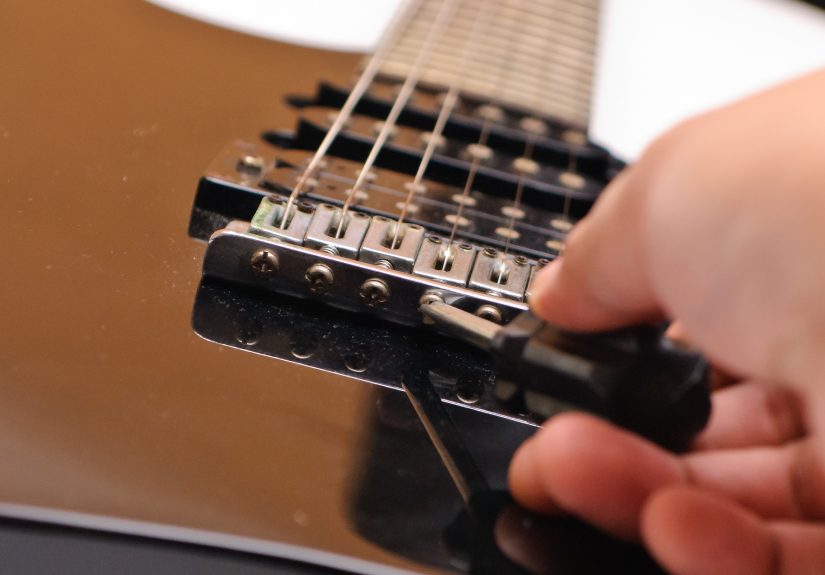
Here comes the actual adjustment. Use the screwdriver to move the saddle for the string you are working on:
- If the fretted 12th-fret note is sharp, move the saddle back away from the neck to lengthen the string.
- If the fretted 12th-fret note is flat, move the saddle forward toward the neck to shorten the string.
Make small adjustments, not dramatic ones. Think quarter-turns or similarly modest movements. This is not a “send it” situation. Small changes are easier to track, and they keep you from overshooting the target and bouncing around like a shopping cart wheel.
On some Strat bridges, saddle movement is easy. On others, especially with more tension or a floating trem, the screw may feel stubborn. Work carefully. If something feels wrong, stop and inspect the saddle, screw, and spring rather than forcing it.
Step 6: Retune and Recheck Every Time
After each saddle movement, retune the string to pitch before checking intonation again. This step is where many players get lazy, and then their results go sideways. Moving the saddle changes the string tension slightly, so if you do not retune, the tuner reading is already compromised.
Repeat the process: tune the string, compare the harmonic and the fretted 12th-fret note, make a small adjustment, then retune again. Yes, it is repetitive. Yes, this is normal. Intonation is not difficult because it is advanced; it is difficult because it requires patience. The guitar version of cardio.
Once the 12th-fret fretted note matches cleanly, move to the next string. Work methodically from low E to high E or the reverse. A neat process usually beats a chaotic one, especially if your coffee level is aggressive.
Step 7: Play Real Chords and Notes Across the Neck
When all six strings are intonated, do the thing that matters most: play the guitar. Test open chords, barre chords, octave shapes, and melodies higher up the neck. Check common trouble spots such as the G and B strings, because they often reveal setup issues faster than the others. If the tuner says everything is perfect but your chords still sound wrong, revisit tuning, string age, nut condition, neck relief, and your fretting pressure.
This last step matters because perfect mathematical intonation on a fretted instrument is always a little bit of a compromise. Guitars are not pianos, and human hands are not robots. What you want is a Strat that sounds convincingly in tune in real musical situations. That is the win.
Common Strat Intonation Mistakes to Avoid
Using old or mismatched strings
Dead strings do not intonate well. Neither do random leftover strings from three brands and two decades. If you want accurate results, use a fresh, consistent set.
Changing string gauge and expecting the old setup to work
If you jump from .009s to .011s, or from standard tuning to drop C, your Strat setup will change. String tension affects relief, action feel, trem balance, and intonation. The bridge does not magically adapt out of politeness.
Ignoring the tremolo system
Strat bridges are part bridge, part negotiation. If you use a floating trem, the bridge angle and spring tension should be stable before you intonate. If the bridge keeps moving during the process, your tuner readings can chase their own tail.
Pressing too hard when fretting
Some players unintentionally bend notes sharp just by fretting with too much force. This is especially common with lighter strings and lower action. If your tuner keeps showing sharp fretted notes even after setup, your left hand may be contributing to the drama.
Trying to fix a nut problem with saddle adjustment
If notes are noticeably sharp in the first few frets but improve higher up, the nut slots may be too high. That is not an intonation-saddle issue. It is a nut issue, and adjusting the saddles will not truly solve it.
What a Properly Intonated Strat Usually Looks Like
Many players expect the saddles on a Strat bridge to line up in a perfectly tidy row. In reality, they often form a staggered pattern. That is normal. Bass strings usually sit farther back, while the treble strings follow their own logic based on gauge and compensation needs. A bridge that looks slightly zig-zagged is often a sign that individual string lengths are doing their jobs.
Also, do not panic if your Strat does not match a photo online exactly. Two guitars with the same scale length may still need different saddle positions because of string brand, string gauge, action, playing style, and tuning preferences. Your tuner and your ears matter more than internet bridge geometry debates.
When to Take Your Strat to a Pro
If your saddle screws are stripped, your bridge is damaged, your trem is unstable, your frets are uneven, or the guitar still refuses to play in tune after a careful setup, it may be time for a professional guitar tech. Sometimes the real issue is fret wear, a poorly cut nut, neck twist, or hardware that has simply given up on modern life.
There is no shame in that. Learning to adjust intonation on a Strat is useful, but knowing when the problem is bigger than intonation is even more useful.
Final Thoughts
Adjusting intonation on a Strat is one of those guitar maintenance skills that sounds intimidating until you actually do it. Then you realize it is mostly a matter of fresh strings, a stable setup, correct saddle direction, patient retuning, and a willingness to let the tuner have the final word. Once you get comfortable with it, you can keep your Strat playing sweeter, recording cleaner, and annoying you less during that one chord at the ninth fret that always sounded suspicious.
The best part is that intonation teaches you how your instrument really works. You stop seeing the bridge as a collection of metal bits and start understanding it as a fine-tuning system for playability and pitch. That is good for your guitar, good for your ears, and very good for everyone who has to hear your chorus chords.
Real-World Experience: What Adjusting Strat Intonation Actually Feels Like
The first time most players adjust intonation on a Strat, they expect a dramatic, movie-style transformation. They imagine one twist of a screw, a beam of light from the heavens, and suddenly every chord sounds like a million-dollar studio take. Real life is not usually that cinematic. It is more like this: you tune the low E, check the harmonic, fret the 12th fret, frown at the tuner, move the saddle a tiny bit, retune, check again, and slowly realize that tiny changes matter more than heroic ones.
One of the most common experiences is discovering that a guitar can feel “mostly fine” until you really listen. A Strat may sound decent for open chords and power chords, but the moment you play triads higher up the neck, record a doubled guitar part, or sit next to a keyboard, the pitch issues become obvious. That is usually when intonation stops being an abstract setup term and becomes a very personal mission.
Another real-world lesson is that patience beats confidence. Many players go too far on the first adjustment because the screw moved and it felt productive. But intonation rewards restraint. Move the saddle a little, not a lot. Retune every time. Check again. The people who get the best results are not the fastest; they are the ones who stay methodical even when the process gets repetitive.
Strats also teach humility because the tremolo system likes to remind you that everything is connected. You think you are adjusting one string, but bridge tension shifts slightly, another string drifts a hair, and now the tuner acts like it is judging your life choices. That does not mean the process is failing. It just means the guitar is a system, not six independent science experiments taped to a plank.
Players also learn pretty quickly that their hands are part of the equation. A light fretting touch can produce one tuner reading, while a heavier grip can push the same note sharp. This is especially true on lighter strings. So there is a funny moment in every setup journey when you stop blaming the guitar for everything and admit, quietly, that maybe your left hand has been entering the chat.
Perhaps the most satisfying experience comes after you finish. You strum a few open chords, move up to a barre chord, play octaves at the 12th fret, then hit a melody line higher on the neck. Everything sounds calmer, cleaner, and more “locked in.” It is not flashy, but it is deeply satisfying. A properly intonated Strat feels like a guitar that finally agrees with itself. And honestly, that is more than some bands can say.