Table of Contents >> Show >> Hide
- Why Undocumented 8086 Instructions Exist at All
- Inside the 8086 Control Path: Microcode + Decode ROMs
- How to Find Undocumented 8086 Instructions Via Microcode
- Notable Undocumented 8086 Behaviors
- Case Study: Why “Blank Opcode Slots” Became Future Real Estate
- Why This Matters in 2026 (Yes, Still)
- Practical Guidance for Reverse Engineers
- Experience-Based Notes from the Field (About )
- Conclusion
If you’ve ever stared at an opcode map long enough, you’ve probably had the same thought every reverse engineer eventually has:
“Those blank spots can’t really be blank… right?” On the Intel 8086, that hunch turned out to be absolutely correct.
Some “undefined” opcodes were never truly inert; they were side effects of how decode logic and microcode were built under late-1970s
silicon constraints. In other words, the chip sometimes did something perfectly deterministic even when the manual shrugged.
This article breaks down how undocumented 8086 instructions are discovered through microcode analysis and decoder behavior, not folklore.
We’ll walk through the architecture-level reason hidden opcodes exist, the practical workflow used to find them, real examples (like
SALC and opcode aliases), and why this still matters to emulator developers, security researchers, and anyone who writes
low-level tooling. We’ll keep it rigorous, readable, and occasionally funnybecause if you’re decoding 1978 silicon for fun, you deserve
both precision and snacks.
Why Undocumented 8086 Instructions Exist at All
The 8086 launched at a time when every transistor was precious. Designers weren’t spending area to make opcode space look aesthetically
pleasing for future blog diagrams. They were optimizing control logic, instruction throughput, and die area. That engineering mindset
produced a decoder that was practical first, symmetrical second.
As a result, some instruction patterns were decoded partially. If a certain bit was irrelevant for a specific decode path, the hardware
could treat multiple opcode values as equivalent. That means one “official” instruction might have one or more hidden aliases. These
aliases were often omitted from manuals, not necessarily because they were unknown to Intel engineers, but because they were unsupported
behavior from a product-documentation perspective.
This is the key mental shift: undocumented on 8086 often means underdocumented behavior emerging from real decode and microcode
structure, not random cosmic rays in ceramic DIP packaging.
Inside the 8086 Control Path: Microcode + Decode ROMs
Microcode was the conductor, not a side character
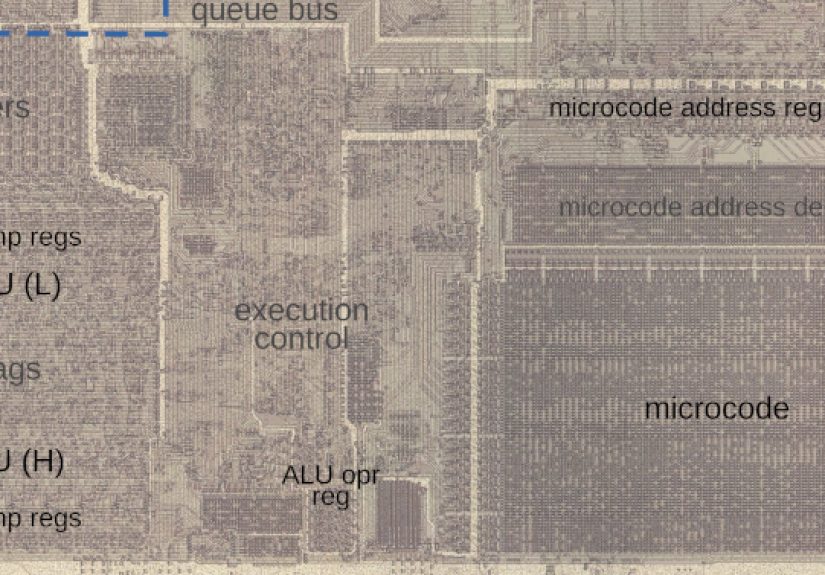
The 8086 uses microcode to orchestrate many instruction behaviors. Reverse-engineering work has shown a compact but clever control store,
where micro-instructions drive ALU operations, register transfers, memory sequencing, and control flow. The result is a layered execution
model: external x86 instructions on top, micro-operations underneath.
Two helpers matter a lot: Group Decode ROM and Translation ROM
A major insight from die-level work is that instruction handling is not just “fetch opcode, jump into one giant microcode table.”
The 8086 uses smaller helper structures that classify opcodes and route control into appropriate microcode entry points.
This is exactly where alias behavior can emerge: if several opcode patterns map through the same classification route, they can land
in the same execution machinery.
Why hidden instructions are predictable
Once you identify how decode bits are groupedand which bits are ignored for specific pathsyou can often predict undocumented opcodes
before testing them. In other words, you can move from “I found a weird byte sequence by chance” to “I can explain why this byte sequence
must behave like that.” That’s the difference between trivia and engineering.
How to Find Undocumented 8086 Instructions Via Microcode
Serious discovery work blends microcode-informed reasoning with hardware validation. A practical pipeline
looks like this:
1) Start with the published opcode map
Build a grid of documented opcodes and flag “holes.” But don’t stop there. Also mark instruction groups where encoding fields are known to
collapse (for example, when specific bits don’t influence the final operation).
2) Infer decode equivalence classes
Using die analysis and instruction-family patterns, identify which opcode bits likely matter for group selection and which are “don’t care”
for that path. Candidate aliases usually appear in these don’t-care dimensions.
3) Inspect microcode entry behavior
If different opcode bytes converge into one microcode routine (or one routine plus tiny prologue differences), you’ve got a strong case for
equivalence. At this stage, you’re no longer guessingyou’re building a causal model.
4) Validate on real hardware and high-fidelity emulators
Always test candidate opcodes for:
- Register and flag effects
- Exception behavior
- Timing differences (when relevant)
- Cross-generation compatibility (8086, 8088, later x86 chips)
This is where many myths die. Some hidden opcodes are stable across generations, some mutate, and some disappear when later processors
reclaim opcode space for new official instructions.
Notable Undocumented 8086 Behaviors
SALC (Opcode D6)
SALC is one of the classic examples: it sets AL from the carry flag (AL = 00h if CF=0, AL = FFh if CF=1). For years, this was known in
low-level circles but not treated like a first-class citizen in official docs. Its long half-undocumented life is exactly why assemblers,
disassemblers, and emulators have handled it inconsistently over time.
Jcc aliases in the 0x60–0x6F range (on early x86)
On 8086/8088-era behavior, parts of this opcode region can execute as conditional-jump aliases because decode logic doesn’t always
distinguish every bit pattern the way a modern “clean” map might suggest. Later CPUs reused portions of this space for other documented
instructions, which is why blindly relying on aliases is a compatibility trap.
AAD/AAM immediate forms
Another famous category: instructions historically documented with a fixed immediate convention (often shown as decimal-adjust style usage)
can behave generically with other immediate values. The silicon can support broader semantics than early documentation implied.
POP CS and edge-case instruction forms
Some forms exist on early chips and then become invalid, repurposed, or architecturally disallowed on later generations.
This is a recurring pattern in x86 history: behavior that began as an implementation artifact later collides with ISA evolution.
Case Study: Why “Blank Opcode Slots” Became Future Real Estate
Here’s a pattern you see repeatedly in x86 archaeology:
- A generation exhibits hidden or aliased behavior in nominally unused opcode space.
- Software mostly avoids those bytes because they are undocumented.
- A later generation reclaims that space for new official instructions.
- Old code that depended on hidden behavior breaks in spectacularly confusing ways.
This exact dynamic helps explain why later processors could introduce new instructions in areas that looked “empty” in manuals,
even when early silicon may already have exhibited side effects there.
Why This Matters in 2026 (Yes, Still)
Emulators and virtualization
If an emulator gets undocumented behavior wrong, reverse-engineering workflows can misclassify binaries, anti-analysis tricks can succeed,
and old software can fail for reasons that look like ghosts. Getting “weird” opcodes right is part of getting normal execution right.
Security tooling and disassembly correctness
Instruction-decoding mismatches between hardware and tools can create blind spots. Modern fuzzing research has shown this repeatedly:
tools disagree, processors disagree, and malicious code can hide in those cracks.
Compiler/assembler ecosystem drift
The SALC story is a perfect example: once references acknowledge a behavior, toolchains gradually decide whether to parse, emit, or reject it.
That lag can last years, which affects reproducibility in forensic and legacy-build environments.
Practical Guidance for Reverse Engineers
Use a three-layer truth model
- Layer 1: Vendor documentation (what is promised)
- Layer 2: Die/microcode analysis (what hardware is wired to do)
- Layer 3: Empirical execution on target CPUs (what actually happens in your context)
Do not equate undocumented with universal
A hidden instruction may work on one stepping, behave differently on another, and fault on later cores. Treat it as model-specific unless
validated across your deployment set.
Separate “cool demo” from production policy
Hidden opcodes are fantastic for research and educational tooling. In production, they are technical debt with a fireworks budget.
Experience-Based Notes from the Field (About )
Teams that investigate undocumented 8086 instructions tend to report the same arc: excitement, overconfidence, humbling edge cases,
then finally a repeatable method. At first, the work feels like treasure huntingpoke opcode holes, see what happens, post screenshots.
But the projects that produce reliable results are the ones that become boring in the best way: controlled harnesses, deterministic test
loops, versioned traces, and strict “no assumptions without evidence” rules.
One common early mistake is trusting a single disassembler output as ground truth. In practice, different tools may parse the same byte
stream differently, especially around undocumented or prefix-sensitive patterns. Researchers who succeed usually run multiple disassemblers,
then compare those interpretations with actual execution traces from hardware. If traces disagree with tool output, hardware winsevery time.
That sounds obvious, but in real workflows people still let pretty assembly listings outrank ugly reality.
Another recurring lesson is that test isolation matters more than raw speed. When probing odd opcodes, a harness that accidentally leaks
state between iterations (flags, segment assumptions, stack alignment, exception handlers) can create convincing fake patterns.
Veteran practitioners reset machine state aggressively between cases and log pre/post snapshots for registers and flags, not just final
outputs. The extra logging feels excessive until the day you catch an apparent “new instruction” that was really stale flag state from
the previous test. Congratulations: you have discovered not a secret opcode, but your own bug.
People also underestimate the documentation burden. The opcode itself is only half the story; what really helps future readers is
provenance: CPU model, stepping, clock conditions, test harness version, and exact byte sequence with context. Without that metadata,
replication becomes archaeology layered on archaeology. The best writeups read like lab notebooks, not marketing copy. They include
dead ends, contradictory runs, and caveats. Counterintuitively, this makes conclusions more credible.
In emulator development, the lived experience is even more practical: one undocumented behavior can break a very old installer,
a DOS extender, or a hand-optimized routine no one has touched for 30 years. Developers often add feature flags (“strict documented mode”
vs. “legacy-compatible mode”) because users care about different outcomes. Purists want spec cleanliness; preservationists want old binaries
to run exactly as they did on real hardware. Neither camp is wrongthey just optimize for different truths.
Security researchers report a parallel lesson: decoder ambiguity is not merely retro nostalgia. If analysis tools disagree on instruction
boundaries or opcode meaning, attackers can exploit that mismatch. Even when the specific 8086-era behavior is historical, the methodology
for finding decoder gaps is modern and valuable. Many teams now combine microcode-informed reasoning with fuzzing-style exploration
precisely because each method catches what the other misses.
The most practical takeaway from these experiences is simple: treat undocumented opcode research as systems engineering, not mythology.
Build hypotheses from microcode and decode structure, validate on hardware, document everything, and assume you are wrong until repeated
runs say otherwise. The fun part is that once you adopt that discipline, the “mystery” of undocumented 8086 instructions becomes less
mystical and more elegant. You stop collecting curiosities and start building understanding.
Conclusion
Finding undocumented 8086 instructions via microcode is not about collecting obscure party tricks. It is about understanding how a seminal
processor really works at the boundary between architecture and implementation. The 8086’s decode design, helper ROMs, and compact microcode
created behavior that was sometimes broader than official documentation. Reverse engineering makes that behavior legible.
If you care about emulator fidelity, toolchain correctness, binary analysis, or x86 history, this topic remains surprisingly relevant.
The old lesson still applies to modern systems: what the manual says, what the tooling assumes, and what hardware does are relatedbut not
always identical. The engineer’s job is to measure the gap.