Table of Contents >> Show >> Hide
- What the Fairholme Fund isand why it’s wired for drama
- The “feast” years: how a contrarian became a star
- The “famine” years: when the same traits hurt
- St. Joe: the elephant… and the entire circus tent
- The supporting cast: cash-like positions and a few chunky satellites
- The “special situations” layer: Fannie/Freddie, litigation, and long timelines
- Fees, friction, and the “don’t day-trade this” sign
- Feast-or-famine math: why many investors get the worst of both
- How to evaluate the Fairholme Fund without losing your mind
- Bottom line: Fairholme is a thesis, not a default setting
- Experiences and Lessons from the “Feast or Famine” Reality (Extra)
Some mutual funds feel like a steady road trip with snacks, a playlist, and cruise control. The Fairholme Fund has always been more like
a road trip where the driver says, “I know a shortcut,” then turns onto a dirt road, points at the horizon, and adds, “Trust me.”
Sometimes that shortcut gets you there early with a victory lap. Other times, you meet a goat, a pothole, and your sense of time.
This is the “feast or famine” reputation in a nutshell: when the fund’s big bets work, results can look brilliant; when they don’t,
the same concentration can feel… educational. Let’s break down what makes Fairholme different, why the swings happen, what has driven
performance in recent periods, and how to think about a fund that refuses to be boring.
What the Fairholme Fund isand why it’s wired for drama
The Fairholme Fund (ticker: FAIRX) is an actively managed mutual fund led by longtime manager Bruce Berkowitz. It’s built around
a classic value-investing idea: buy a small set of investments that appear meaningfully undervalued, then hold them long enough for
reality (and other investors) to catch up.
That philosophy sounds calm. The portfolio construction is not. Fairholme has often owned a very limited number of holdings,
sometimes with one position dominating the entire fund. The result is a portfolio that behaves less like a broad mutual fund and more
like a single, heavily researched thesis with a few supporting characters.
Concentration is the point (and also the plot twist)
Here’s a simple way to understand Fairholme: it tends to follow the “best ideas deserve the biggest weights” rule. If the manager has
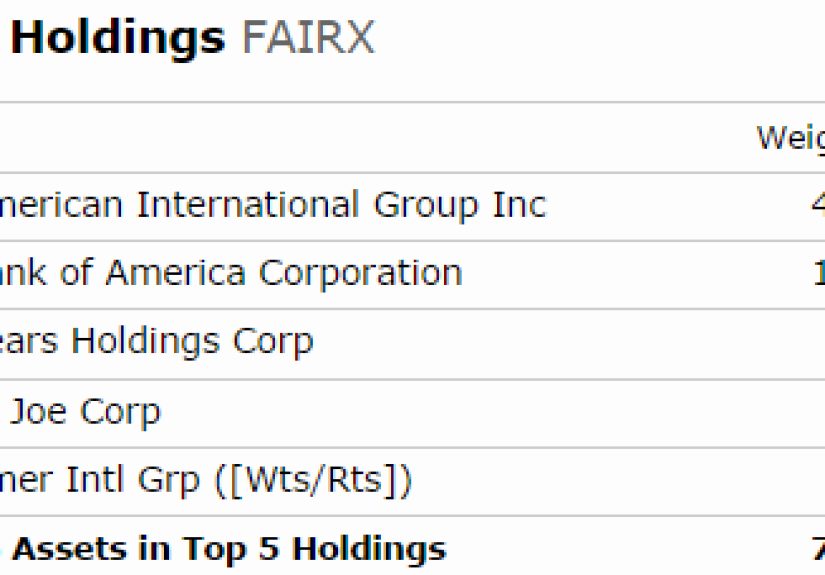
high conviction, the position can become enormous. In recent disclosures, the fund’s top holding has been The St. Joe Company (a Florida-focused
real estate development company), often accounting for roughly three-quarters of net assets. The top 10 holdings have represented nearly the entire
portfolio, far above typical diversified funds.
If that makes you blink twice, goodyour risk instincts are working. But it also explains the feast-or-famine effect:
when your biggest holding moves, your fund moves. A lot.
Low turnover, high conviction
Fairholme’s portfolio turnover has generally been low in recent reports. Low turnover can reduce transaction costs and taxes in taxable accounts,
but it also means the manager is willing to sit through long stretches where the market disagrees. That patience can be a superpowerif you can
handle the waiting (and the occasional “Why did I do this?” moments).
The “feast” years: how a contrarian became a star
Fairholme’s reputation didn’t appear out of thin air. The fund became famous for strong long-term performance in earlier eras, helped by a style
that leaned into unloved financial and special-situation investments when many investors wanted nothing to do with them.
In the late-2000s/early-2010s, Berkowitz was widely recognized in the fund world, including major accolades tied to long-run results. That period
cemented the fund’s identity: concentrated, contrarian, and unapologetically different.
The key lesson from the “feast” years isn’t just that the fund did well. It’s how it did well: not by owning a little of everything, but by
owning a lot of a few thingssometimes exactly when doing so felt uncomfortable.
The “famine” years: when the same traits hurt
Every investing style has a dark side. For concentrated value funds, the dark side is usually some combination of:
(1) a few holdings taking longer than expected to work, (2) a thesis breaking, and/or (3) the rest of the market sprinting in the opposite direction.
Fairholme has experienced all of the above at different times. And because it doesn’t diversify away its biggest convictions, “being early” can look
exactly like “being wrong” for long stretchesuntil (and unless) the market eventually agrees.
Recent published performance snapshots highlight the two-sided nature of this approach. Over certain windows the fund has posted strong returns,
while other windows have lagged broad stock indexes. That’s not a contradiction; it’s the business model. When a portfolio is dominated by a few
holdings, results will inevitably diverge from the S&P 500sometimes dramatically.
St. Joe: the elephant… and the entire circus tent
If you want to understand Fairholme’s recent behavior, start with a single name: The St. Joe Company.
In recent holdings reports, St. Joe has been the fund’s largest position by a mile. That means Fairholme often behaves like a “St. Joe fund with extras.”
Why St. Joe can create “feast” outcomes
The optimistic thesis (in plain English) tends to look like this:
- Land + development optionality: Real estate companies with large land positions can have long “runways” if demand and development economics cooperate.
- Population and migration tailwinds: Florida has been a high-growth state in many recent periods, and regional growth can support housing demand, commercial projects, and local business activity.
- Time is an asset: If the company can develop prudently and monetize over years, patient investors may benefit from compounding rather than quick flips.
When investors get excited about real estate prospects, regional growth, or the company’s longer-term development story, a dominant St. Joe position
can power the fund upward in a hurry. This is the “feast” setup.
Why St. Joe can create “famine” outcomes
Now the other side: real estate is sensitive to interest rates, consumer sentiment, and local cycles. If mortgage rates rise, affordability gets squeezed.
If buyers slow down, the market can punish anything connected to housingeven if the long-term story hasn’t changed.
There’s also the simple math of concentration: if three-quarters of your fund is one stock, even a normal, garden-variety drawdown can feel like
your portfolio is auditioning for a disaster movie. (Cue dramatic music. Not even good dramatic music. The kind that plays when your phone falls behind
the couch.)
In the fund’s own shareholder communications for recent fiscal periods, St. Joe has been cited as a major driver of resultsespecially when performance
has disappointed. That’s not a footnote; it’s the headline.
The supporting cast: cash-like positions and a few chunky satellites
While St. Joe tends to dominate, Fairholme has also held several other meaningful positions that shape the ride.
Enterprise Products Partners (and the “pay me while I wait” idea)
One recurring theme in Fairholme disclosures has been a sizable position in Enterprise Products Partners (EPD), a major midstream energy business.
Midstream companies can appeal to value investors because they often generate cash flows and distribute cash to investors. In plain terms:
you may get paid to be patient, even if prices bounce around.
In some recent reporting periods, cash distributions from EPD were highlighted as a positive contributor. That doesn’t eliminate riskenergy infrastructure
still faces commodity-cycle and regulatory issuesbut it helps explain why the fund might like the balance of income and value.
Treasury bills and money market funds: the shock absorbers
Another notable feature in recent holdings: meaningful exposure to U.S. Treasury bills and cash-like instruments.
In higher-rate environments, Treasury bills can provide competitive interest income with relatively low credit risk. For a concentrated fund, these
positions can act like suspension on a bumpy road: they won’t win the race, but they may reduce the number of times you spill coffee on yourself.
A few smaller positions that still matter
Recent top holdings lists have also included names like Bank OZK and a small position in Federal National Mortgage Association (Fannie Mae), among others.
Even small weights can be meaningful when the portfolio is otherwise highly concentratedespecially if those positions are tied to complex, event-driven outcomes.
The “special situations” layer: Fannie/Freddie, litigation, and long timelines
Fairholme has long been associated with investments connected to the housing-finance system, including exposures related to the government-sponsored
enterprises (GSEs) and legal disputes arising from the post-2008 conservatorship era.
A core piece of context here is the “net worth sweep” and subsequent shareholder litigation. The U.S. Supreme Court’s decision in
Collins v. Yellen addressed the Federal Housing Finance Agency’s structure and remedies, and it did not automatically unwind the net worth sweep.
The practical consequence for investors is simple: these are complicated, slow-moving situations where outcomes can hinge on legal process and policy.
That kind of setup can be attractive to deep-value investors who believe the market is mispricing eventual outcomes. It can also be maddening for anyone
expecting a tidy timeline. In a concentrated fund, even small special-situations positions can become “attention magnets” because they represent asymmetric
possibilities: either nothing happens for a long time, or something finally happens and prices move quickly.
Fees, friction, and the “don’t day-trade this” sign
Fairholme’s published fee disclosures include an expense ratio around 1.00% in recent materials, along with a manager undertaking that limits the management
fee to 0.80% under certain conditions. The fund also uses a 2% redemption fee on shares redeemed or exchanged within 60 days of purchase.
Translation: this is not designed for hot-money trading. The redemption fee is basically the fund politely saying,
“If you’re here for a quick flip, please enjoy the door on your way out.”
This matters because high-volatility funds can tempt investors into short-term decisions. The structure tries to discourage that behaviorbecause “performance chasing”
is how many investors manage to buy high, sell low, and then blame the fund for their own timing.
Feast-or-famine math: why many investors get the worst of both
Here’s the awkward truth about swingy funds: the fund’s published returns and the average investor’s experience can be two different stories.
When performance is strong, money often flows in after the move. When performance is weak, investors bail out near the lows. The result is a “behavior gap”
where the average dollar invested earns less than the fund’s headline track record.
Commentators have used Fairholme as a classic example of this dynamic because its performance has been so lumpy. A concentrated portfolio can create
big multi-year differences versus benchmarks. That’s fineif you signed up for it. But if you bought it because you saw a hot streak on a chart,
you may have unknowingly purchased a ticket for the rough part of the ride.
How to evaluate the Fairholme Fund without losing your mind
If you’re analyzing Fairholme (or any concentrated value fund), the right question usually isn’t “Will this beat the S&P 500 next year?”
A better set of questions looks like this:
1) Do I understand what I actually own?
With Fairholme, that means checking current holdings and weights. If the top holding is roughly three-quarters of the fund, you should mentally prepare
for the fund to behave like that company’s stockbecause that’s what the math says will happen.
2) Can I hold through a long disagreement with the market?
Concentrated value investing often requires time. Not “a few weeks” time. More like “enough time to grow a garden, repaint the kitchen, and forget
the password to your old email” time.
3) Is my position size small enough that I can be patient?
For many investors, a concentrated fund fits better as a satellite holding rather than the core of a portfolio.
That way, you can benefit if the thesis works without having your whole financial life tied to one stock’s mood swings.
4) Am I comparing it to the right benchmark?
If a fund is largely driven by one real estate development company plus a handful of other positions, it may not behave like a broad U.S. equity index.
Comparing it to the S&P 500 can still be useful, but you should expect long stretches of divergence.
5) Do I have a process for rebalancing (instead of panicking)?
A practical approach is to decide in advance what would cause you to trim, add, or hold. If you wait until emotions peak, you’ll tend to do the opposite
of what helps: buy after big gains and sell after big losses.
Bottom line: Fairholme is a thesis, not a default setting
The Fairholme Fund can deliver “feast” outcomes when its biggest convictions are rewarded. It can deliver “famine” outcomes when those same convictions
face headwinds or simply take longer than investors want. This is not a bug. It’s the design.
If you want a fund that behaves like the market, buy the market. If you want a fund that can look wildly different than the marketsometimes brilliantly,
sometimes painfullyFairholme is a case study in that tradeoff. The real decision isn’t whether the manager is “right.” The real decision is whether
you can live with the process long enough to find out.
Experiences and Lessons from the “Feast or Famine” Reality (Extra)
Below are common real-world experiences investors report with highly concentrated, conviction-driven funds like Fairholme. These are
illustrative composites (not specific individuals), built from patterns that show up again and again in investor behavior.
The “I bought the legend” experience
One investor discovers Fairholme after reading about its storied past and big-name recognition. The chart looks impressive over a long span, and the story is
compelling: a manager with conviction, a portfolio that’s not afraid to be different, and a reputation for big wins. The investor buys in expecting that
reputation to show up quickly. Then the fund promptly enters a period where the main holding underperforms, the news flow feels negative, and friends with
index funds start acting like they invented investing. The emotional whiplash is real. The lesson that finally lands: buying a concentrated fund for its
history is not the same as buying it for its current portfolio thesis.
The “I didn’t realize I owned one stock” experience
Another investor thinks, “It’s a mutual fundso it must be diversified.” That assumption lasts right up until they look at the holdings and discover the fund is
dominated by a single company. Suddenly the monthly statements make more sense: the fund rises and falls in sync with one story. The investor’s new habit is
checking the top holdings before adding money, not after. The takeaway: the word “fund” doesn’t guarantee diversification; the holdings do.
The “I learned to match the fund to the role” experience
A more process-driven investor treats Fairholme like a satellite positionsomething with the potential to add differentiated returns, but not something that
should determine whether retirement is a beach or a basement. They size it modestly, expect multi-year divergence, and rebalance occasionally. When the fund has
a strong run, they trim a bit. When it struggles, they don’t automatically sell; they revisit whether the thesis still makes sense. Their lesson is boring in the
best way: position sizing is how you turn “feast or famine” into “spicy side dish.”
The “I tried to trade it” experience (and paid tuition)
Another investor tries short-term timingbuying after a bounce, selling after a drop, and repeating the cycle like it’s cardio. The problem is that concentrated
funds can move fast, and the investor is often one headline behind. Add in redemption-fee rules designed to discourage short-term trading, and the strategy becomes
even less forgiving. Eventually the investor realizes they’ve been paying what amounts to “market tuition”: fees, friction, and missed rebounds. The takeaway:
if a fund is built for patience, impatience becomes an expensive hobby.
The “I stopped needing it to be right every month” experience
The most peaceful experience comes from an investor who accepts the core truth: you don’t buy a concentrated value fund to feel smart every month. You buy it
because you believe the manager’s thesis can play out over years. Once the investor stops checking performance like it’s a scoreboard for their self-esteem,
decision-making improves. They focus on whether the fund still fits their plan, whether the risk is acceptable, and whether the position size is appropriate.
The lesson: the biggest risk in a feast-or-famine fund is often the investor’s reaction, not the portfolio itself.