Table of Contents >> Show >> Hide
- Why ‘Sesame Street’ Was Able to Parody Trump So Well
- Ronald Grump: The Trash-Tower Tycoon
- Joe Pesci and the 25th Anniversary Special
- Donald Grump and ‘The Grouch Apprentice’
- Why the Grump Parodies Still Feel Relevant
- Is the Word “Monster” Fair?
- The Politics of a Children’s Show That Teaches Kindness
- What Writers Can Learn From the Grump Episodes
- Why Fans Keep Rediscovering the Clips
- The Real Lesson Hidden in the Trash
- Experience-Based Reflections: Watching the Grump Parodies Today
- Conclusion: A Fuzzy Satire That Still Has Teeth
For a show famous for teaching children how to count, share, spell, apologize, and resist eating cookies by the truckload, Sesame Street has also had a surprisingly sharp eye for American celebrity culture. Long before Donald Trump became a president, a political movement, a headline machine, or a permanent resident of cable-news oxygen, the sunny little neighborhood with the brownstone stoops and suspiciously affordable rent had already turned him into a joke. Not just a joke, eithera Grouch-style monster with a tower obsession, a talent for self-promotion, and a business plan that usually involved making everyone else miserable.
That is the wonderfully strange truth behind the headline: Donald Trump has long been a monster on Sesame Street. More accurately, he has been parodied through characters such as Ronald Grump and Donald Grump, trash-loving, deal-making, ego-inflated figures who stomp into the neighborhood with big promises and leave behind chaos, bad contracts, and a faint smell of rotten fish. In other words, classic children’s television.
The brilliance of these parodies is not that they are mean. Sesame Street is rarely mean. The brilliance is that they translate adult-world behavior into preschool logic. Greed becomes garbage. Luxury real estate becomes a stack of trash cans. Reality-TV cruelty becomes a silly “you’re fired” routine. Power becomes ridiculous the moment Oscar the Grouch, Elmo, Maria, and Big Bird have to deal with it.
Why ‘Sesame Street’ Was Able to Parody Trump So Well
Sesame Street has always been more than alphabet songs and counting games. Since its debut in 1969, the series has mixed education, comedy, music, puppetry, and cultural references in a way that keeps children engaged while giving adults a reason not to flee the room. Sesame Workshop’s larger mission has long centered on helping children grow “smarter, stronger, and kinder,” and that mission explains why the show’s satire works. It does not simply mock famous people. It turns public behavior into a moral lesson.
That is why Trump-inspired characters fit so neatly into the Grouch universe. Grouches love trash, complaints, arguments, and all things rotten. They are not evil in a horror-movie way; they are cranky, theatrical, and hilariously committed to being unpleasant. Oscar the Grouch is beloved because his negativity is honest. He says what he dislikes, then happily returns to his trash can. The Grump characters, by contrast, often bring a different kind of unpleasantness: manipulation, vanity, and the belief that every neighborhood problem can be solved by putting one’s own name on a tower.
Ronald Grump: The Trash-Tower Tycoon
The first major Trump-style parody arrived in the late 1980s with Ronald Grump, a character whose name alone does about 70 percent of the comedy. Grump appears as a real-estate developer who wants to transform Oscar’s home into a new project called Grump Tower. This is not a subtle joke, but subtlety has never been required when a felt puppet in a hat is trying to bulldoze a trash can.
The setup is simple and clever. Oscar, who loves trash more than most people love vacation days, is offered a deal. Grump promises him a fancy new can-based development and sweetens the offer with trash. Oscar is tempted. Maria, representing common sense and basic neighborhood preservation, sees the danger immediately. Before long, Oscar learns that the fine print is not as friendly as the sales pitch. The proposed tower is less a dream home and more a lesson in what happens when someone treats a community like a branding opportunity.
For children, the lesson is easy: do not sign away your home just because someone offers you shiny garbage. For adults, the joke lands on a different level. In the 1980s, Trump was widely known as a New York real-estate celebrity, a man associated with tall buildings, flashy branding, and tabloid attention. Sesame Street took that public image and reduced it to its funniest possible preschool form: a Grouch developer trying to build luxury trash cans.
Joe Pesci and the 25th Anniversary Special
The parody returned in 1994 during Sesame Street’s 25th anniversary special, and this time Ronald Grump was played by Joe Pesci. That sentence sounds like something generated by a dream after too much birthday cake, but it is real. Pesci’s version of Grump wants to demolish Sesame Street and replace it with a flashy Grump Tower concept that would erase the neighborhood’s character.
This version works because it raises the stakes. The target is no longer just Oscar’s trash can. The entire street is under threat. The episode uses a familiar children’s-story structure: an outsider arrives, promises something grand, ignores the people who already live there, and must be stopped by community action. Big Bird and the rest of the neighborhood become defenders of a shared place. The message is clear enough for a child and pointed enough for any adult who has watched a beloved block become a “luxury lifestyle destination” with one sad bench and a juice bar.
In true Sesame Street fashion, the conflict remains playful. Nobody gives a lecture on zoning law. Nobody produces a 400-page urban-planning report. Instead, the residents stand up for their home, and Grump’s vision of domination collapses under the force of friendship, memory, and probably several unionized chickens.
Donald Grump and ‘The Grouch Apprentice’
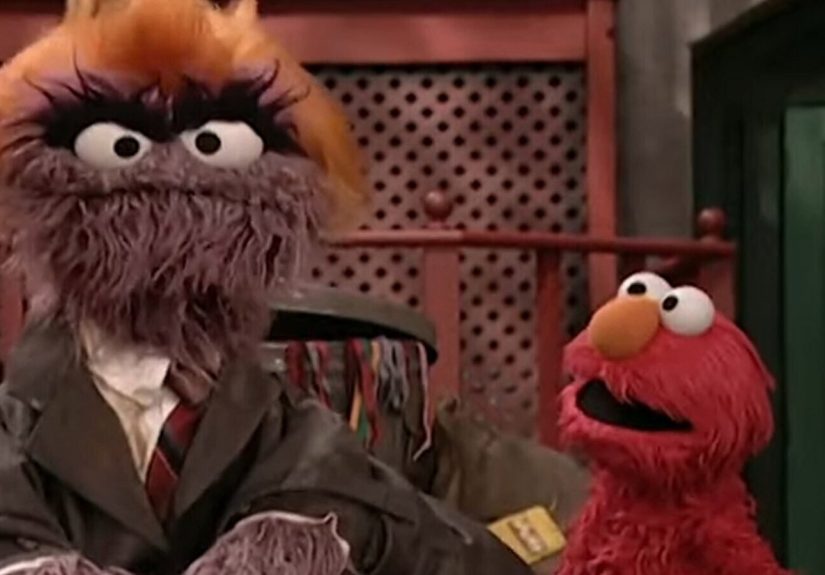
In 2005, the parody evolved again with Donald Grump, a Grouch version of Trump shaped by the era of The Apprentice. This character appears with the orange wig, the celebrity-boss attitude, the catchphrase energy, and a magnificent commitment to trash-based capitalism. He is not merely rich in the ordinary sense. He is rich in garbage, which on Sesame Street is basically being a billionaire with a smellier portfolio.
The segment, often remembered as “The Grouch Apprentice,” turns reality TV into a preschool sorting game. Donald Grump announces that he needs a helper to sort his trash. Oscar, Grundgetta, other Grouches, and even Elmo compete for the job. The tasks involve rotten fish, old sneakers, and the kind of refuse-based challenges that make perfect sense on a street where a garbage can is prime real estate.
The joke sharpens when Elmo does the tasks correctly. In most children’s shows, doing things correctly means winning. In Grump’s world, however, competence is not enough. Elmo is fired for being too good and too nice. It is a wonderfully silly reversal, but it also functions as social commentary. The segment turns the ruthless logic of reality television into something absurd: a boss who does not really want the best helper, only the helper who best reflects his own grouchy values.
Why the Grump Parodies Still Feel Relevant
The Grump sketches continue to circulate online because they seem oddly prophetic. They were not predictions in a mystical sense. Sesame Street did not peer into a crystal ball and announce future electoral maps. What the writers understood was much simpler: certain public personas are already cartoons. Trump’s brand, long before his presidency, was built around spectacle, wealth, confidence, conflict, and the power of the name. That made him unusually easy to translate into Muppet language.
In the Sesame Street universe, the Trump-like figure is not frightening because he is powerful. He is funny because his power looks childish when placed next to actual children’s characters. A boast becomes a song. A business empire becomes a pile of stinky trash. A catchphrase becomes a playground game. A gold-plated tower becomes a stack of cans that nobody really needs.
This is what good satire does. It shrinks oversized public images down to humanor Muppetscale. It asks, “What is this behavior, really?” In the case of Ronald Grump and Donald Grump, the answer is: a lot of noise, a lot of branding, and not much concern for the neighbors.
Is the Word “Monster” Fair?
Calling Trump a “monster” on Sesame Street works best when understood through the show’s own vocabulary. Sesame Street is full of monsters, and many of them are adorable. Elmo is a monster. Grover is a monster. Cookie Monster is a monster, though mostly to baked goods. The term does not automatically mean villain. It means fuzzy, exaggerated, emotional, and larger than life.
That said, the Grump characters are usually villainous in the story structure. They arrive with selfish plans. They create conflict. They try to control space, labor, or attention. They turn ordinary neighborhood life into a contest or a transaction. Then the community pushes back. The “monster” label is therefore doing two jobs at once: it refers to the literal Muppet-like form and to the oversized appetite of the character.
That double meaning is part of the headline’s appeal. Donald Trump has long been a monster on Sesame Street not because the show engaged in partisan campaigning, but because it repeatedly found comedy in the monstrous proportions of celebrity ego. The monster is the inflated self-image, the tower-sized vanity, the inability to see a neighborhood without imagining one’s name across it.
The Politics of a Children’s Show That Teaches Kindness
Because Trump later became president, the old Grump sketches gained a political charge they did not originally carry in the same way. When people revisit the clips now, they often connect them to debates over public broadcasting, PBS, and federal funding. Those debates are real and serious, but it is important not to overstate the link. The parodies existed because Trump was already a famous cultural figure, not because the show was secretly preparing a decades-long campaign strategy from inside Oscar’s trash can.
Still, the contrast is irresistible. Sesame Street represents public-minded educational media: letters, numbers, empathy, inclusion, and the radical idea that children deserve thoughtful content. The Grump characters represent private ego invading shared space. That tension makes the sketches feel bigger than celebrity parody. They become little fables about what communities owe one another.
In that sense, Sesame Street was never merely making fun of hair, wealth, or catchphrases. It was asking a question: what happens when someone treats every relationship like a deal? The answer, according to the show, is that the neighborhood gets worse until people remember how to cooperate.
What Writers Can Learn From the Grump Episodes
From a storytelling perspective, the Grump parodies are tiny masterclasses in satire. They do not require viewers to know every detail of Trump’s biography. A child can understand the conflict without recognizing the reference. That is why the sketches age well. The surface joke is topical, but the underlying story is universal.
1. Turn a public image into a simple symbol
The writers took Trump’s public association with towers, wealth, deals, and boss-like authority and converted it into trash, cans, contracts, and sorting games. That is satire at its cleanest. It does not explain the joke to death. It lets the symbol do the work.
2. Keep the moral clear
Every Grump story has a basic ethical shape. Someone powerful wants something. The neighborhood is pressured to give it up. The community resists. Children learn that selfishness can be challenged, and adults get the extra pleasure of recognizing the celebrity target.
3. Make the villain ridiculous
The Grump characters are not terrifying. They are ridiculous. That matters. Ridicule can be more effective than outrage because it punctures the balloon. A bossy tycoon loses some of his power when he is yelling about rotten fish while Elmo politely tries to help.
Why Fans Keep Rediscovering the Clips
Online culture loves a resurfaced clip, especially when it seems to contain a message from the past. The Grump segments are perfect for that kind of rediscovery. They are short, visual, easy to understand, and packed with details that feel newly relevant depending on the political moment. A viewer can watch a 1988 or 2005 sketch and feel as though Sesame Street somehow saw the future coming.
But the deeper reason fans keep sharing these moments is nostalgia mixed with surprise. Many people remember Sesame Street as gentle and safe. They forget how witty it could be. The show regularly included jokes for parents, parodies of movies and television, celebrity cameos, and sly cultural references. The Grump sketches remind viewers that children’s media can be smart without becoming cynical.
They also prove that a joke can be both silly and sturdy. A Muppet named Donald Grump sorting trash is silly. A story about greed, branding, labor, ego, and community is sturdy. Put them together, and you get a clip that survives long after the original pop-culture context has shifted.
The Real Lesson Hidden in the Trash
At its heart, the long-running Trump parody on Sesame Street is not about one man alone. It is about a type of behavior. The Grump figure is anyone who arrives in a community and sees only what can be extracted from it. He is anyone who confuses attention with respect, winning with helping, and ownership with belonging.
That is why Oscar, of all characters, makes such a perfect foil. Oscar is selfish, cranky, and proudly disagreeable, but he belongs to the neighborhood. His grouchiness has boundaries. He may complain about everyone, but he is still part of the ecosystem. Grump’s grouchiness is different. It expands. It wants to build. It wants to rename. It wants to turn shared space into branded space.
The resolution, again and again, is community. The neighbors do not defeat Grump by becoming richer, louder, or more famous. They defeat him by remembering what the street is for. It is a place where different people and monsters live together, argue, sing, learn, and occasionally count to twelve for no practical reason except joy.
Experience-Based Reflections: Watching the Grump Parodies Today
Watching the old Grump clips today feels like opening a dusty toy box and finding a tiny political cartoon wedged between a rubber duck and a plastic letter B. The first reaction is usually laughter, because the visuals are so wonderfully blunt. The hair, the tower obsession, the bossy voice, the trash brandingit is all there, translated into the cheerful absurdity of children’s television. The second reaction is surprise. Many viewers do not expect Sesame Street to be that direct. They remember alphabet songs, not a real-estate satire with community organizing on the side.
The experience is also oddly comforting. In an era when political conversation often feels like a food fight held inside a burning comment section, the Sesame Street approach feels refreshingly clear. The show does not need insults or rage to make its point. It simply stages bad behavior in a small neighborhood and lets the consequences unfold. A pushy developer pressures Oscar. A reality-show boss turns work into humiliation. A flashy outsider tries to replace a community with a monument to himself. Children can follow the story. Adults can recognize the pattern. Nobody needs a ten-part documentary narrated in a whisper.
There is also a personal, almost generational quality to rediscovering these sketches. Adults who grew up with Sesame Street may find themselves noticing jokes that sailed over their heads when they were young. As children, they may have seen Ronald Grump as just another silly villain. As adults, they can see the satire of celebrity branding, aggressive development, and the strange American habit of treating wealth as personality. The joke matures with the viewer, which is one reason the clips continue to travel so well online.
For writers, parents, teachers, and media fans, the Grump episodes offer a reminder that children’s storytelling does not have to be shallow. A simple story can carry a sophisticated idea if the emotional stakes are clear. Kids understand fairness. They understand someone taking over a place that is not theirs. They understand a boss who is mean for no good reason. They understand friends helping friends. Sesame Street trusted that understanding, then added jokes for the grown-ups standing near the TV with coffee.
The funniest experience of all is realizing that Oscar the Grouch, a character who literally lives in garbage, often comes out looking more ethical than the Grump figure. Oscar may be rude, but he is not pretending to improve the neighborhood while making it worse. He is exactly what he says he is. That honesty gives him a weird dignity. In the end, the Grump parodies endure because they are not merely about Trump. They are about recognizing the difference between a harmless grouch and a destructive one.
Conclusion: A Fuzzy Satire That Still Has Teeth
Donald Trump’s long life as a monster on Sesame Street is one of the stranger and sharper threads in American pop culture. Through Ronald Grump and Donald Grump, the show turned a celebrity businessman into a Grouch-world fable about greed, ego, branding, and the defense of community. The parodies worked in the 1980s, returned in the 1990s, adapted to reality television in the 2000s, and still feel relevant because their target was never just a hairstyle or a catchphrase. Their target was a way of moving through the world.
That is why these sketches remain so watchable. They are funny, yes, but they are also cleanly constructed moral comedies. The neighborhood is threatened. The residents push back. The bully leaves. The street survives. And somewhere, Oscar gets to enjoy his trash in peace, which may be the most Sesame Street ending imaginable.