Table of Contents >> Show >> Hide
- Why Carrier-Based Early Warning Aircraft Matter
- The U.S. E-2C Hawkeye: The Original “Radar Plane” for Carriers
- The E-2D Advanced Hawkeye: Same Job, Sharper Tools
- China’s KJ-600: What It Is and Why It Exists
- So… Is the KJ-600 a “Hawkeye Clone” or Just a Familiar Shape?
- Key Similarities People Notice (and Why They Matter)
- Important Differences (and the Big Unknowns)
- Why the KJ-600 Is Strategically Significant Anyway
- Quick FAQ
- Conclusion
- Experiences: Seeing the “Flying Mushroom” Up Close (Without Needing a Flight Deck Pass)
At first glance, China’s KJ-600 looks like it wandered onto a U.S. Navy flight deck, borrowed an E-2C Hawkeye’s outfit,
and said, “No one will notice.” High wing? Check. Big spinning “flying mushroom” radome on top? Check. Twin turboprops,
fold-friendly carrier geometry, and a tail arrangement that screams “I live on a boat”? Check.
But here’s the twist: in the airborne early warning (AEW) world, “looking similar” is often less about copying a style
and more about obeying the same set of physics, carrier-deck realities, and radar requirements. AEW aircraft are built
around a mission that’s basically: see far, see early, sort chaos, and tell everyone else where to gowhile launching
from (and landing on) the planet’s most stressful runway.
Why Carrier-Based Early Warning Aircraft Matter
A carrier strike group is powerful, but it’s also a moving island that’s only as safe as what it can detect and react to
in time. Ships can carry large radars, yet they’re limited by the curvature of the Earth: a radar mounted close to sea
level can’t “see” very far over the horizon. Put radar at altitude, and the horizon moves outward. That’s the AEW cheat
code: climb high, widen the view, and turn scattered sensor returns into a coherent “what’s happening out there” picture.
In practice, AEW aircraft do three big jobs:
- Early detection: Spot aircraft, missiles, and surface contacts sooner than shipboard radars can.
- Battle management: Identify what’s friendly, unknown, or hostile; prioritize threats; assign fighters and intercepts.
- Networking: Share targeting-quality tracks so ships and aircraft can act fasterand sometimes from farther away.
If fighters are the “punch,” AEW is the “eyes and brain.” Without it, a carrier group can still swing, but it risks swinging late.
The U.S. E-2C Hawkeye: The Original “Radar Plane” for Carriers
The E-2 Hawkeye family has been the U.S. Navy’s carrier-based airborne early warning platform for decades, and the E-2C
became a defining version in that lineage. The core idea is simple: a robust twin-turboprop aircraft carrying a large
rotating radar dome (a 24-foot diameter rotodome) and a crew sized for command-and-control work, not just flying. The Navy
describes the E-2 as a five-crewmember, high-wing turboprop built for airborne early warning, command, and control.
The E-2C’s mission set is broad: airborne early warning and command and control for the carrier battle group, plus surface
surveillance coordination, strike and interceptor control, search-and-rescue guidance, and communications relay. In other
words, it’s the airborne traffic controller, threat analyst, and group chat moderatorexcept the “group chat” includes jets,
ships, and sometimes very expensive missiles.
E-2C Sensors and the “Hawkeye 2000” Upgrade Path
Over time, the E-2C evolved through upgrades that improved radar performance, data sharing, and crew systems. Northrop Grumman
notes that the E-2C Hawkeye 2000 variant built on the Group II baseline and incorporated the AN/APS-145 radar, improved IFF,
and tactical data links such as JTIDS, helping the aircraft remain operationally relevant as threats changed.
The E-2D Advanced Hawkeye: Same Job, Sharper Tools
While your headline calls out the E-2C, it’s hard to talk about “Hawkeye” without mentioning the E-2Dbecause it shows where
the concept can go when sensors and networks get a major glow-up. The Navy’s E-2D program emphasizes a “two-generation leap”
in radar capability and upgraded systems designed to improve surveillance and battle management.
A centerpiece is the AN/APY-9 radar, described as delivering enhanced airborne command and control and expanded surveillance.
The E-2D also matters because it’s not just “a radar with wings”it’s a network node. In U.S. doctrine, Cooperative Engagement
Capability (CEC) is a major way to share sensor data and enable engagements based on remote tracks, and the Navy’s own fact file
explains CEC as providing the ability to engage threats using sensor data from elsewhere in the network.
Why Networking Changes the Game
The modern value of an AEW aircraft isn’t just detectionit’s turning detection into shared, actionable tracks. U.S. Navy discussions
of Naval Integrated Fire Control concepts highlight how an E-2D can support over-the-horizon targeting by relaying radar tracks to
other shooters. This matters because it compresses the timeline from “we see it” to “we can respond,” especially in cluttered littoral
environments where sorting targets is hard.
China’s KJ-600: What It Is and Why It Exists
China’s KJ-600 is widely assessed as a carrier-capable fixed-wing airborne early warning aircraft designed to operate from catapult-equipped
carriers. And that “catapult-equipped” part is not a footnoteit’s the whole point.
China’s first two carriers relied on ski-jump ramps, which are fine for launching many fighters but impose constraints on heavier aircraft
or those that need to launch with full fuel and payload. A fixed-wing AEW aircraft is exactly the kind of platform that benefits from catapult
launches. Reporting around China’s Fujian (Type 003) has described it as featuring electromagnetic catapults, a leap that enables heavier aircraft
to launch more effectivelyincluding support aircraft like the KJ-600.
The Fujian Factor: Catapults Enable the “Force Multipliers”
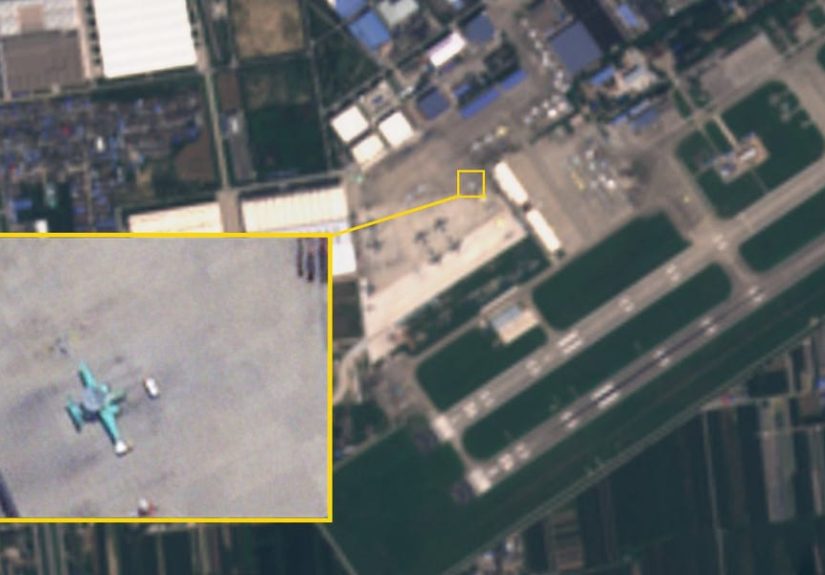
Publicly released imagery and reporting in 2025 showed Fujian conducting catapult operations that included the KJ-600 in the mix. Observers noted this
as a significant milestone because it signals more than “we can launch fighters.” It suggests the beginnings of a carrier air wing that includes
force multipliers: early warning aircraft, potentially electronic warfare aircraft, and other enablers that make the whole group more capable.
In plain terms: a carrier with only fighters is a boxer with strong arms. A carrier with fighters plus AEW is a boxer who can see punches coming.
So… Is the KJ-600 a “Hawkeye Clone” or Just a Familiar Shape?
If you’re expecting a dramatic courtroom reveal“Aha! The KJ-600 is literally an E-2C in a mustache!”real life is less theatrical.
The more useful question is: why would a carrier-based AEW aircraft converge on this configuration at all?
Design Convergence: When Physics Hands Everyone the Same Homework
Carrier-based fixed-wing AEW imposes a tight design box:
- You need a big radar aperture. A rotodome provides volume and a clear view. Big radar = big drag and structural loads.
- You need stability. The radar dome changes aerodynamics; a high wing and robust tail surfaces help keep control predictable.
- You need deck practicality. Folding wings reduce footprint. Tough landing gear survives arrested landings.
- You need endurance and efficiency. Turboprops sip fuel compared to jets at loiter speedsperfect for “stay up there and watch.”
When multiple countries try to solve the same mission on the same kind of runway (a moving ship), it’s not shocking they end up with similarly shaped
solutions. In that sense, “it looks like a Hawkeye” can be true without proving “it is a copy of a Hawkeye.”
Key Similarities People Notice (and Why They Matter)
1) The Rotodome: The Most Obvious “Tell”
The rotating radar dome is the visual signature of the Hawkeye family, and it’s also the best way to signal: “This aircraft’s main job is sensing.”
The E-2’s 24-foot rotodome is a major part of its identity. A similarly prominent dome on the KJ-600 is a logical outcome of the same requirement:
maximize radar performance from an aircraft small enough for carrier operations.
2) Twin Turboprops: Not Glamorous, But Ideal
AEW missions require long on-station time. Turboprops excel at efficient loiter, and carrier operations reward reliable powerplants and predictable handling.
Jets can do AEW (as land-based AWACS shows), but for a carrier deck, the turboprop solution has a long track record.
3) High Wing + Folded Geometry: The “Carrier Origami” Requirement
High wings help keep engines and props away from deck spray and foreign object debris, while providing clearance for the fuselage-mounted radar dome structure.
Folding wings aren’t a fashion statementthey’re the only way to fit more aircraft on a crowded deck and in a hangar.
Important Differences (and the Big Unknowns)
Here’s where responsible analysis gets honest: much of what makes an AEW aircraft decisive is not its silhouetteit’s the sensor performance, data links,
processing, crew workflow, and doctrine. Those details are far harder to verify publicly for the KJ-600 than for the U.S. E-2 community.
1) Radar and Mission Systems
The E-2D’s APY-9 radar is openly described by U.S. industry and Navy sources as a major capability leap, and U.S. documentation discusses how its data
can be integrated into broader networks. By contrast, public discussions of KJ-600 radar performance tend to be inferentialbased on visible dome size,
China’s broader radar industry progress, and the role the aircraft is expected to play.
2) Networked Warfare Maturity
The U.S. Navy’s emphasis on sensor networking (CEC and related concepts) is backed by long development timelines, testing, and integration with Aegis-capable
ships. China is clearly investing in networking and battle management, but the maturity of carrier strike group-level integration is a different question than
“does the plane exist.” A platform is only as powerful as the system it plugs into.
3) Carrier Operations and Training Depth
Carrier aviation is a skill stack built over time: deck crews, maintenance rhythms, sortie generation, weather operations, and the kind of “muscle memory”
that comes from repetition. Even if two aircraft look similar, the organizations operating them may be at different points on the learning curve.
Why the KJ-600 Is Strategically Significant Anyway
Even with unknowns, a carrier-based fixed-wing AEW aircraft is a big deal because it extends the carrier’s sensing and command-and-control reach. That can:
- Improve defensive warning time against aircraft and missiles.
- Enable more coordinated long-range fighter control.
- Support complex operations in cluttered coastal environments.
- Increase the carrier group’s ability to build and maintain situational awareness farther from the ships.
In other words, the KJ-600 isn’t just “another plane.” It’s a sign that China’s carrier aviation ambitions are moving beyond “launch fighters” toward building
a fuller carrier air wing with the support aircraft that make carriers truly effective at range.
Quick FAQ
Is the KJ-600 literally an E-2C copy?
Visually, it strongly resembles the Hawkeye layout. But visual similarity alone doesn’t prove identical internal systems or equal capability. In AEW design,
similar requirements often yield similar shapes.
Why can’t a ski-jump carrier just use an AEW turboprop?
Ski-jumps impose launch limitations that make it harder for heavier, less thrusty aircraft to take off with full fuel and payload. Catapults expand the types of
aircraft that can launch effectivelyone reason Fujian’s catapult configuration is so significant.
What’s the biggest advantage of an AEW aircraft over ship radar?
Altitude extends radar line-of-sight and improves detection and tracking, especially against low-flying threats. It also helps fuse information and coordinate the
air battle more effectively.
Conclusion
Yes, China’s KJ-600 looks a lot like the U.S. E-2C Hawkeyeenough that casual observers will keep making side-by-side memes for years. But the deeper story is
less about aesthetics and more about mission logic. Carrier-based fixed-wing AEW is a narrow design challenge, and the Hawkeye shape is what happens when you
optimize for a big radar, long endurance, deck survivability, and stable airborne command-and-control.
The more meaningful comparison isn’t just “do they look alike?” It’s “how well do they detect, manage, and share the fight?” For the E-2 community, decades of
integration and networking have made the Hawkeye family central to how a carrier group sees and responds. For the KJ-600, the aircraft’s emergence alongside a
catapult-capable carrier signals a clear direction: China wants the kind of carrier air wing that can do more than launch fightersit wants the airborne eyes and
coordination that make a carrier group truly hard to surprise.
Experiences: Seeing the “Flying Mushroom” Up Close (Without Needing a Flight Deck Pass)
If you’ve ever watched carrier operations footageeven the grainy kind with more pixels missing than presentyou know the vibe: everything is loud, fast, and
choreographed like a dance routine where the penalty for a bad step is “please don’t step into the prop arc.” That’s the first “experience” lesson with AEW aircraft:
they’re not glamorous stealth fighters, but they’re treated like VIPs because the whole air picture leans on them.
A fun way to appreciate why the KJ-600 and E-2C look alike is to imagine a flight deck as a tiny, windy parking lot where every vehicle is oversized and everyone’s
late. You start noticing practical details. Folding wings? That’s not optional; it’s survival. High wings and sturdy landing gear? Same. Even the distinctive tail layout
makes more sense when you picture tight turns on deck, hangar storage, and the need for stable handling when you’re coming in to land on a moving ship.
Another “experience” angle comes from spotting how people react to the radar dome itself. In photos and videos, it’s the first thing your eyes grablike a billboard
that says, “This plane is here to watch you.” That’s also why it becomes the center of comparison. The dome turns the aircraft into an icon, so when China fields a
dome-topped carrier plane, the Hawkeye comparison is practically automatic. It’s not unlike seeing someone wearing a tuxedo: you assume there’s a formal event, even if
you don’t know which one.
If you’re a model builder, simulator fan, or the kind of person who pauses videos to count tie-down points on a deck, AEW aircraft are a rabbit hole. You start asking
questions like: How long can it stay on station? How many operators are inside? What does “battle management” actually look like in real time? Then you realize the
aircraft is less like a “radar truck” and more like a flying officeoperators sorting tracks, managing identification, coordinating fighters, and keeping the carrier’s
world from becoming a surprise party.
There’s also the armchair-analyst experience: you see a clip of a catapult launch, and suddenly the conversation shifts from “cool video” to “what does this enable?”
A catapult doesn’t just fling aircraftit expands the menu. It’s the difference between “we can launch the fast stuff” and “we can launch the heavy, specialized stuff
that makes the fast stuff smarter.” That’s why the KJ-600 matters: it represents a move toward the supporting cast that turns a carrier into a more complete system.
Finally, there’s the most relatable experience of all: realizing that in military aviation, the weird-looking planes often matter the most. Fighters get the posters.
AEW aircraft get the responsibility. And once you’ve seen how often serious navies revolve around their airborne eyes, the “Hawkeye look-alike” headline stops being a
joke and starts being a clue about priorities. If you’re building a carrier air wing for real operationsnot just paradesyou eventually need the plane that sees first,
talks to everyone, and keeps the team from being blindsided.