Table of Contents >> Show >> Hide
- What Is NASA’s Gateway?
- Why Put a Space Station Around the Moon?
- The Orbit: A Lunar Halo With a Job
- The Core Modules: HALO and PPE
- International Partners: Gateway Was Never a Solo Act
- What Would Astronauts Do on Gateway?
- Gateway as a Science Platform
- The Dust Problem Nobody Should Laugh At
- The 2026 Shift: Is Gateway Still Happening?
- Why Gateway Still Matters
- Experience Section: What Gateway Teaches Us About the Future of Space Travel
- Conclusion
Editor’s note: NASA’s lunar Gateway has been one of the most fascinating pieces of the Artemis program: a compact, high-tech space station designed to orbit the Moon, support astronauts, host science, and help humanity rehearse for Mars. As of NASA’s March 2026 Artemis update, the agency says it intends to pause Gateway “in its current form” and shift near-term focus toward lunar surface infrastructure. Still, the Gateway design remains one of the clearest previews of how deep-space stations may work in the coming era.
Imagine a space station that does not circle Earth every 90 minutes like the International Space Station, but instead loops around the Moon in a long, elegant orbit, sometimes close enough to support lunar missions and sometimes far enough away to stare into deep space like a quiet cosmic lighthouse. That is the basic idea behind NASA’s Gateway: humanity’s proposed first space station around the Moon, a small but mighty outpost built for Artemis astronauts, lunar science, international collaboration, and future missions to Mars.
Gateway is not meant to be a giant orbital city. No shopping mall, no space bowling alley, no zero-gravity coffee chain with suspiciously expensive lattes. Instead, it is designed as a practical deep-space workbench: part laboratory, part docking hub, part power station, part communications node, and part astronaut shelter. In NASA’s original Artemis architecture, Gateway would help crews move between Orion, lunar landers, logistics vehicles, and scientific experiments in lunar orbit.
The current status is more complicated than the early concept art suggested. NASA’s official Gateway page still describes the lunar station as a future mission, while NASA’s 2026 policy update says the agency is pausing Gateway in its current form and exploring ways to repurpose applicable hardware and partner commitments for a more surface-focused Moon base strategy. That makes Gateway both a real engineering project and a case study in how space exploration evolves when politics, budgets, engineering risk, and ambition all show up to the same meeting wearing hard hats.
What Is NASA’s Gateway?
NASA’s Gateway is a planned lunar-orbiting station developed under the Artemis program, the campaign aimed at returning astronauts to the Moon and building a sustainable human presence there. Unlike the International Space Station, which flies in low Earth orbit, Gateway was designed to operate much farther away, in the Moon’s neighborhood. That distance makes it harder to reach, harder to maintain, and far more useful for learning how humans and machines behave beyond Earth’s protective cocoon.
At its core, Gateway is about preparation. NASA does not simply want to plant flags, snap heroic photos, and head home with a suitcase full of Moon rocks. The Artemis vision is broader: learn how to live and work around the Moon, use the lunar environment as a proving ground, and build the skills needed for eventual crewed missions to Mars. Gateway was created as one of the stepping stones in that chain.
The station’s planned role includes supporting astronauts in lunar orbit, enabling science investigations, serving as a staging point for surface missions, testing high-power solar electric propulsion, and giving international partners meaningful hardware responsibilities. In other words, Gateway is not just a place. It is a system of systems, and space engineers love systems almost as much as they love acronyms.
Why Put a Space Station Around the Moon?
At first glance, placing a station near the Moon may sound like taking a road trip and building a garage halfway down the driveway. Why not go directly to the lunar surface? That question has been debated for years, and it is one reason NASA’s 2026 architecture update shifted emphasis toward surface operations. Still, the Gateway concept has several strong arguments behind it.
First, a lunar station could act as a flexible docking and transfer point. Orion spacecraft, lunar landers, cargo vehicles, and logistics modules could meet at Gateway, allowing astronauts to transfer between vehicles before descending to the Moon or returning to Earth. This kind of traffic management matters as lunar missions become more frequent and more complex.
Second, Gateway could serve as a science platform in deep space. The area around the Moon offers a different radiation environment from low Earth orbit, making it valuable for studying space weather, solar particles, galactic cosmic rays, and the health effects of deep-space travel. That is not just academic curiosity. Radiation is one of the biggest challenges for future Mars missions.
Third, Gateway offers a rehearsal space for autonomy. A station around the Moon cannot rely on constant hands-on maintenance from crews. It must operate for long periods without astronauts onboard, monitor its own systems, manage power and thermal conditions, and support visiting vehicles. That experience is directly relevant to Mars missions, where help is not exactly around the corner.
The Orbit: A Lunar Halo With a Job
Gateway was designed for a near-rectilinear halo orbit, often shortened to NRHO. That may sound like something a physics professor says right before the classroom gets very quiet, but the idea is fairly simple. Instead of circling the Moon in a low, round path, Gateway would follow a stretched orbit influenced by the gravity of both Earth and the Moon.
This orbit has useful advantages. It can provide access to the lunar South Pole region, where NASA is especially interested in permanently shadowed areas that may contain water ice. It also allows long periods of visibility with Earth, which helps with communications. For astronauts, mission planners, and nervous people watching live streams from home, communication is not a minor detail.
The lunar South Pole is central to Artemis because water ice could become a critical resource. If future explorers can extract water, they may be able to produce oxygen, drinking water, and even rocket propellant. That is why the Moon is no longer just a destination. It is becoming a test site for living off-world.
The Core Modules: HALO and PPE
The first Gateway configuration centered on two major elements: HALO and PPE. HALO stands for Habitation and Logistics Outpost. PPE stands for Power and Propulsion Element. Together, they were designed to form the first functional version of the lunar station.
HALO: The Astronauts’ Compact Deep-Space Home
HALO is the pressurized module where astronauts would live, work, dock, and prepare for lunar missions. It is not spacious in the way the International Space Station is spacious. Think less “floating laboratory campus” and more “high-tech camper van built for the Moon.” But compact does not mean simple. HALO includes docking ports, life-support connections, command systems, storage, crew accommodations, and interfaces for visiting spacecraft.
HALO’s journey from concept to hardware has been a major milestone. Its primary structure was fabricated by Thales Alenia Space in Turin, Italy, and shipped to Northrop Grumman’s facility in Gilbert, Arizona, for final outfitting. That physical progress is important because Gateway has never been merely a PowerPoint dream. Real metal has been cut, tested, shipped, unboxed, inspected, and prepared for integration.
PPE: The Station’s Solar-Electric Powerhouse
The Power and Propulsion Element is the engine room of Gateway, although “engine room” sounds too old-fashioned for what is essentially a high-power solar electric spacecraft. PPE was designed to generate about 60 kilowatts of electrical power and use solar electric propulsion to maneuver the station, maintain its orbit, and support operations in deep space.
Solar electric propulsion is not the roaring, fire-breathing launch technology people usually imagine. It is more like the spaceflight version of a patient marathon runner. It uses electricity, often generated by solar arrays, to accelerate propellant and produce efficient thrust over long periods. The acceleration is gentle, but in space, gentle can be powerful if you keep at it long enough. Space rewards patience, math, and very good thermal control.
International Partners: Gateway Was Never a Solo Act
One of Gateway’s most important features is that it was designed as an international project. NASA leads the effort, but major contributions have come from the European Space Agency, the Canadian Space Agency, the Japan Aerospace Exploration Agency, and the Mohammed Bin Rashid Space Centre of the United Arab Emirates.
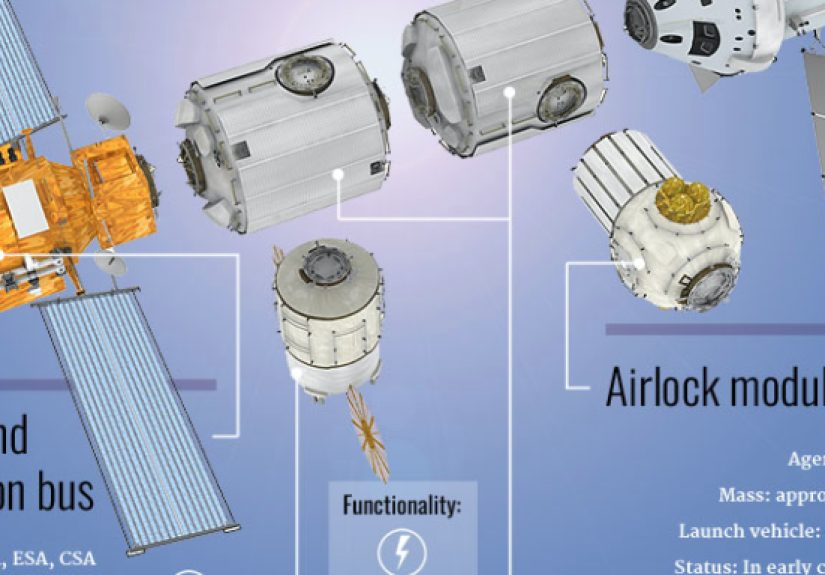
ESA’s planned contributions include Lunar I-Hab, a habitation module that would provide additional living and working space, and Lunar View, a module designed to support refueling, cargo logistics, and windows for looking at the Moon, Earth, and deep space. Windows may sound like a luxury until you remember that astronauts are humans, not USB drives. Views matter for operations, mental health, photography, and the sheer awe of being somewhere no one else is.
Canada’s contribution, Canadarm3, continues the country’s long robotic legacy. Following the famous Canadarm and Canadarm2, Canadarm3 was designed as a highly autonomous robotic system capable of inspecting, maintaining, repairing, relocating modules, assisting spacewalks, and catching visiting spacecraft. In lunar orbit, where crews are not always present, that kind of robotic helper is less “nice to have” and more “please do not make the astronauts fly out here just to tighten a bolt.”
JAXA’s work includes critical life-support technologies for the International Habitation module, including environmental control, thermal systems, batteries, and imagery components. The UAE’s Emirates Airlock was planned to support spacewalks, science transfers, and external operations. Together, these contributions show that the Moon is becoming an international construction zone, only with better vacuum and fewer lunch breaks.
What Would Astronauts Do on Gateway?
Gateway missions were expected to be short compared with long ISS expeditions, especially in early operations. Astronauts would arrive in Orion, dock with the station, conduct checks, prepare for lunar surface sorties, manage experiments, transfer supplies, and coordinate with landers. Gateway would function as a mission hub rather than a permanent apartment complex.
Inside, crew members would deal with the practical realities of deep-space living: limited volume, careful scheduling, exercise, equipment maintenance, communication windows, food storage, hygiene, sleep, and the little daily rituals that keep people sane when they are very far from home. No matter how advanced the spacecraft becomes, somebody still has to label bags, troubleshoot cables, and ask where the missing tool floated off to.
Gateway’s design also reflects lessons from the International Space Station. NASA and its partners know that astronauts need more than oxygen and checklists. They need reachable handholds, clear lighting, safe translation paths, manageable noise, intuitive displays, and workspaces that do not turn every task into a slow-motion wrestling match. Human factors testing on habitat mockups is a serious part of making spacecraft usable.
Gateway as a Science Platform
Gateway’s science value comes from its location. In lunar orbit, the station would sit outside most of Earth’s magnetic protection, exposing instruments and hardware to a harsher radiation environment. That makes it an excellent place to study space weather and deep-space radiation.
One planned science package, HERMES, is designed to study the causes of space-weather variability, including solar wind behavior and energetic particles. Another European radiation experiment, ERSA, focuses on measuring particles from the Sun, galactic cosmic rays, neutrons, ions, and magnetic fields around Gateway. These measurements could help researchers better understand the radiation risks astronauts face beyond low Earth orbit.
This matters because space weather is not a decorative background effect. Solar storms can threaten astronauts, disrupt electronics, degrade materials, and complicate mission planning. If humanity wants to send crews to Mars, we need better forecasting, better shielding, and better operational rules. Gateway’s environment would provide a useful laboratory for all three.
The Dust Problem Nobody Should Laugh At
Lunar dust sounds harmless, almost cute. It is not. Apollo astronauts discovered that Moon dust clings to suits, scratches surfaces, irritates equipment, and generally behaves like glitter’s angrier, sharper cousin. NASA has been studying how lunar dust may affect Gateway materials, spacesuits, seals, and equipment as astronauts move between landers, habitats, and spacecraft.
The problem is that lunar dust is jagged, electrostatically clingy, and created by billions of years of micrometeorite impacts. On Earth, wind and water smooth particles over time. On the Moon, there is no weather to sand down the edges. That means dust can be abrasive enough to damage hardware and annoying enough to make engineers mutter into their coffee.
For Gateway and future Moon bases, dust control is essential. Airlocks, suitports, surface procedures, filters, coatings, and cleaning strategies all matter. It is one of those unglamorous engineering problems that can decide whether a mission feels elegant or turns into an expensive lunar housekeeping emergency.
The 2026 Shift: Is Gateway Still Happening?
The honest answer is: not in the same way originally envisioned, at least for the near term. NASA’s March 2026 update says the agency intends to pause Gateway in its current form while concentrating on a phased lunar surface architecture. The agency emphasized more frequent landings, surface power, habitats, logistics, commercial hardware, and infrastructure that supports sustained operations directly on the Moon.
This does not mean every Gateway idea disappears. NASA specifically noted that applicable equipment and international partner commitments may be repurposed to support surface goals. It also does not erase the engineering knowledge gained from Gateway development. HALO, PPE, robotics, life-support planning, radiation research, docking systems, and autonomous operations remain relevant to future exploration.
In a way, Gateway now represents a bigger lesson about space programs: architecture changes. Apollo changed. The Space Shuttle changed. The International Space Station changed repeatedly before becoming the orbital laboratory we know today. Artemis is changing too. The question is not whether plans evolve; they always do. The question is whether the work already done can still push exploration forward.
Why Gateway Still Matters
Even if Gateway is paused or reshaped, its concept remains important because it answers a question humanity will keep asking: how do we build and operate infrastructure beyond Earth? The Moon is close enough to reach in days, but far enough to force serious deep-space thinking. A lunar station is one possible answer. A Moon base is another. A network of landers, surface habitats, orbital relays, robotic assistants, and reusable vehicles may be the answer that finally emerges.
Gateway also helped define what international lunar collaboration can look like. Instead of one country doing everything, different partners contribute specialized systems. Europe builds habitat and service modules. Canada provides robotics. Japan supports life-support technology. The UAE develops airlock capability. The United States integrates the architecture through Artemis. That model may become standard for future Mars campaigns.
For the public, Gateway offers something equally valuable: a glimpse of exploration becoming infrastructure. The first Moon race was about getting there. The next phase is about staying, learning, adapting, and building useful systems. That is less cinematic than a single giant leap, but it may be more historically important.
Experience Section: What Gateway Teaches Us About the Future of Space Travel
Looking at NASA’s future space station around the Moon is a little like touring a model home in a neighborhood that has not been built yet. You can see the layout. You can imagine the daily routine. You can picture the view from the window. But you also know the final neighborhood may change once the builders encounter budgets, weather, contractors, and that one pipe nobody remembered was underground. Gateway gives us that same feeling: part blueprint, part promise, part reality check.
The first experience Gateway offers is perspective. Most of us think of space stations as places above Earth. The International Space Station has trained the world to imagine astronauts floating with our blue planet below them. Gateway changes that mental picture. Its view would be stranger and more dramatic: the Moon nearby, Earth distant, deep space everywhere else. That shift matters. It reminds us that humanity’s next chapter is not just about visiting another world, but about learning to operate between worlds.
The second experience is humility. Gateway’s compact design shows that deep-space exploration is not glamorous in the movie-trailer sense. Astronauts will not be lounging in giant glass domes, casually sipping orange juice while Earth rises in the background. They will be managing checklists, conserving resources, monitoring radiation, securing cargo, repairing equipment, and sleeping in tight quarters. Deep space is beautiful, but it is not forgiving. Gateway’s design is a practical response to that reality.
The third experience is patience. The public often wants space progress to feel like a rocket launch: loud, bright, and immediate. But much of exploration is slow work. HALO shipping from Italy to Arizona, PPE assembly in California, human factors tests in habitat mockups, dust adhesion studies, robotics design reviews, and life-support integration are not as flashy as a countdown. Yet these are the steps that make exploration real. Space is built in cleanrooms long before it appears on live television.
The fourth experience is collaboration. Gateway shows that modern space exploration is no longer a solo heroic sprint. It is a relay race with many countries passing hardware, expertise, and responsibility to one another. That can be messy. International partnerships require agreements, schedules, standards, and trust. But the payoff is huge: shared cost, shared knowledge, and shared ownership of humanity’s future beyond Earth.
The fifth experience is adaptability. NASA’s 2026 decision to pause Gateway in its current form may disappoint people who loved the original station plan. But exploration has always required adjustment. Sometimes a better path appears. Sometimes a schedule slips. Sometimes a system becomes too complex for the mission sequence. A mature space program must be able to pivot without throwing away everything it has learned. Gateway’s hardware, technology, and lessons may still influence lunar bases, Mars vehicles, orbital platforms, or future deep-space habitats.
Finally, Gateway teaches us that the future of space travel will be less about single destinations and more about networks. The Moon will need landers, habitats, power systems, rovers, communication relays, navigation tools, cargo services, science stations, and maybe orbital outposts. Mars will require even more. Gateway is one early sketch of that networked future. Whether it flies exactly as imagined or evolves into something new, it has already helped engineers, astronauts, and policymakers think beyond the old model of “launch, land, return.”
That may be Gateway’s most important legacy. It encourages us to imagine space not as a place we briefly visit, but as a frontier where humans build systems, solve problems, and slowly become capable of going farther. The Moon is no longer just a glowing disk in the night sky. It is becoming a proving ground. Gateway, paused or reimagined, remains one of the boldest first looks at how we may learn to live and work there.
Conclusion
NASA’s Gateway is more than a lunar space station concept. It is a preview of the decisions, technologies, partnerships, and trade-offs that will define the next generation of exploration. Its planned modules, including HALO and PPE, reveal how astronauts might live and work in lunar orbit. Its international contributions show how the Artemis program has become a global effort. Its science goals highlight the importance of radiation research, space weather monitoring, and deep-space operations.
At the same time, NASA’s latest Artemis direction shows that the future is not frozen in concept art. Gateway is being paused in its current form as NASA emphasizes surface infrastructure and a sustained Moon base. That does not make Gateway irrelevant. It makes it part of a living, changing exploration strategy. The dream of a station around the Moon may evolve, but the knowledge behind it is already shaping humanity’s path from the Moon to Mars.