Table of Contents >> Show >> Hide
- First, a quick translation: what “6DoF SLAM” actually means
- Who is Lynxand why the Lynx-R1 has always been “the open one”
- So what did Lynx release, exactly?
- Why open-sourcing 6DoF tracking matters more than it sounds
- The engineering reality check: SLAM is powerful, but picky
- Where developers can actually use this (and why it’s exciting)
- “Okay, but will it work on my headset?” A sane FAQ
- What this could unlock next in Android XR
- Field Notes: 500+ Words of “Real-World” Experiences Around Open-Source SLAM
- Conclusion
In XR, there are two kinds of magic: the kind that makes virtual objects stick to your coffee table, and the kind that makes your coffee table
stick to your virtual objects (which is… less ideal). The first kind depends on something unglamorous but absolutely essential: positional tracking.
And in August 2025, the team behind the Lynx-R1 mixed reality headset did something developers have been begging for across the headset universe:
they open-sourced a 6DoF SLAM tracking solution based on ORB-SLAM3packaged to run on Android headsets, especially those built on Qualcomm XR chips.
If you’ve ever tried building an AR/MR experience and thought, “Why does tracking feel like it’s guarded by a dragon with an NDA?”this release is
a big deal. Not because SLAM is new, but because shipping SLAM (reliably, at low latency, on real hardware) is the hard part. Lynx is essentially
handing the community a serious starting point, plus a demo app you can run on real headset hardware.
First, a quick translation: what “6DoF SLAM” actually means
“6DoF” stands for six degrees of freedom: three for position (move left/right, up/down, forward/back) and three for rotation
(pitch, yaw, roll). True 6DoF tracking is why you can lean closer to a virtual object and it behaves like it’s in the room, not taped to your face.
“SLAM” stands for Simultaneous Localization and Mapping. In plain English: the headset uses cameras (and often an IMU) to figure out
where it is and build a map of visual features in the environment at the same time. It’s like giving your headset a tiny internal notebook:
“That corner of the bookshelf looks familiar… therefore I must be here.”
The goal is simple and brutal: low-latency, low-drift pose estimates that hold up when you turn quickly, walk into a brighter room,
or wave your hands around like you’re conducting an orchestra made of pixels.
Who is Lynxand why the Lynx-R1 has always been “the open one”
Lynx is a mixed reality headset company that’s been outspoken about openness: an Android/AOSP-based operating system, an OpenXR-compatible runtime
focus, and a “let developers access the raw sensor data” mindset rather than the classic “please enjoy this black box and do not look directly at it.”
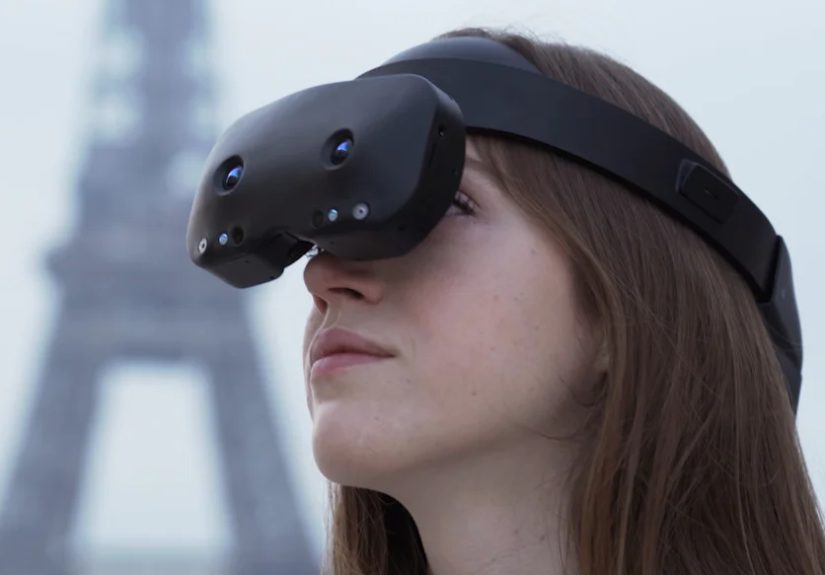
The Lynx-R1 itself is a standalone mixed reality headset designed to do both VR and video passthrough MR.
Hardware-wise, the Lynx-R1 has been described as using multiple external cameras to enable inside-out tracking and hand tracking. That camera array is
the foundation for SLAM: more visual information, more chances to find stable features, more ways to keep your virtual content nailed to reality.
Whether you’re an enterprise team building training tools, a researcher prototyping perception features, or a developer who just wants a headset that
doesn’t require a cloud account and a loyalty oath, Lynx has tried to position the R1 as a platform you can actually tinker with.
So what did Lynx release, exactly?
The short version: Lynx open-sourced a 6DoF SLAM solution built from ORB-SLAM3, modified to run on Androidspecifically
targeting Android headsets built on Qualcomm XR chipsets.
Two parts: the library and the demo app
-
An Android-focused ORB-SLAM3 build/library project that produces a native
.solibrary for pose estimationtaking camera
images in, outputting a 6DoF pose out. -
A Lynx-R1 demo application that integrates the SLAM library on-device, captures stereo camera feeds, runs the tracking pipeline, and
visualizes results (including map points).
Important context: this isn’t the default tracking stack on Lynx-R1
Lynx has been clear that the headset’s default perception/tracking pipeline uses Qualcomm’s provided 6DoF system. The open-source SLAM project is
described as experimental and used by specific customers and scenariosthink “tool for builders” more than “what every retail unit runs.”
What makes the implementation notable
ORB-SLAM3 is already well-known in research and advanced prototyping because it supports multiple sensor configurations (monocular, stereo, RGB-D) and
can do visual-inertial SLAM, relocalization, and multi-map behavior. Lynx’s work is about making it behave in the real world of Android headsets:
camera pipelines, performance constraints, and the “you have 11 milliseconds… good luck” timing reality of XR.
Lynx’s documentation and repositories discuss performance-oriented decisions like pushing heavy feature extraction and matching onto Qualcomm-specific
accelerators (including DSP/HWA pathways), minimizing memory copies (for example, using hardware buffers), and reducing expensive optimization steps
when necessary to keep framerate high.
Licensing: open-source, with strings attached (the helpful kind)
Lynx frames the release as GPLv3 for the SLAM component, which is a deliberate “if you use it, keep it open” stance. Meanwhile, parts of the demo-side
code may use a more permissive license in a separate repository while still depending on GPL components. The practical takeaway: if you want to ship
this in a product, treat licensing as a first-class engineering constraint, not a footnote you read at 2 a.m. with a cold pizza.
Why open-sourcing 6DoF tracking matters more than it sounds
1) It reduces “tracking lock-in” for smaller XR players
Big headset makers often build custom tracking stacks. Smaller companies, labs, and niche device builders may rely on a vendor-provided solution. That’s
not inherently baduntil you need to debug a tracking edge case, customize behavior for a weird environment (warehouses! factories! surgical sims!), or
meet privacy requirements where “send telemetry to the cloud” is a non-starter.
A credible open-source baseline means you can inspect, modify, and benchmark. It doesn’t magically remove engineering complexity, but it changes the
conversation from “can we do this?” to “how much do we want to invest?”
2) It turns SLAM from academic concept into productizable building blocks
SLAM is famously “solved in papers” and “chaos in hallways with shiny floors.” ORB-SLAM3 is respected because it performs robustly across configurations
and supports mapping and relocalization strategies that matter for AR/VR. Lynx’s contribution is operational: Android compatibility, XR chip targeting,
and the messy plumbing needed to keep latency down and framerates up.
3) It supports privacy-by-design XR
On-device tracking is inherently privacy-sensitive: a headset is literally looking at your rooms, offices, equipment, and sometimes other people. A local,
transparent tracking stack helps teams build solutions where maps and camera feeds don’t have to leave the device. That’s valuable for enterprise and
regulated environmentsand for anyone who prefers their headset to be a tool, not a spy with lenses.
The engineering reality check: SLAM is powerful, but picky
If SLAM were a houseplant, it would be the kind that thrives with perfect sunlight, correct humidity, and daily affirmationsand dramatically collapses
if you move it two inches to the left. A good implementation can be resilient, but physics still gets a vote.
Lighting and texture are not “nice-to-haves”
SLAM needs stable visual features. Blank white walls, glossy surfaces, repeated patterns, and low light can reduce tracking quality. A warehouse with
identical aisles can be just as confusing to a vision system as it is to humans who swear they parked “right here.”
Latency is the hidden boss fight
XR comfort depends on keeping motion-to-photon latency low. That’s why Lynx’s documentation focuses on performance techniquesaccelerating feature
extraction, reducing copies, and tuning optimization. In XR, “almost real time” is often another way of saying “nausea with better branding.”
IMU integration is a major capabilityyet Lynx also highlights a visual-only fast path
ORB-SLAM3 supports visual-inertial approaches, and IMUs are typically crucial for handling rapid motion. Lynx’s release notes describe an optimization
path that can run at high framerates without IMU input under certain constraints, which is impressivebut it also hints at trade-offs:
fast motion can challenge purely visual tracking, and adding sensors often improves robustness at the cost of integration complexity.
“Works on my desk” is not the same as “works in production”
Productizing SLAM means handling edge cases: tracking loss, recovery, mapping resets, dynamic scenes, and concurrency with other perception tasks like
hand tracking. Lynx even notes that performance can drop when multiple tracking systems or other heavy perception workloads run simultaneously.
In other words: the code is open-source, but your testing plan should be open-eyed.
Where developers can actually use this (and why it’s exciting)
Let’s talk practical applicationsbecause “open-source SLAM” sounds cool, but it gets really cool when it solves specific problems.
Enterprise MR apps that must stay offline
Training simulations, industrial maintenance, secure facility workflowsthese often need on-device tracking without cloud dependency. An open solution
gives teams more confidence about what’s happening under the hood and what data is generated or stored.
Research and education
Students can learn how a real-world headset tracking pipeline is assembled: camera capture, feature extraction, matching, pose estimation, mapping, and
visualization. This is especially valuable because XR constraints (battery, thermals, fixed camera setups, strict latency budgets) are different from
desktop robotics demos.
Custom hardware and niche headsets
Not every headset maker is Meta-sized. If you’re building a specialized Android-based XR devicesay for medical visualization or field engineeringan
open SLAM baseline can shrink early R&D time, even if you later tune or replace parts of the pipeline.
OpenXR-friendly ecosystems
Lynx has emphasized OpenXR compatibility in its overall platform direction. That matters because tracking data ultimately needs to feed an application
runtime and engine pipeline with consistent coordinate frames and predictable update timing. Open standards don’t solve everything, but they reduce the
“every device is its own planet” problem.
“Okay, but will it work on my headset?” A sane FAQ
Is this tracking system only for the Lynx-R1?
The demo app targets Lynx-R1, but the broader idea is Android headset tracking on Qualcomm XR platforms. Some acceleration paths and configurations may
be device-specific, and some parts may assume certain camera setups (like stereo pairs).
Is it production-ready?
Lynx describes it as experimental and used in specific customer contexts. Think of it as a strong foundation with real engineering behind itnot a
universal plug-and-play replacement for every commercial tracking system.
Does it replace vendor tracking stacks?
Not automatically. Vendor stacks often include deep hardware integration, extensive edge-case handling, and years of tuning. Open-source SLAM can be a
baseline, a research tool, or a custom solution for special casesespecially where transparency and control matter.
Why ORB-SLAM3?
ORB-SLAM3 has a strong reputation for accuracy and robustness across sensor configurations, plus capabilities like relocalization and multi-map behavior
that are meaningful for AR/VR scenarios. It’s a serious algorithm, not a hobby project wearing a lab coat.
What this could unlock next in Android XR
The most interesting part of open-sourcing a tracking stack is what happens after the announcement fades. The community can now:
- Benchmark and compare tracking quality across environments and devices (bright office vs. dim workshop vs. outdoor walk).
- Improve recovery behaviors when tracking dropsfast relocalization is one of the biggest “feels premium” features.
- Integrate with additional sensors and experiment with visual-inertial tuning and timestamp alignment.
- Build tooling for calibration, logging, and debugging so teams can diagnose drift and jitter without guesswork.
- Create a shared baseline for smaller OEMs and enterprise builders who want something inspectable and modifiable.
If Android XR is going to become a true ecosystemnot just a collection of islandsopen perception tooling is one of the best bridges you can build.
Field Notes: 500+ Words of “Real-World” Experiences Around Open-Source SLAM
The best way to understand open-source 6DoF SLAM isn’t reading a definitionit’s watching what happens the moment you try to use it in a real space.
Developers who experiment with SLAM on headsets often describe the same emotional arc: excitement, confidence, confusion, then the slow realization that
the environment is a co-author of your tracking quality.
Picture a small team building a mixed reality training demo. In the office conference room, everything looks perfect: textured carpet, posters on the wall,
plenty of corners and edges. The headset locks onto the world like it’s planted there, and everyone nods like, “Yes. This is the future.” Then the demo
moves to a client sitean industrial space with shiny floors and repeating patterns. Suddenly the virtual instructions drift slightly, like the hologram is
reconsidering its career choices. Nothing is “broken” exactly; the algorithm is doing what it can with what it sees. But the difference between a feature-rich
room and a feature-poor one can feel like switching from GPS in a city to GPS in a tunnel.
Another common experience: the “blank wall moment.” Someone tests tracking by turning toward a clean white wall (because it’s right there), and the map
points vanish like they got embarrassed. The fix is usually simpleturn back toward something textured, add a marker, change lightingbut the lesson is
lasting: SLAM thrives on visual anchors. Teams learn to design demos with that in mind, choosing spaces and staging experiences so the headset has enough
stable features to work with.
Then there’s the performance reality. On a desktop, you can throw compute at SLAM until it behaves. On a headset, you’re juggling heat, battery, and frame
budget like you’re spinning plates while riding a bike. Developers often report that the most valuable part of an engineering release is not the “SLAM math”
(which is well-studied), but the pipeline work: how frames arrive from the camera, how memory copies are minimized, how threads are organized, and how
expensive steps are tuned so pose updates stay smooth. When Lynx talks about acceleration and optimization, it resonates because it reflects this lived reality:
you can’t ship a slideshow and call it “immersive.”
Open-source also changes team behavior. Instead of guessing why tracking hiccups, engineers can instrument the pipeline, log the right metrics, and actually
locate the bottleneckfeature extraction taking too long, pose optimization stalling, or concurrency with other perception tasks causing frame drops. That’s not
glamorous, but it’s empowering. It turns “mystery wobble” into “actionable bug.”
And finally, there’s the community effect. When developers share improvementsbetter recovery, smarter map resets, calibration helpersit feels like the early
days of open graphics and open runtimes: the baseline rises, and even teams who never contribute code benefit from better documentation, clearer benchmarks,
and a shared vocabulary for what “good tracking” looks like. In practice, open-source 6DoF SLAM isn’t just about one headset maker releasing code. It’s about
more people learning how the magic worksand fewer people being told to trust a black box that shrugs when the hologram slides off the table.
Conclusion
Lynx open-sourcing its 6DoF SLAM work is a meaningful move for developers who want more control over tracking on Android-based XR hardware. By adapting
ORB-SLAM3 to Android and providing a practical library-plus-demo approach, Lynx offers the community something rare: not just theory, but a product-leaning
implementation that acknowledges the constraints of real headsets.
Will it instantly replace every vendor tracking stack? No. But as a transparent baseline for experimentation, offline/enterprise scenarios, education, and
niche headset development, it’s a strong contributionand a reminder that the future of XR gets better when more of the “core plumbing” is open, testable,
and improvable.