Table of Contents >> Show >> Hide
- Quick Cheat Sheet: Which Method Works When?
- 1) Feather Sexing: Read the “Outfit,” Not the Vibes
- 2) Vent Sexing: The Gold Standard for Many Coturnix Quail
- 3) Vocalizations & Behavior: Listen for the Tiny Rooster Energy
- 4) Eggs or DNA Testing: The Two Ways Quail Can’t Argue With
- Pro Tips: Make Any Method More Accurate
- Conclusion: The Smart Way to Sex Quail (Without Losing Your Mind)
- Experience Notes: of “Ask Me How I Know” Quail Sexing Lessons
Quail are tiny, fast, and extremely confident for birds that could fit in the palm of your hand. They’re also
masters of keeping secretsespecially the “am I a boy or a girl?” kind. If you’ve ever stared at a quail like
it owes you rent money, trying to figure out its sex, welcome to the club. The good news: you don’t need a
crystal ball. You just need the right method for the right quail at the right age.
Here’s the big thing most people learn the hard way: sexing quail is species- and age-dependent.
A mature Coturnix (Japanese quail) can be relatively straightforward. A juvenile? Not so much. A fancy color
mutation or a species where males and females look nearly identical? That’s when you bring in the “grown-up”
tools like vent checks or DNA testing.
Below are four reliable, real-world methods (with practical steps, accuracy tips, and a few “please don’t do
that” warnings). If you’re optimizing for accuracy, use at least two methodsbecause quail
are small, but they’re big fans of humble pie.
Quick Cheat Sheet: Which Method Works When?
| Method | Best For | Typical Age | Reliability | Common Gotcha |
|---|---|---|---|---|
| Feather/Plumage Clues | Dimorphic species (many Coturnix, bobwhite, California quail) | After adult plumage develops | High (when applicable) | Color mutations can erase clues |
| Vent Sexing / Cloacal Gland | Coturnix and other quail with clear breeding anatomy | Sexual maturity | Very high (when done correctly) | Too early = misleading results |
| Vocalizations & Behavior | Breeding groups, adults in stable housing | As hormones kick in | Medium | Some females call; some males stay quiet |
| Eggs or DNA Testing | Absolute confirmation, monomorphic birds, valuable breeders | Eggs: laying age; DNA: any age | Eggs = definitive female; DNA = definitive sex | Eggs take time; DNA costs money |
1) Feather Sexing: Read the “Outfit,” Not the Vibes
Feather sexing (also called plumage sexing) is the most popular approach because it’s non-invasive and fast
when your quail species actually cooperates. Many quail species show sexual dimorphism, meaning males
and females have different markings once adult feathers come in.
How it works (and why it sometimes fails)
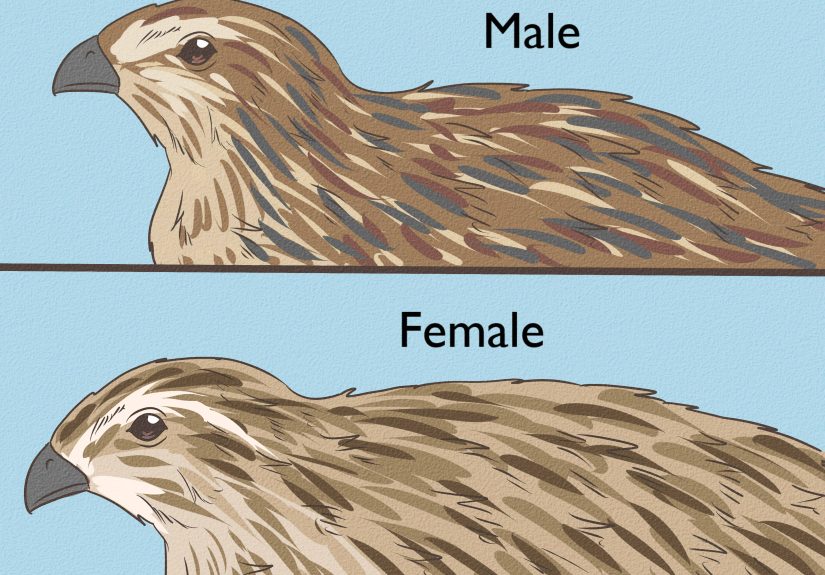
In many Coturnix (Japanese quail) lines, adult males develop a more solid, rusty/cinnamon throat and breast,
while females often show lighter areas with speckling/stippling on the breast. In some wild quail species,
males get bolder head patterns while females stay more muted and camouflaged.
Step-by-step feather check
-
Confirm the species (or at least the “type”).
Coturnix, bobwhite, California quail, Gambel’s quail, and button/king quail can all have different rules. -
Wait for meaningful feather development.
Juveniles are like teenagers: constantly changing and not always honest about who they are yet. -
Check the key zones:
- Throat and breast: solid color vs speckles (common in Coturnix wild-type).
- Face mask / eyebrow stripes: bolder contrasts often signal male in some species.
- Crests/topknots: sometimes longer or more dramatic in males (species-dependent).
- Compare multiple birds side-by-side. Differences pop more when you’re looking at “this one vs that one,” not “this one vs my hopes.”
Real examples you’ll actually run into
-
Coturnix (wild-type/pharaoh): males often show a more solid rusty breast; females often have speckled breast feathers.
(But some color varieties are not feather-sexable.) - Northern bobwhite: males often show stronger black-and-white head patterning; females tend to be buffier and less contrasting.
- California quail: both sexes have that iconic comma-shaped topknot, but it’s often longer in males; males also tend to show bolder facial/throat contrast.
When feather sexing lies to you
Feather sexing can fail when:
(1) the bird is too young,
(2) the species is not strongly dimorphic,
(3) you’re dealing with a color mutation that removes the usual “male vs female” pattern cues,
or (4) a bird has hormonal or health issues that change plumage presentation.
If your quail’s color variety is known for being tricky, don’t force feather sexingmove to vent sexing or DNA.
2) Vent Sexing: The Gold Standard for Many Coturnix Quail
If feather sexing is “reading the outfit,” vent sexing is “checking the paperwork.” It’s one of the most
reliable ways to determine sex in many Coturnix quail once they reach sexual maturity.
Mature males develop a noticeable cloacal/proctodeal gland structure near the vent; when gently pressed,
it may excrete a characteristic white, foamy substance during breeding condition.
Before you start: a safety pep talk
- Be gentle. Quail are not stress toys.
- Wash your hands before and after. Hygiene matters.
- Work quickly (under a minute per bird when practiced) to reduce stress.
- Don’t do this on very young chicks expecting reliable results.
- If your bird seems injured, swollen, bleeding, or distressed, stop and consult an experienced breeder or avian vet.
How to vent sex a quail (practical version)
- Hold the quail securely with its back in your palm, supporting the body. Keep wings tucked.
- Part the feathers around the vent so you can see the area clearly.
-
Look for structure:
- Male (common in Coturnix): a more pronounced, bulbous glandular area just above the vent opening when mature.
- Female: generally flatter appearance, lacking that prominent gland.
-
Foam check (only if mature): apply a very gentle pressure near the gland area.
In breeding-condition males, you may see a white, foamy secretion. No foam doesn’t always mean “female” if
the bird is not mature or not in breeding conditionbut foam is a very strong “male” clue in Coturnix. - Release and reward. Return the bird calmly; minimize chasing in the pen afterward.
Accuracy tips breeders swear by
-
Time it right: vent sexing is most reliable once birds are sexually mature. If you try too early,
you’ll mostly just learn what your quail’s opinion of you is (spoiler: not great). - Use a second method (plumage or behavior) for confirmationespecially in tricky color lines.
-
Band your birds once you’re confident (leg bands or temporary markers) so you don’t “re-discover”
the same bird three times like it’s a plot twist.
3) Vocalizations & Behavior: Listen for the Tiny Rooster Energy
Quail behavior can be surprisingly informative once hormones kick in. Males of many quail species develop
distinct calls (often a crowing or advertising call), and breeding behavior becomes… obvious. Think strutting,
chasing, mounting attempts, and a general attitude of “I am the main character.”
Behavior clues that often indicate a male
- Crowing/advertising call: repeated, patterned callsespecially around dawn/dusk or when females are present.
- Strutting and chest-puffing near other birds.
- Mounting attempts or persistent courtship behavior.
- Increased territorial aggression (species and housing dependent).
Behavior clues that often indicate a female
- Egg laying (we’ll cover that nextbecause it’s the ultimate “case closed”).
- Nesting behavior in appropriate environments (more relevant in naturalistic setups).
- Less frequent advertising calls in many species (but exceptions exist).
Why behavior is not foolproof
Behavior-based sexing is a “strong hint,” not a courtroom confession. Some females vocalize, some males are
quiet, and stress or overcrowding can scramble normal patterns. Also, if you keep only one or two birds,
they may not display typical breeding behavior at all. Use this method to support what you see in
plumage or the vent, not replace it.
4) Eggs or DNA Testing: The Two Ways Quail Can’t Argue With
When you need certaintybecause you’re building a breeding trio, selecting a show bird, or dealing with a
non-dimorphic speciesgo with confirmation methods. You’ve got two main options: wait for eggs, or run a DNA test.
One costs time. The other costs money. Both buy you peace.
Option A: Egg laying (definitive for females)
If your quail lays an egg, congratulations: you have a female. This is the most definitive method on Earth,
mostly because biology is pretty committed to its job description here. The downside is obviousyou must wait
until laying age, and some females won’t lay reliably under stress, poor lighting, nutritional deficits, or
seasonal conditions.
Option B: DNA sexing (definitive for any age)
DNA sexing is the “I’m done guessing” method. Labs typically determine sex using sex-linked genetic markers
(in birds, males are usually ZZ and females are ZW). For quail that don’t show clear plumage differencesor
when you’re working with pricey breeder stockDNA can be a smart investment.
How DNA sexing usually works (without turning your kitchen into a lab)
- Order a DNA sexing kit (or follow the lab’s collection instructions).
-
Collect a sampleoften freshly plucked feathers (with intact quills), a small blood spot,
or another approved sample type. (Down feathers usually won’t cut it because they may not contain enough usable DNA.) - Mail it in and wait for results.
- Use the result to plan housing/breeding with confidence.
If you’re managing multiple birds, DNA sexing can also prevent “accidental bachelor apartments” (too many males)
or “why won’t my eggs hatch?” situations (too few malesor a male you mis-sexed as a female because he’s polite).
Pro Tips: Make Any Method More Accurate
1) Know what kind of quail you have
“Quail” is a big umbrella. Coturnix are common backyard birds. Bobwhite and California quail are often discussed
in wildlife contexts. Button/king quail are a different vibe altogether. Each has different sex cues.
2) Don’t rely on size alone
Yes, females are sometimes larger in certain lines, but weight is influenced by feed access, health, age, and
whether one bird is basically running a secret snack cartel. Use size only as a supporting clue.
3) Use a two-factor rule
If plumage says “male” and the vent says “male,” you’re probably done. If plumage says “female” but behavior says
“male,” pause and verify with vent sexing or DNA. Quail aren’t trying to trick you… they’re just being quail.
4) Reduce stress before you judge anything
Stress can change calling patterns, suppress laying, and make handling harder. Calm birds give you better clues.
Solid nutrition, clean water, appropriate lighting, and enough space make sexing easier and your flock healthier.
Conclusion: The Smart Way to Sex Quail (Without Losing Your Mind)
Determining the sex of a quail isn’t one single trickit’s a toolkit. Start with feather sexing if your species
and color variety make that reliable. Confirm with vent sexing once birds are mature, especially for Coturnix.
Use behavior as a supporting clue, not a final verdict. And when you need absolute certainty, let eggs or DNA
testing deliver the mic-drop moment.
If you take only one lesson from this: use two methods. Quail are tiny, but the consequences of
a wrong guess can be loud (too many males) or disappointing (no fertile eggs). Two methods = fewer surprises,
better planning, and a much calmer you.
Experience Notes: of “Ask Me How I Know” Quail Sexing Lessons
The first time I tried to sex quail, I was armed with confidence, a vague memory of a chart I’d seen online,
and the kind of optimism usually reserved for people who buy white couches while owning toddlers. I had a small
group of Coturnix, and I told myself, “This will be easy. I’ll just look at their breasts.” Reader, it was not easy.
My first mistake was assuming every quail follows the same fashion rules. One bird had a nicely colored chest
and I declared, loudly and incorrectly, “Male!” Two weeks later it laid an egg like it had been waiting for the
dramatic reveal. That was the moment I learned the difference between “a helpful guideline” and “a universal law.”
Plumage works beautifully for some Coturnix varietiesand then a color mutation shows up and laughs in your face.
My second mistake was relying on behavior too early. I heard chirping, saw a little chasing, and assumed I had
a rowdy male. Turns out quail can be expressive teenagers before they become expressive adults. The “suspected male”
calmed down, the “quiet one” started calling like it was auditioning for a tiny bird opera, and suddenly my whole
narrative flipped. Behavior became much more useful once the birds were older, settled, and not stressed by constant
changes in housing and pecking order.
Vent sexing was the skill that finally made everything clickafter I got over the initial awkwardness of thinking,
“I can’t believe this is my hobby now.” The key was going slow, being gentle, and practicing on a calm day when I
wasn’t rushed. The first time I saw the classic foamy secretion from a mature male, it was like a neon sign:
“HELLO, I AM A BOY.” (Quail are subtle until they’re not.) The other big lesson: if you try vent sexing too early,
you’ll get uncertain results and a lot of judgmental quail eye contact. Waiting until maturity saved me time and
prevented me from “re-sexing” the same birds every week like I was stuck in a sitcom.
The biggest quality-of-life upgrade I made was tracking. I started using simple leg bands and a notebook:
bird color/markings, my best guess, the method used (plumage, vent, behavior), and the date. That way I wasn’t
relying on memorybecause memory is a liar when you’re staring at five nearly identical birds under a heat lamp.
And when I did need absolute certainty for a breeding plan, DNA testing was the calm, boring, wonderful finale:
no guessing, no second-guessing, just a clear result that let me set up the right ratios and stop playing quail roulette.
If you’re new to this, here’s my honest advice: don’t rush, don’t bet everything on one clue, and don’t take it
personally if a quail makes you feel wrong. They’re not judging you. They’re just… aggressively confident pigeons
in game-bird form.