Table of Contents >> Show >> Hide
- The Big Idea: Circles Aren’t One BehaviorThey’re a Whole Vocabulary
- When Circling Is Normal (and Kind of Genius)
- 1) Circling to Herd Dinner: The Ocean’s Version of “Group Project,” But Useful
- 2) The “Bait Ball” Problem: Prey Fish Circle Because Panic Has Physics
- 3) Circling as Courtship: “Hi, I’m Here, Please Notice My Excellent Swimming”
- 4) Navigation and Orientation: Making a Circle to Get a Better Read
- 5) Currents, Eddies, and “Lazy Swimming”: Sometimes the Water Makes the Circle
- When Circling Is a Warning Sign (and What Might Be Causing It)
- How to Tell the Difference: “Strategic Circles” vs. “Something’s Wrong”
- What You Should Do If You See a Wild Animal Circling
- Quick FAQs People Ask After Watching One Too Many Ocean Videos
- 500 More Words of “This Is What It Looks Like in Real Life” Experiences
- Experience #1: The “Ring of Bubbles” That Looks Like Ocean Magic
- Experience #2: A Dolphin Draws a Circle on the Seafloor Like a Chalk Artist
- Experience #3: A Spinning Cloud of Sardines That Turns Into a Feeding Frenzy
- Experience #4: A Beach Scene That Feels “Off”
- Experience #5: The Researcher’s PerspectiveCircles You’d Never Notice Without Sensors
- Experience #6: The “Captivity Loop” That Looks Like a Metronome
- Conclusion: Circles Can Be Brilliant, Boring, or BadSo Read the Context
If you’ve ever watched a video of a shark, turtle, dolphin, or fish doing laps like it’s training for the “Olympics of Confusion,” you’re not alone.
Circling is one of those ocean behaviors that looks weirdly humanlike your friend pacing in the kitchen while “thinking.” The twist? In the sea,
circles can mean anything from “Dinner time!” to “I’m lost,” to “Something’s wrong.”
The good news is that marine animals aren’t randomly auditioning for a role as a living compass. The better news is that once you know the common
reasons, you can usually tell whether the circles are smart, social, strategic… or a genuine red flag.
The Big Idea: Circles Aren’t One BehaviorThey’re a Whole Vocabulary
“Swimming in circles” is a human label for a bunch of different patterns: tight loops, wide arcs, spirals, milling schools, orbiting a target, or
circling while changing depth. Animals circle for at least four broad reasons:
- Foraging and hunting: corralling prey, coordinating attacks, or confusing fish into making mistakes.
- Navigation and “checking the map”: sampling cues like currents, landmarks, or even Earth’s magnetic field.
- Social behavior: play, courtship, bonding, or group coordination.
- Stress or illness: toxins, injury, parasites, low oxygen, neurological problems, or captivity-related stereotypic behavior.
When Circling Is Normal (and Kind of Genius)
1) Circling to Herd Dinner: The Ocean’s Version of “Group Project,” But Useful
Many marine hunters use circles the way humans use fences: to keep prey from escaping. Instead of wooden posts, they use bodies, bubbles, mud, and
coordinated movement.
Humpback whales are famous for “bubble-net feeding,” where whales create rings or curtains of bubbles to corral schooling fish into a
tighter clusterbasically turning chaos into a buffet line. Some whales then lunge upward through the ring to gulp fish and water, filtering the water
out afterward. If you see wide circles paired with bubbles and a sudden upward surge, that’s not confusionthat’s choreography.
Bottlenose dolphins can do something equally dramatic in shallow, sandy areas: “mud-ring feeding.” One dolphin swims fast in a circle,
stirring up sediment into a cloudy ring that traps or disorients fish. The fish often panic and jump, and the dolphins pick them off. In videos, it can
look like a dolphin is “stuck” in circlesuntil you notice the mud plume and the fish launching like popcorn.
2) The “Bait Ball” Problem: Prey Fish Circle Because Panic Has Physics
Sometimes the animal swimming in circles isn’t the predatorit’s the prey. When small fish are threatened, they can tighten into dense, rotating groups.
This can reduce the chance any one fish gets singled out (there’s safety in numbers), confuse predators, and create a moving “wall” of flashing bodies.
In extreme cases, schools compress into bait ballstight, swirling clusters that attract a parade of predators: tuna, sharks, dolphins, seabirds, and
whales. The result can look like a living tornado. If you see many fish circling together, especially near the surface with predators nearby, that’s
often defensive group behavior, not illness.
3) Circling as Courtship: “Hi, I’m Here, Please Notice My Excellent Swimming”
The ocean doesn’t have dating apps, so animals use movement. Circling can be part of courtshipapproaching, displaying, or positioning. In some tagged
shark observations, circling shows up during interactions that look like mating behavior: a male looping around a female, adjusting distance and angle.
Courtship circling often looks deliberate: repeated arcs around another animal, consistent speed, and purposeful spacingmore “dance” than “drunk
Roomba.”
4) Navigation and Orientation: Making a Circle to Get a Better Read
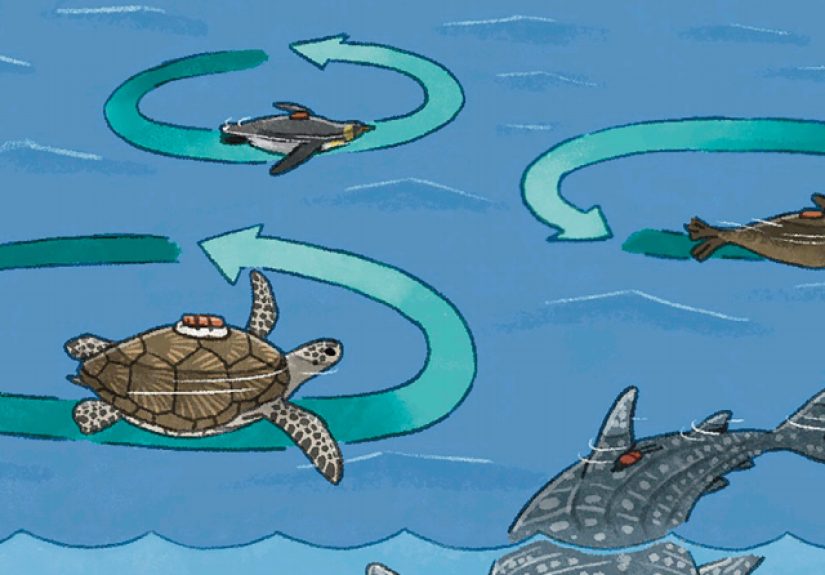
This one surprises people: circling can help animals orient themselves. Researchers using biologging (tiny sensors attached to animals that record
movement) have found circling across many speciesturtles, penguins, sharks, whales, and seals. The circles aren’t always tied directly to feeding,
which raises an intriguing possibility: sometimes animals loop to “sample” directional cues.
Imagine trying to figure out which way you’re facing while standing in fog. Turning slowly helps you compare what you sense from multiple directions.
Some scientists suggest that circling could help animals reduce “noise” and read the geomagnetic field or other navigation cues more accurately, kind of
like how certain instruments are calibrated by turning through different headings.
5) Currents, Eddies, and “Lazy Swimming”: Sometimes the Water Makes the Circle
Not every circle comes from an animal’s internal decision-making. The ocean is a moving conveyor belt of currents, eddies, and swirling water masses.
Animals may circle while:
- Holding position in a current (like walking on a treadmill so you stay in one place).
- Riding an eddy (a rotating patch of water) to conserve energy.
- Searching in a localized area where food cues (smell, sound, or visual prey) are strongest.
In these cases, the circles are usually wider, smoother, and not franticmore “patrolling” than “spiraling.”
When Circling Is a Warning Sign (and What Might Be Causing It)
Here’s the uncomfortable truth: tight, repetitive circling can sometimes signal neurological trouble. The key is contextespecially whether the animal
looks coordinated, responsive, and goal-directed.
1) Neurotoxins and Harmful Algal Blooms: When the Food Web Turns Into a Trap
Some harmful algal blooms produce toxins that can affect the nervous system. Fish may become disoriented, lose balance, or show abnormal swimming
patternsincluding spinning or circling. Marine mammals can also be affected indirectly when toxins accumulate in prey fish and then move up the food
chain.
For example, domoic acid (a toxin produced by certain algae) has been linked to strandings and unusual behavior in marine mammals, including disorientation
and abnormal swimming. When these events happen, responders may observe animals behaving strangely near shoreincluding repetitive movement patterns that
don’t look purposeful.
In Florida, researchers and wildlife agencies have investigated episodes where fish appeared to spin in circles before dying. Suspected contributors
include toxin exposure (including toxins associated with certain dinoflagellates), along with environmental stressors that can worsen the situation.
The common thread is neuro-disruption: when the brain’s “steering system” gets scrambled, straight-line swimming is one of the first things to fail.
2) Low Oxygen, Heat Stress, or Pollution: The Ocean’s “Bad Air Day”
Low dissolved oxygen (hypoxia), unusually warm water, and some pollutants can push fish and other animals into physiological stress. When gills and blood
chemistry are compromised, animals may become lethargic or disorientedsometimes circling near the surface or in shallow water.
This type of circling often comes with other clues: gulping at the surface, slow responses, drifting, or congregating in unusual places (like channels
where oxygen is slightly better).
3) Injury, Parasites, or Neurological Problems: When Balance Systems Go Off-Line
Many animals rely on finely tuned balance and sensory systems. Damage to nerves, inner-ear structures (in species that have them), or sensory organs can
produce looping and spiraling. Parasites can also affect tissues and behavior in some fish, and infections or inflammation can disrupt normal motor
control.
In aquarium or captive settings, a common non-marine example is swim bladder dysfunction in fishwhen buoyancy and balance are thrown off. While wild marine
fish have different pressures and conditions than a home tank, the principle transfers: when balance and orientation are compromised, straight swimming is
hard, and circles happen.
4) Captivity and Stress: “Stereotypic” Circling That Doesn’t Have a Goal
In zoos, aquariums, and marine parks, repetitive looping can sometimes be a stereotypyan abnormal, repetitive behavior that may show up in environments
that don’t meet an animal’s behavioral needs (space, complexity, stimulation, social structure).
Not every circle in captivity means poor welfareanimals can circle during play and training too. But when circling is frequent, rigid, and
“same-speed-same-route” for long periods, researchers often consider it a potential welfare indicator worth investigating (alongside other measures like
health, social behavior, appetite, and behavioral diversity).
How to Tell the Difference: “Strategic Circles” vs. “Something’s Wrong”
You don’t need a PhD or a submarine to make a decent guess. Use a simple checklist:
Green flags (more likely normal)
- Context makes sense: circling happens near prey, during group hunting, or in obvious social interaction.
- Movement is coordinated: smooth turns, stable depth control, consistent speed, no “listing” or wobbling.
- There’s a goal: mud plume, bubble ring, bait ball, or clear pursuit/positioning.
Red flags (more likely distress or illness)
- Tight, frantic loops with no obvious purpose, especially near shore or at the surface.
- Loss of balance: rolling, drifting sideways, inability to maintain depth, bumping into objects.
- Unusual location: an ocean-going species stuck in very shallow water, or lingering near beaches.
- Other symptoms: lethargy, labored breathing, abnormal posture, repeated stranding attempts.
What You Should Do If You See a Wild Animal Circling
If you suspect distress, the best help is often not hands-on. Keep your distance (for your safety and theirs), avoid chasing the animal for a
better video, and contact local wildlife authorities or stranding networks. In the U.S., NOAA and regional stranding responders can advise what to do.
If the circling looks like normal feeding behavior (bubble nets, mud rings, bait balls), enjoy the showrespectfully. The ocean doesn’t need you to jump
in and “fix” it. It needs you not to become an extra problem in the frame.
Quick FAQs People Ask After Watching One Too Many Ocean Videos
Do sharks circle before attacking?
Sometimes sharks circle out of curiosity, to get a better sensory read, or to maintain position relative to currents or a potential food source. But
“circling = attack” is a movie trope. Real behavior depends on species, situation, and context.
Why do dolphins circle people or boats?
Dolphins may circle while playing in a boat wake, investigating something novel, or coordinating with each other. If the circling is fast and repetitive
in a captive setting, it may also reflect stress or habit. Context matters.
Is circling always bad?
Not at all. In many cases, circling is a highly effective tool: hunting strategy, defensive schooling, navigation sampling, or social coordination.
It’s “bad” mainly when it comes with disorientation, loss of control, or abnormal persistence without a clear purpose.
500 More Words of “This Is What It Looks Like in Real Life” Experiences
To really understand circling, it helps to picture the scenes where people most often notice it. Here are a few real-world-style momentsthings
whale-watchers, snorkelers, coastal residents, and researchers commonly describeplus what’s likely happening underneath the surface.
Experience #1: The “Ring of Bubbles” That Looks Like Ocean Magic
You’re on a whale-watching boat and someone yells, “Bubbles!” At first you see a faint circle of foam, like the ocean just exhaled. Then it tightens.
Seabirds show up instantlybecause seabirds are basically the world’s fastest notification system. A second later, the surface erupts as humpbacks lunge
through the middle with open mouths. From above, it looks like the whales are doing a giant synchronized swirl for fun. What’s actually happening is a
cooperative feeding technique: the whales use a circular bubble net to corral fish into a dense patch, then time their lunges to maximize payoff.
The “circling” is the setup, not the main event.
Experience #2: A Dolphin Draws a Circle on the Seafloor Like a Chalk Artist
In shallow coastal water, people sometimes notice a dolphin moving fast in a tight loop, kicking up sand until a brownish ring blooms outward. It can
look like the dolphin suddenly forgot how to swim straight. Then the trick reveals itself: small fish start popping out of the water as if the ocean is
boiling. That’s mud-ring feeding. The dolphin’s circle creates a temporary “mud fence” that traps or disorients fish. The fish do what panicked fish do:
they boltoften upwardmaking them easier targets. If you spot a tight dolphin circle plus a growing mud plume, you’re watching a clever hunting method,
not an emergency.
Experience #3: A Spinning Cloud of Sardines That Turns Into a Feeding Frenzy
Divers and snorkelers sometimes describe a “living storm” of fishsardines, anchovies, or mackerelswirling in a dense rotating mass while predators
slash through the edges. The fish aren’t circling because they’re sick. They’re circling because every individual is trying to get away from danger, and
the group’s physics creates a rotating, ball-like formation. That bait ball can be a last-ditch defense, but it also becomes a beacon that draws in more
predators. When you see circular schooling in a tight cluster with predators nearby, the circles are a collective survival moveeven if it’s a stressful
one.
Experience #4: A Beach Scene That Feels “Off”
Coastal residents sometimes report animals behaving strangely near shore: fish drifting oddly, circling in shallow water, or swimming as if they can’t
steer. In marine mammals, responders have documented disoriented behavior during certain toxin events, including animals lingering near the surf zone
when they normally wouldn’t. This is the kind of circling that looks less like strategy and more like a malfunctioning control system. It’s not always
easy to diagnose from a phone video, but the warning signs tend to stack up: tight repetitive loops, poor coordination, and an animal staying in an
unusual place for too long.
Experience #5: The Researcher’s PerspectiveCircles You’d Never Notice Without Sensors
Some circling is so subtle or underwater that you’d miss it entirely without biologging tags. Scientists attach sensors that record 3D movement, depth,
and sometimes magnetic data. Later, the tracks show loops and spirals across many speciessometimes during feeding, sometimes during transit, and sometimes
in situations that don’t scream “food.” That’s part of why circling is such a fascinating topic: it’s not just a quirky behavior you occasionally see.
It may be a common tool marine animals use to gather informationabout prey, partners, currents, or directionwhile living in an environment where “left”
and “right” aren’t painted on the road.
Experience #6: The “Captivity Loop” That Looks Like a Metronome
In tanks and pools, visitors may see an animal repeating the same route again and againturn, glide, turn, glidelike it’s tracing a racetrack no one
asked for. Sometimes that’s a temporary pattern (anticipation before feeding, a short burst of play, a training routine). But when it’s long-lasting and
rigid, it can resemble stereotypic behavior described by welfare researchers in some captive settings. The important point isn’t to jump to conclusions
from one glance; it’s to recognize that persistent, functionless circling can be a meaningful signal in animal welfare scienceone that facilities
monitor alongside health data and enrichment programs.
Conclusion: Circles Can Be Brilliant, Boring, or BadSo Read the Context
Marine animals swim in circles for reasons that range from “highly intelligent hunting strategy” to “group defense under pressure” to “I’m sampling
navigation cues” to “something is seriously wrong.” The same shape can mean different things depending on speed, coordination, surroundings, and whether
other clues appear (bubbles, mud plumes, prey schools, predators, or signs of distress).
The simplest takeaway: circling is not automatically a problem. In the ocean, circles can be a toolsometimes a brilliant one. But when
circling is tight, frantic, uncoordinated, and out of place, it can be an early warning sign worth reporting to wildlife professionals.