Table of Contents >> Show >> Hide
- Why Soccer Speed Is Different From Track Speed
- How to Get Faster for Soccer: 11 Steps
- 1. Build a Dynamic Warm-Up You Never Skip
- 2. Master the First Three Steps
- 3. Improve Sprint Mechanics Without Overthinking Yourself Into a Statue
- 4. Train Short Sprints More Than Long Sprints
- 5. Add Flying Sprints for Top-End Speed
- 6. Get Stronger in the Lower Body
- 7. Use Plyometrics to Build Explosive Power
- 8. Train Deceleration Like It Is a Skill
- 9. Practice Change-of-Direction Drills That Look Like Soccer
- 10. Get Faster With the Ball at Your Feet
- 11. Recover Like Speed Actually Matters
- Sample Weekly Soccer Speed Training Plan
- Common Mistakes That Keep Soccer Players Slow
- Real-World Experiences: What Actually Makes Soccer Players Faster
- Conclusion
- SEO Tags
Speed in soccer is not just about winning a 40-yard dash in gym class while your friends pretend not to be impressed. Soccer speed is messier, sharper, and much more useful. It is the first three steps that get you to a loose ball. It is the quick cut that leaves a defender turning like a confused shopping cart. It is the recovery sprint that saves your team after everyone else has already started making excuses.
If you are searching for how to get faster for soccer, the good news is that speed can be trained. Genetics help, sure, but so do better sprint mechanics, stronger legs, smarter agility work, better recovery, and more intentional practice. The even better news: you do not need a professional training facility, laser timing gates, or a dramatic slow-motion video montage. You need a plan, consistency, and the humility to warm up properly before trying to become lightning in cleats.
This guide breaks soccer speed training into 11 practical steps. You will learn how to improve acceleration, top-end speed, change of direction, foot quickness, and game-speed decision-making without turning every workout into a punishment invented by a villain with a whistle.
Why Soccer Speed Is Different From Track Speed
A track sprinter runs in a straight line with a clear start and finish. A soccer player sprints, slows down, scans, turns, shields, reacts, jumps, lands, and sprints again while someone tries to steal the ball and occasionally clips a heel “by accident.” That means soccer speed includes several qualities working together:
- Acceleration: Your ability to explode over the first 5 to 20 yards.
- Maximum speed: Your fastest sprinting pace when you open up your stride.
- Agility: Your ability to change direction under control.
- Quickness: Your reaction speed and first-step sharpness.
- Deceleration: Your ability to stop safely and re-accelerate.
- Speed with the ball: Running fast while keeping the ball close enough that it still belongs to you.
The best soccer players are rarely just fast in a straight line. They are fast at the right time, in the right direction, with the ball or without it. That is the kind of speed this article is built to develop.
How to Get Faster for Soccer: 11 Steps
1. Build a Dynamic Warm-Up You Never Skip
A great speed session starts before the sprinting begins. Cold muscles do not love sudden acceleration. They complain. Sometimes loudly. A dynamic warm-up raises your body temperature, wakes up your nervous system, improves mobility, and prepares your joints for sharp soccer movements.
Before soccer sprint drills, spend 10 to 15 minutes moving through exercises like light jogging, high knees, butt kicks, lateral shuffles, walking lunges, leg swings, skips, and controlled accelerations. Save long static stretching for after training or later in the day. Before sprinting, you want movement, rhythm, and readinessnot a hamstring that has been stretched into a sleepy noodle.
Example warm-up: Jog for 3 minutes, perform 10 walking lunges per leg, 10 leg swings each direction, 2 sets of high knees for 15 yards, 2 sets of lateral shuffles for 15 yards, and finish with three progressive sprints at 50%, 70%, and 85% effort.
2. Master the First Three Steps
In soccer, many important races are decided in the first three steps. Beating a defender to a through ball, closing down a midfielder, or exploding into space all depend on acceleration. To accelerate well, lean slightly forward from the ankles, drive your arms aggressively, push the ground away, and keep your first steps powerful rather than choppy.
Think of your body as a rocket, not a pogo stick. Your first steps should push backward into the ground so your body travels forward. Avoid standing straight up too early. If your chest pops up immediately, you lose power and become easier to catch.
Drill: Set two cones 10 yards apart. Start from different positions: standing, one knee down, side-on, or facing backward. Sprint 10 yards as explosively as possible. Rest 45 to 60 seconds between reps. Perform 6 to 10 total sprints.
3. Improve Sprint Mechanics Without Overthinking Yourself Into a Statue
Good sprint mechanics make you faster and more efficient. The basics are simple: drive your knees, swing your arms from cheek to hip, keep your shoulders relaxed, and strike the ground underneath your body rather than far out in front. Overstriding acts like a brake. It is basically your foot saying, “What if we slowed down right now?”
Use short sprint technique drills to improve rhythm and posture. A-skips, wall drives, ankling drills, and marching drills can help you feel proper knee drive and foot placement. Keep technique work crisp and short. The goal is not to look fancy; the goal is to teach your body to sprint with less wasted motion.
Quick cue: Run tall, push hard, and keep your face relaxed. If your eyebrows are sprinting harder than your legs, loosen up.
4. Train Short Sprints More Than Long Sprints
Soccer has long runs, but most explosive plays happen over short distances. That is why soccer speed training should include many sprints between 5 and 30 yards. These distances train acceleration, reaction, and repeated explosive efforts without turning every workout into a track meet.
Try 5-yard bursts for first-step quickness, 10-yard sprints for acceleration, 20-yard sprints for building speed, and 30-yard sprints for opening your stride. Quality matters more than quantity. If your sprint speed drops badly, stop the set. Practicing slow sprinting is like practicing missed shotsit gets you very good at the wrong thing.
Sample session: 4 x 5 yards, 4 x 10 yards, 4 x 20 yards, and 2 x 30 yards. Rest 45 to 90 seconds between sprints, longer if you need it to stay explosive.
5. Add Flying Sprints for Top-End Speed
Acceleration gets you moving. Top-end speed helps you stay gone. Flying sprints train your fastest running mechanics without forcing you to blast from a dead stop every time.
Set up three zones: a 15-yard build-up, a 10- to 20-yard sprint zone, and a 10-yard slow-down area. Gradually accelerate through the build-up, hit your fastest controlled speed in the sprint zone, then slow down smoothly. Do not slam on the brakes like you just saw a parking ticket on your windshield.
Drill: Perform 4 to 6 flying sprints with full recovery. These are high-quality reps, not conditioning. Rest 90 seconds to 2 minutes between attempts.
6. Get Stronger in the Lower Body
Speed is not only about moving your feet quickly. It is about producing force into the ground. Stronger glutes, hamstrings, quads, calves, and core muscles help you accelerate, cut, hold off opponents, and stay powerful late in the match.
Soccer players do not need to train like powerlifters, but they should build strength with good form. Useful exercises include squats, split squats, lunges, Romanian deadlifts, hip thrusts, calf raises, step-ups, and sled pushes if available. Younger athletes should focus on bodyweight control first before adding heavy loads.
Beginner strength circuit: 3 rounds of 10 bodyweight squats, 8 reverse lunges per leg, 10 glute bridges, 12 calf raises, and a 30-second plank. As you improve, progress to loaded versions under proper supervision.
7. Use Plyometrics to Build Explosive Power
Plyometrics teach your muscles and tendons to produce force quickly. That is exactly what you need for sprint starts, jumps, cuts, and sudden changes of pace. The key is to land well. If your landing sounds like a refrigerator falling down stairs, reduce the intensity and clean up your technique.
Start with low-level plyometrics: pogo jumps, squat jumps, broad jumps, lateral bounds, and skipping variations. Focus on soft landings, knees tracking over toes, and quick ground contact. More advanced players can add box jumps, single-leg hops, and repeated bounds.
Simple power set: 3 sets of 5 broad jumps, 3 sets of 10 pogo jumps, and 3 sets of 5 lateral bounds each side. Rest enough to keep every rep sharp.
8. Train Deceleration Like It Is a Skill
Players love training acceleration because it feels exciting. Deceleration is less glamorous, but it is the secret sauce of real soccer agility. If you cannot stop under control, you cannot cut quickly. You just drift past the play like a dramatic background character.
To decelerate well, lower your hips, take shorter steps, keep your chest over your base, and avoid letting your knees collapse inward. Practice stopping from different speeds and directions. The goal is to absorb force safely, then re-accelerate.
Drill: Sprint 10 yards, stop within a 3-yard zone, hold your position for two seconds, then backpedal to the start. Perform 6 to 8 reps. Progress by adding a side shuffle or a second sprint after the stop.
9. Practice Change-of-Direction Drills That Look Like Soccer
Agility drills for soccer should not only be about memorizing cone patterns. Cone drills are useful, but soccer is reactive. You move because the ball, opponent, teammate, or space tells you to move. Build from planned drills to reactive drills.
Start with basic patterns like the 5-10-5 shuttle, T-drill, zig-zag cuts, and box drills. Then add a coach, partner, or visual signal. For example, your partner points left or right, drops a ball, or calls a color. You react and sprint. Suddenly, the drill becomes more like soccer and less like competitive traffic cone appreciation.
Reactive drill: Set three cones in a line, each 5 yards apart. Start at the middle cone. A partner calls “left” or “right.” Sprint to that cone, touch it, return through the middle, then sprint forward 10 yards.
10. Get Faster With the Ball at Your Feet
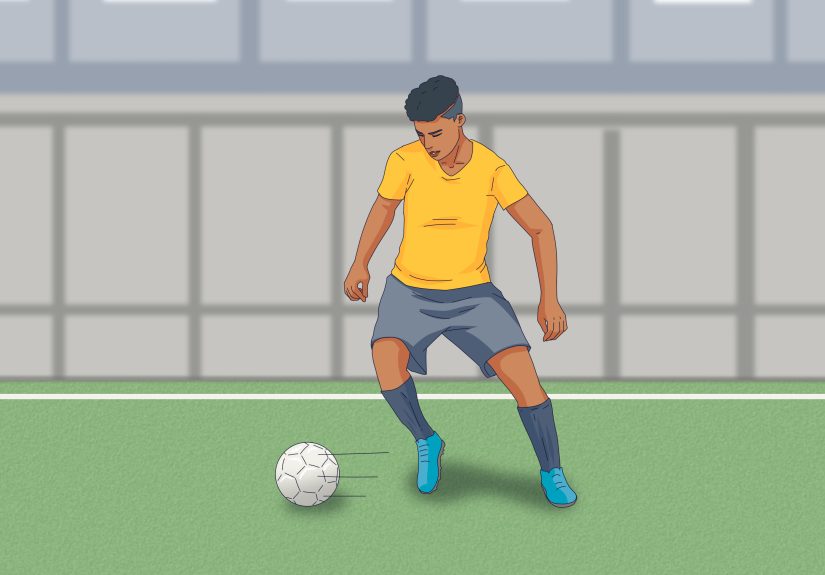
Pure speed helps, but soccer speed must eventually meet the ball. Many players sprint beautifully until the ball appears, then their touches become longer than a vacation email. To run faster with the ball, practice controlled touches at different speeds.
Use slightly bigger touches when sprinting into open space and smaller touches when defenders are near. Keep your head up as much as possible so you can scan the field. A fast player who never looks up is just delivering the ball quickly to someone else.
Drill: Set cones every 5 yards for 25 yards. Dribble at 60% speed to the first cone, 75% to the second, 90% to the third, then push the ball into space and sprint through the final cone. Repeat 6 to 8 times.
11. Recover Like Speed Actually Matters
Speed improves when your body adapts. Adaptation happens between training sessions, not while you are heroically dragging yourself through one more ugly sprint. Recovery is not laziness. Recovery is where your hamstrings send a thank-you card.
Sleep, hydration, nutrition, and rest days all affect speed. Eat enough carbohydrates to fuel hard sessions, include protein after training to support muscle repair, and drink fluids consistently throughout the day. If you train hard, play matches, and then stay up until 2 a.m. scrolling soccer highlights, do not be shocked when your legs feel like wet towels.
For most players, two dedicated speed sessions per week is enough, especially during the season. Place speed work early in practice when you are fresh. Save heavy conditioning for a different day or after technical work, depending on your coach’s plan.
Sample Weekly Soccer Speed Training Plan
Use this plan as a starting point. Adjust based on your age, training level, match schedule, and recovery. If you are injured or returning from injury, work with a qualified coach, athletic trainer, or medical professional.
Day 1: Acceleration and Strength
- Dynamic warm-up: 10 to 15 minutes
- 10-yard sprints: 8 reps
- 20-yard sprints: 4 reps
- Lower-body strength: squats, lunges, hip hinges, calf raises
- Cool-down: light jogging and static stretching
Day 2: Ball Work and Agility
- Dynamic warm-up: 10 minutes
- Zig-zag dribbling: 6 reps
- Reactive cone drill: 8 reps
- 1v1 small-space games: 10 to 15 minutes
- Cool-down and mobility
Day 3: Top Speed and Plyometrics
- Dynamic warm-up: 15 minutes
- Flying sprints: 5 reps
- Broad jumps: 3 sets of 5
- Lateral bounds: 3 sets of 5 per side
- Controlled deceleration drill: 6 reps
Common Mistakes That Keep Soccer Players Slow
Doing Too Much Conditioning and Not Enough Speed
Conditioning matters in soccer, but running endless laps does not automatically make you faster. To improve speed, you need high-quality explosive work with enough rest. Tired sprints train survival. Fresh sprints train speed.
Ignoring Strength Training
Some players avoid strength work because they fear getting “too bulky.” In reality, smart strength training helps you become more powerful, resilient, and harder to knock off the ball. You are not going to accidentally become a bodybuilder from split squats twice a week.
Only Practicing Ladder Drills
Agility ladders can improve coordination and foot rhythm, but they are not magic carpets to elite speed. Use them as a warm-up or quickness tool, not the entire program. Real soccer agility requires force, reaction, balance, and decision-making.
Skipping Recovery
If you sprint hard every day, your body will eventually file a complaint. Muscles, tendons, and joints need time to adapt. Better recovery means better sessions, fewer sloppy reps, and more consistent progress.
Real-World Experiences: What Actually Makes Soccer Players Faster
Here is the part most players learn the hard way: getting faster for soccer is rarely one dramatic breakthrough. It is usually a collection of small improvements that stack up over weeks and months. The player who warms up better, sprints with intention, lifts consistently, sleeps more, and practices game-speed touches often looks “naturally fast” by midseason. Very mysterious. Definitely not the result of doing the basics over and over.
One common experience is that players feel faster first in small moments, not full-field sprints. Maybe you reach a bouncing ball one step earlier. Maybe you close down a defender before they can lift their head. Maybe your first touch into space suddenly feels more aggressive. These little wins matter because soccer speed is measured in moments. You do not need to be the fastest person in the league to become faster in the situations that decide games.
Another real lesson: speed training feels different from conditioning. A good speed session should not leave you gasping on the ground after every rep. It should feel sharp, powerful, and focused. When players first learn this, they sometimes think they are not working hard enough because they are resting between sprints. But rest is what allows the next sprint to be truly fast. If every rep becomes slower, the workout has changed from speed training into fatigue practice. Fatigue practice has its place, but it will not build the same explosive first step.
Players also discover that strength work improves confidence. A stronger lower body helps you push off harder, land better, and hold your line when shoulder-to-shoulder contact happens. This is especially noticeable for wingers, fullbacks, and central midfielders who constantly accelerate, cut, and absorb contact. After several weeks of lunges, split squats, hip hinges, and core work, many players feel more stable before they even feel faster. Stability is underrated. You cannot be quick if you are constantly fighting your own balance.
Ball speed is another eye-opener. Some players improve their sprint times but still lose the ball when they dribble at pace. The fix is not to slow down forever; it is to practice different touch sizes. In open grass, take a bigger touch and sprint onto it. In traffic, shorten your stride and keep the ball closer. Great players change gears with the ball. They do not use the same dribble speed in every situation like a video game character stuck on one setting.
Finally, the biggest experience-based truth is that faster soccer players become better readers of the game. When you anticipate the pass, your body starts earlier. When your body starts earlier, you look faster. Watch quick players closely and you will notice they are not always reacting after everyone else. They are scanning, guessing, adjusting, and moving before the race officially begins. Train your eyes, not just your legs. The fastest sprint is the one you start at the right time.
Conclusion
Learning how to get faster for soccer is about more than sprinting harder. It is about training the full speed system: warm-up quality, acceleration, sprint mechanics, lower-body strength, plyometrics, deceleration, agility, reaction, ball control, and recovery. When those pieces work together, you become the player who arrives first, changes direction cleanly, and still has enough speed left late in the match to make something happen.
Start simple. Warm up well. Sprint short distances with full effort. Strength train two or three times per week. Add plyometrics carefully. Practice agility with real reactions. Dribble at speed. Sleep like you actually want your legs to cooperate tomorrow. Do that consistently, and you will not just feel fasteryou will play faster.