Table of Contents >> Show >> Hide
- What Was Opportunity, Exactly?
- Why Opportunity Mattered So Much
- How Opportunity Survived So Long
- What Killed Opportunity?
- Why the World Cared So Much
- The Final Panorama and a Fitting Goodbye
- Opportunity’s Legacy in Mars Exploration
- Conclusion
- Extended Reflections: The Human Experience of Losing Opportunity
- SEO Tags
Some machines retire quietly. Opportunity did not. NASA’s beloved Mars rover went from being a 90-sol science mission to becoming the robotic equivalent of that one marathon runner who casually finishes the race, grabs a banana, and asks what’s next. For nearly 15 years, Opportunity rolled across the Red Planet, survived dust, dodged disaster, outlasted expectations, and turned a modest rover mission into one of the most charming success stories in space exploration.
Then Mars did what Mars does best: it got dramatic. A planet-wide dust storm blotted out the sunlight that powered Opportunity’s solar panels in June 2018. The rover fell silent. Engineers kept calling. Opportunity never answered. On February 13, 2019, NASA officially declared the mission complete.
So yes, the Mars Opportunity rover is dead. But “dead” is a little too small a word for a machine that transformed what humans know about Mars, rewrote expectations for robotic exploration, and somehow made millions of people emotional about a six-wheeled robot the size of a golf cart. Opportunity may be silent, but its legacy is loud.
What Was Opportunity, Exactly?
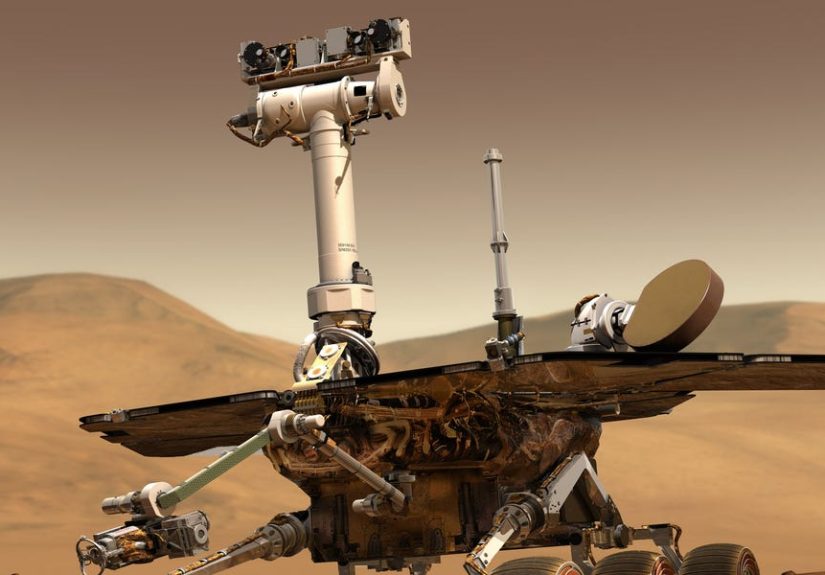
Opportunity was one of NASA’s twin Mars Exploration Rovers, launched in 2003 alongside its sibling, Spirit. The mission goal sounded straightforward enough: land on Mars, explore the terrain, study rocks and soil, and find out whether liquid water once existed there. That last part mattered because where there was water, there may once have been conditions suitable for life.
Opportunity landed in Meridiani Planum in January 2004. The rover was designed to last about 90 Martian days. Instead, it kept going for almost 15 years. That is not merely “better than expected.” That is engineering showing off.
The rover traveled more than 28 miles across the Martian surface, setting a distance record for off-Earth driving that stood as a symbol of its endurance and clever mission planning. It explored craters, examined outcrops, studied strange little mineral spheres nicknamed “blueberries,” and sent home a steady stream of images that made Mars feel less like an abstract red dot and more like a place.
Why Opportunity Mattered So Much
If you only know one thing about Opportunity, make it this: the rover helped confirm that ancient Mars was once wet. Not splash-a-little-water-on-a-rock wet. We’re talking about persuasive geological evidence that water once altered the Martian landscape in meaningful, long-lasting ways.
Early in its mission, Opportunity found hematite-rich spherules embedded in rock outcrops. These tiny spheres became famous as the rover’s “blueberries.” They were more than just oddly photogenic Martian pebbles. Their chemistry and context strongly suggested they formed in the presence of water. For scientists chasing clues about ancient Mars, that was a big deal.
Later, Opportunity found gypsum veins and clay minerals near Endeavour Crater. That mattered because these minerals pointed to water that was not just present, but at times less acidic and potentially more favorable to ancient microbial life. In other words, Opportunity did not simply help prove that Mars was once wet. It helped sharpen the much more interesting question: What kind of wet was it?
From “Water Was Here” to “Could Life Have Been Here?”
This is where the rover’s scientific legacy gets especially important. Mars missions are often framed as treasure hunts for little green microbes, but real science is rarely that dramatic. It works step by step. Opportunity’s job was to gather environmental evidence, and it did that beautifully. By showing that water interacted with Martian rocks and by identifying more habitable ancient environments, the rover helped lay the groundwork for future missions focused more directly on habitability and biosignatures.
That means Opportunity helped build the bridge between old-school planetary geology and the modern search for ancient life on Mars. It was not the rover that answered every big question. It was the rover that made better questions possible.
How Opportunity Survived So Long
At some point, Opportunity stopped being a mission and started being a legend. Engineers designed it well, of course, but a lot of its longevity came from a mix of careful operations, favorable conditions, and a little cosmic luck.
The rover was solar-powered, which meant it lived and died by sunlight. Dust gathering on its panels could have ended the mission far earlier. But Mars occasionally offered a weird little gift: wind gusts that cleaned the panels, the famous “cleaning events” that gave the rover fresh life. On Earth, dust is a housekeeping problem. On Mars, it was basically the plot twist of every season finale.
Opportunity also benefited from patient driving strategies and disciplined science planning. It did not sprint recklessly across Mars. It worked methodically, one target at a time, collecting high-value science while staying alive far beyond its warranty period. The result was a mission that exceeded its planned lifetime by more than 50 times.
What Killed Opportunity?
In June 2018, a massive dust storm grew into a planet-encircling event. This was not your average windy afternoon. The storm thickened the atmosphere with so much dust that sunlight at Opportunity’s location dropped to dangerous levels. Because the rover relied on solar power, that was a nightmare scenario.
Before falling silent, Opportunity reported extremely low power conditions. Its final contact with Earth came on June 10, 2018, from a region called Perseverance Valley. Then communication stopped.
NASA did not give up quickly. Engineers spent months sending commands and listening for a response. More than a thousand recovery attempts were made. There was hope that seasonal winds might clear the dust off the solar panels, just as they had in the past. But the rover never woke up.
Eventually, NASA had to do the painfully human thing that often follows even the most brilliant scientific effort: accept that the mission was over.
The “My Battery Is Low” Line
If you followed the story online, you probably saw the viral line, “My battery is low and it’s getting dark.” It spread everywhere because it sounded heartbreakingly perfect, like a robot-written farewell poem from another world.
But the line was not a literal final message transmitted in plain English by the rover. It was a poetic interpretation of the rover’s last reported status. That distinction matters. Opportunity did not deliver a movie-script goodbye. Reality was more technical and less tidy. Yet the public reaction to that line revealed something important: people had become deeply attached to this machine.
Why the World Cared So Much
Robots are not supposed to make people emotional. Opportunity did anyway.
Part of that came from the mission’s length. Opportunity stayed in our lives for so long that it stopped feeling like a temporary experiment and started feeling like a reliable little explorer, always out there doing its job. Part of it came from the rover’s underdog story. It was built for a short mission, then kept surviving. Every extra month felt like a bonus. Every extra year felt absurdly heroic.
And part of it came from the way Mars exploration naturally invites human projection. We saw Opportunity’s tracks. We saw the panoramas. We saw a machine patiently climbing crater rims, examining rocks, and surviving storms alone on a cold world millions of miles away. It became easy to describe the rover in human terms: persistent, brave, stubborn, maybe even a little scrappy.
Scientists knew it was a robot. The public knew it was a robot. Nobody cared. Oppy, as many affectionately called it, had personality anyway.
The Final Panorama and a Fitting Goodbye
After the mission ended, NASA released Opportunity’s final panorama, a sweeping 360-degree view assembled from 354 images taken in the rover’s last weeks. It showed the terrain around Perseverance Valley, the place where the rover made its final stand. The image felt less like raw data and more like a quiet curtain call.
That final panorama captured the strange emotional power of the Opportunity mission. It was scientific documentation, yes. It was also the last chapter of a story people had followed for years. The view showed rocky ground, distant terrain, rover tracks, and a landscape so stark and ancient that it almost looked fictional. Except it was real. Opportunity had been there. Opportunity had seen it.
Opportunity’s Legacy in Mars Exploration
Opportunity’s death did not end its influence. Quite the opposite. Its work shaped how NASA and the broader scientific community think about Mars exploration. The rover helped establish ancient water as a central theme in understanding the Red Planet. It expanded confidence in long-duration rover operations. And it built public excitement for the missions that followed, including Curiosity and Perseverance.
In a bigger sense, Opportunity also reminded space agencies that durability matters, flexibility matters, and public storytelling matters. Great missions do science, but unforgettable missions do something else too: they create a relationship between discovery and imagination.
Opportunity did that better than almost any robotic explorer in history. It made geology feel adventurous. It made remote sensing feel personal. It made Mars feel close.
Conclusion
Mars Opportunity rover is dead, but the mission did not end in failure. It ended in triumph, exhaustion, and the kind of quiet dignity reserved for explorers that went much farther than anyone expected. Opportunity arrived on Mars to spend 90 sols looking for evidence of water. It stayed nearly 15 years, drove more than 28 miles, changed planetary science, and gave humanity one of the great robotic adventures of the modern age.
There are flashier missions and newer machines. There are rovers with sharper instruments and bolder objectives. But Opportunity holds a special place in space history because it earned its legend one hard mile, one rock target, and one sunrise at a time.
Its wheels are still on Mars. Its tracks are still on Mars. Its signal is gone. Its impact is not.
Extended Reflections: The Human Experience of Losing Opportunity
There is a particular kind of sadness attached to the end of the Opportunity rover mission, and it is different from the sadness people feel when a gadget breaks or when a piece of software gets retired. Opportunity was not sitting in someone’s garage. It was not old tech headed for a recycling bin. It was a working explorer on another planet, doing science in a place no human being has ever stood. That fact gave its silence a strange emotional weight.
For many people, following Opportunity felt like checking in on a distant traveler. You would read updates, see a new panorama, hear about a rock outcrop with a nickname that sounded oddly friendly, and suddenly Mars felt less theoretical. It felt inhabited, at least a little, by human curiosity. Not by humans themselves, of course, but by our minds, our questions, our careful instruments, and our stubborn refusal to stop exploring just because the destination is absurdly far away.
That is why the end of Opportunity hit so hard. The rover represented persistence in a form people could actually watch unfold over time. It was not one dramatic moonwalk moment and then the credits rolled. It was year after year of quiet achievement. A climb here. A drilling target there. A winter survived. A dust cleaning event. A new crater rim. A surprising mineral clue. The mission taught the public how science really works when it is done well: patiently, repeatedly, and with a lot of determination.
There was also something deeply relatable about Opportunity’s final chapter. Engineers kept trying to call home to a machine that could no longer answer. That act alone made the mission feel personal. It echoed the universal human instinct to hold on a little longer, to try one more time, to hope that maybe the silence is temporary. NASA’s final attempts to restore contact were technical operations, but they also felt like something more intimate: an extended goodbye.
Teachers used Opportunity to make space science feel alive in classrooms. Parents shared rover photos with kids who had never known a world without Mars rovers. Amateur astronomy fans stepped outside at night, looked up at the reddish dot in the sky, and knew a little robot was sitting there in darkness. Even people who do not usually follow space news paused when the mission ended. Opportunity had crossed over from science coverage into culture.
That may be the mission’s most unusual achievement. Opportunity turned remote exploration into shared experience. It gave scientists valuable data, gave engineers a masterclass in resilience, and gave the public a story that felt both futuristic and deeply human. In the end, the rover did what the best exploration missions always do: it expanded knowledge, yes, but it also expanded feeling. It made more people care about a world they had never seen with their own eyes.
And maybe that is the most fitting tribute. Opportunity did not just survive on Mars. It invited millions of people to come along for the ride.