Table of Contents >> Show >> Hide
Hollywood loves to sell dreams. Sometimes it sells the wrong dream entirely.
Every actor, even the smart ones, occasionally winds up in a movie that makes audiences ask the same brutal question: How did they say yes to this? Sometimes the answer is simple. A fat paycheck. A bad instinct. A deep and sincere belief that maybe, just maybe, this talking-cat comedy will become the next Who Framed Roger Rabbit. Other times, though, the answer is messier. Scripts change. studios overpromise. rivals play mind games. contracts get weird. And once the cameras roll, the actor realizes they are no longer making the movie they thought they signed up for.
That is the sweet, chaotic heart of this story. Not every example here involves a mustache-twirling villain in a producer’s chair, but every one of them involves some form of bait-and-switch, pressure, deception, or strategic nonsense. In other words, classic Hollywood behavior. Some of these movies were critically mauled. Some were merely disappointing. One or two became legendary cautionary tales, the kind people bring up whenever someone says, “Trust the process.”
So let’s take a tour through six actors who didn’t just end up in weak movies. They ended up in movies they were nudged, cornered, or outright fooled into making. If nothing else, this list should make every awkward work email feel a little less stressful. At least your boss has probably never handed you a fake Storm-heavy script.
1. Bill Murray and Garfield
Bill Murray doing Garfield has always felt like a cosmic clerical error. This is the man from Groundhog Day, Lost in Translation, and Rushmore. He was not exactly known for sprinting toward broad, brand-extension cat content. And yet there he was, voicing America’s most famous lasagna enthusiast in a movie that landed with the grace of a hairball on a white sofa.
The explanation is almost too perfect. Murray later said he saw the name “Joel Cohen” on the script and thought it was Joel Coen, as in one-half of the Coen brothers. That is not a small misunderstanding. That is the difference between expecting sharp, eccentric brilliance and getting a family comedy that felt assembled from leftover studio conference notes and orange fur.
To be fair, Murray did not claim he blindly wandered into the recording booth wearing a blindfold and a trench coat. But the mistaken identity mattered. He has talked about trying to improve the material once he was involved, which is basically the artistic equivalent of realizing halfway through a road trip that your GPS has been taking you toward a swamp.
Garfield was not beloved by critics, and it quickly became one of those strange filmography footnotes that people treat like a pub trivia question. But what makes it memorable is not just that Murray made a dud. It is that he seems to have agreed to it while imagining a completely different creative universe. That is not choosing the wrong movie. That is boarding the wrong plane and only discovering it after the peanuts arrive.
2. Halle Berry and X-Men: The Last Stand
This entry comes with an important asterisk: the most explosive version of the story was told years later by director Matthew Vaughn, not by Halle Berry herself. Still, if Vaughn’s account is accurate, it is one of the most cynical examples of Hollywood bait ever described in public.
According to Vaughn, while he was attached to direct X-Men: The Last Stand, he discovered a special script created to lure Berry back. This version supposedly gave Storm a much bigger, more dramatic role, including a showcase sequence that made the character feel central instead of decorative. Then, Vaughn said, he was told the plan was to toss that version once Berry signed on. He quit the project rather than participate.
If that account is true, it was not just misleading. It was insultingly calculated. Berry had already helped make the franchise huge, and a Storm-focused storyline would have made both creative and commercial sense. Instead, The Last Stand became the overstuffed, emotionally rushed sequel that many fans still argue about today. It made money, sure, but it also became shorthand for a franchise losing its balance.
That is what makes this one sting. Berry did not merely end up in a weaker installment. She may have been sold a version of the movie that promised greater character depth and then received the superhero sequel equivalent of “Oops, never mind.” Even among studio shenanigans, that is a rough look. If an actor signs on because the script finally gives their character room to matter, and the studio already plans to shred that promise, that is not normal production chaos. That is marketing with extra steps.
3. Keanu Reeves and The Watcher
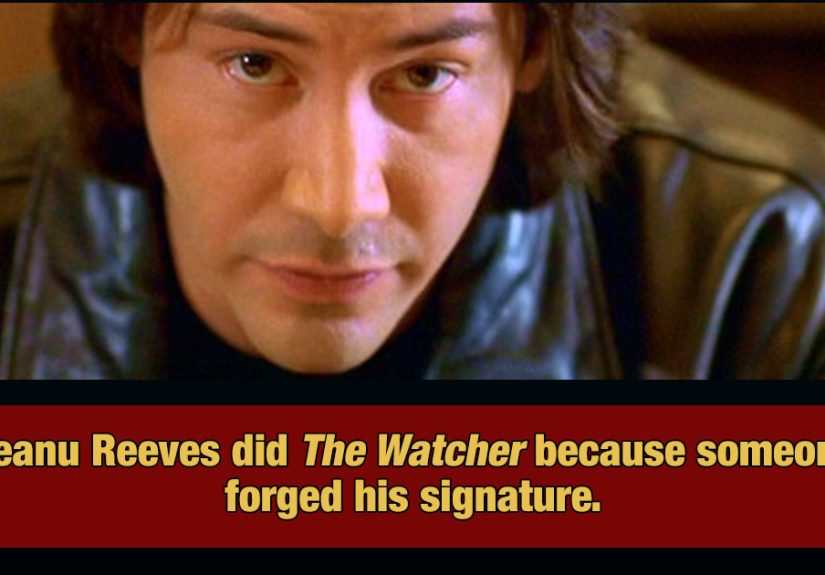
Keanu Reeves has one of the most beloved public reputations in modern Hollywood, which somehow makes the story behind The Watcher even grimier. Reeves later said he never found the script interesting and claimed a friend forged his signature on the agreement. Unable to prove it and unwilling to dive into a legal swamp, he ended up doing the movie anyway.
That is not a quirky misunderstanding. That is nightmare fuel.
The Watcher arrived and was met with a shrug at best and a wince at worst. Critics generally found it generic and underpowered, and even sympathetic reviewers treated it like a thriller assembled from parts scavenged off better thrillers. Reeves, cast as a serial killer, looked like a man performing community service for a crime he did not commit.
And honestly, maybe he was. The strange stiffness in the performance makes a lot more sense if you accept that he reportedly never wanted to be there in the first place. Audiences often assume bad acting means laziness or poor judgment, but sometimes it means the actor is trapped in a project that should have died in a lawyer’s office.
There is something almost tragicomic about the whole episode. Most actors have to survive bad press, bad edits, or bad scripts. Reeves had to survive an alleged forged commitment and then politely show up to promote the result. That is less “career misstep” and more “cinematic hostage situation with a press junket.”
4. Sylvester Stallone and Stop! Or My Mom Will Shoot
If Hollywood were a middle school with bigger budgets, this story would be the yearbook photo.
Sylvester Stallone has openly regretted Stop! Or My Mom Will Shoot, a movie whose title alone sounds like it lost a dare. The twist is that part of the reason he took it, by his own account and Arnold Schwarzenegger’s later confirmation, was because Arnold pretended to be interested in the script. The idea was simple and wonderfully evil: make Stallone think his biggest box-office rival wanted the project, and he might chase it out of competitive instinct.
Reader, it worked.
This is one of those stories so absurd it sounds fake until you remember that Stallone and Schwarzenegger were locked in a very real action-star rivalry for years. Arnold has said the prank was real. Stallone got the movie. Nobody got the dignity.
The finished film became one of the great punchlines of Stallone’s career, the kind of title people mention with affectionate horror. More importantly, it shows how even huge stars can make decisions for reasons that have nothing to do with the actual script. Competition, ego, momentum, fear of losing ground, those things can be more persuasive than dialogue or tone or the nagging internal voice screaming, “This is a disaster.”
In a way, this may be the purest example on the list. No fake paperwork. No editing-room massacre. Just one movie star essentially dangling a banana peel in front of another and waiting for gravity to do its work. Hollywood can be many things. Mature is rarely one of them.
5. Ryan Reynolds and X-Men Origins: Wolverine
Ryan Reynolds eventually became the perfect Deadpool, which is exactly why his first Deadpool outing feels like a bizarre prank pulled on both him and the audience.
Reynolds has spoken about X-Men Origins: Wolverine as a frustrating experience. He has said he was already attached to a proper Deadpool movie, but when Origins came along, the message was basically that he could play Deadpool in this movie or watch someone else do it. That is less a creative invitation and more a studio hostage note with comic-book branding.
Then came the writer’s strike complications, a not-fully-baked script, and eventually the now-infamous decision to turn the Merc with a Mouth into a mostly silent weapon with his mouth sewn shut. There are bad adaptations, and then there are adaptations so backward they feel like performance art. A character famous for nonstop chatter being literally sealed shut is the kind of idea that should have set off alarms in three states.
Reynolds later joked about it, mocked it, and effectively spent years undoing it. But that long redemption arc should not erase the original problem. He did not sign up because he thought that version of Deadpool was brilliant. He signed up because it was the only available doorway to a character he loved. What he got was a creatively compromised version stuck inside a film that many fans still treat like a mutant rights violation.
There is an almost inspirational layer to this story now, since Reynolds eventually turned the mess into motivation and helped launch a wildly successful standalone franchise. But at the time? It was a textbook case of an actor wanting the right role and being handed the wrong movie wearing the right nametag.
6. Jared Leto and Suicide Squad
This one deserves careful wording, because the strongest “tricked” claim did not come through a polished sit-down interview. It came through reports about comments Leto allegedly made to fans after Suicide Squad opened. According to those reports, he felt “sort of tricked” into being part of something that had been pitched differently from what ended up on-screen.
Even setting that quote aside, the broader frustration is well documented. Leto said many Joker scenes were cut. The Wrap and other outlets reported that enough material had been left on the cutting-room floor to fuel endless speculation about what version of the character he thought he was building. Director David Ayer also later spoke about the film being reshaped in post-production, arguing that the theatrical version did not represent what he originally made.
Now, to be fair, plenty of actors lose scenes. That happens all the time. But Suicide Squad was a special case because the marketing leaned hard on Leto’s Joker as a major attraction, while the final film used him more like an intermittent jump scare in purple leather. That gap between the movie sold and the movie delivered did not just frustrate fans. It appears to have frustrated one of the actors standing inside the billboard.
The final result was critically battered and tonally confused, bouncing between grim swagger and jukebox-trailer mayhem. Leto’s performance became part of that chaos rather than the centerpiece the publicity machine had teased. Whether you call that trickery, overpromising, or studio remix culture gone wild, it fits the larger pattern: an actor signs on for one version of a movie and meets a stranger in theaters.
What It Feels Like to Realize You’re in the Wrong Movie
Here is the part people forget: the truly painful moment is probably not opening weekend. It is the slow dawning horror that happens much earlier.
Imagine being an actor who has spent months, maybe years, deciding whether to say yes to a role. You weigh the script. You meet the director. You imagine the tone. You build a character in your head. Maybe you tell your family, “This one is going to be good.” Maybe you cancel other jobs for it. Maybe you train, travel, do fittings, memorize pages, and convince yourself the weird bits will make sense once the whole machine starts moving.
And then the machine starts moving, and suddenly the script is changing every week. Or the best scenes disappear. Or the director leaves. Or the studio note turns your sharp character into a marketing accessory. Or a rival actor has played a long con on your competitive ego. That is when panic probably sets in, not all at once, but in little stabs. A rewritten page here. A deleted monologue there. A trailer that makes the movie look nothing like the one you thought you were making.
There is also the weird loneliness of it. Actors cannot always say, “This is going terribly,” because they are still in it. They have to show up, hit marks, smile for set photos, and act like everything is normal while the floor quietly moves beneath them. Even if they know the film is sinking, professionalism requires them to keep rowing. That may be why so many stories like these come out years later, once the embarrassment has cooled into anecdote.
And yet these disasters are strangely humanizing. They remind us that famous people are still vulnerable to mixed signals, bad bosses, peer pressure, contract traps, and the occasional catastrophic misunderstanding involving a last name. They also remind us that movie stardom does not grant magical script-detection powers. Sometimes an Oscar winner gets handed a fake promise. Sometimes a beloved actor gets talked into a junk project because he thinks a Coen brother is involved. Sometimes a future superhero icon agrees to play a character with his mouth sewn shut and spends the next decade correcting the timeline.
So yes, these are stories about bad movies. But they are also stories about hope, ego, trust, and that universal workplace fear of realizing, much too late, that the job description was nonsense. The only difference is that when most of us take the wrong job, it does not get preserved forever on streaming platforms.
Final Take
The funniest thing about Hollywood is that it sells itself as a dream factory when it is clearly, at least part of the time, a confusion factory with better lighting. These six actors did not simply wake up one morning and say, “I would love to tarnish my filmography for sport.” They walked into situations shaped by misinformation, manipulation, pressure, or major creative drift.
Some recovered easily. Some turned the bad experience into a better career move later. Some are still attached to stories that fans bring up with a mix of pity and fascination. But all six prove the same point: talent does not protect anyone from a bad movie when the movie they agreed to is not the one that actually shows up.
In Hollywood, the script is sacred right up until somebody rewrites it, recuts it, buries it, or hands you a completely different one in a nicer binder.