Table of Contents >> Show >> Hide
- Why Realistic Wool Felt Pets Are Having a Moment
- What Makes a Wool Felt Pet Look Shockingly Real?
- 40 Wool Felt Pets So Realistic You Might Want To Do A Double Take
- Why People Fall Hard for Needle Felted Pet Portraits
- What New Makers Can Learn from These Lifelike Creations
- The Experience of Seeing Realistic Wool Felt Pets Up Close
- Conclusion
At first glance, they look like photos. Then you zoom in and realize the shiny nose, sleepy eyelids, fluffy ruff, and slightly dramatic side-eye were all built fiber by fiber by hand. That is the magic of realistic wool felt pets. In a craft world packed with cute DIY trends, needle felted pet portraits and tiny wool sculptures have carved out a very specific niche: they are adorable, impressive, a little uncanny, and wildly emotional all at once. One second you are admiring a handmade keepsake, and the next you are squinting at the screen like, “Wait, is that a real dog?”
The appeal is easy to understand. Pet lovers do not just want generic décor. They want the white stripe on the forehead, the stubborn tilt of one ear, the fluff explosion around the chest, and the exact expression that says, “I heard the treat bag open from three rooms away.” Wool felt art can deliver all of that. With layered roving, careful shaping, strategic color blending, and an almost suspicious amount of patience, artists are creating wool felt pets so realistic that they stop people mid-scroll.
This is what makes these handcrafted animals so irresistible. We are looking at the details that sell the illusion, the reasons realistic felt pets have become such a beloved gift and memorial art form, and, of course, the kinds of creations that make people do the visual equivalent of a cartoon double take.
Why Realistic Wool Felt Pets Are Having a Moment
Realistic wool felt pets sit at the perfect crossroads of craftsmanship, nostalgia, and internet shareability. They feel personal in a way mass-produced décor never can. A painted portrait can be beautiful, but a felted pet sculpture adds texture, depth, and something close to physical presence. It gives form to fur, not just color to shape. That difference matters.
There is also the satisfying contradiction at the heart of the trend. Wool is soft, warm, and cozy. Realism is precise, technical, and demanding. Put those two together and you get artwork that feels comforting but also shows off serious skill. The result is not just “cute.” It is impressive. People admire these pieces for the same reason they admire miniature painting, detailed wood carving, or hyperreal pencil art: the closer you look, the more unbelievable the process becomes.
Another reason the trend works so well online is that realistic pet replicas tap directly into emotion. Some are commissioned as playful gifts. Others are made as pet memorial keepsakes. Many are based on favorite photos, making them instantly recognizable to the people who loved the animal in real life. That emotional charge gives the craft staying power. These are not just fiber projects. They are tiny acts of preservation.
What Makes a Wool Felt Pet Look Shockingly Real?
It starts with structure, not fluff
The best realistic felt pet art is built like a sculpture first and a fuzzy masterpiece second. Artists usually begin by shaping a firm base, then adding surface layers for markings, fur direction, and texture. That is why the strongest pieces do not just look soft; they look anatomically convincing. The muzzle sits right. The cheeks have volume. The chest fluff does not float in random chaos. Everything has intention.
Eyes do most of the heavy lifting
If the eyes are wrong, the entire illusion collapses. If they are right, viewers forgive almost everything else. Lifelike wool felt pets often feature careful shading around the eyes, slight variations in iris color, a crisp dark rim, and the tiniest suggestion of moisture or reflected light. It sounds dramatic, but a realistic pet portrait can go from “nice craft project” to “why is this cat staring into my soul?” with the right eye work alone.
Color blending matters more than people think
Very few pets are one flat color. Black fur can carry brown undertones. White fur often includes cream, gray, or blue shadows. Ginger cats are basically walking gradients. Realistic needle felting succeeds when artists layer and blend colors instead of filling shapes with a single tone. Those subtle shifts mimic how actual fur catches light and shadow.
Fur direction is the secret sauce
One reason these felted pets feel so convincing is that the fiber is placed with purpose. Around the muzzle, the fur might radiate outward. On the chest, it may fall in longer wisps. Above the eyes, it can form tiny directional changes that create expression. Fur does not just exist. It moves. Good felt artists understand that, and it shows.
Tiny details finish the illusion
Noses, whisker pads, ear edges, paw fluff, whiskers, and breed-specific markings turn a handmade animal into a specific handmade animal. The closer the work gets to those details, the stronger the emotional reaction becomes. That is when viewers stop saying, “Cute dog,” and start saying, “Oh wow, that actually looks like my dog.”
40 Wool Felt Pets So Realistic You Might Want To Do A Double Take
- The tuxedo cat with courtroom-level judgment. The white chest is crisp, the whiskers are sharp, and the expression says this handmade feline has already reviewed your life choices.
- The golden retriever puppy with marshmallow ears. Every soft curl around the cheeks looks touchable, which is unfair because this dog is made of wool, not actual joy.
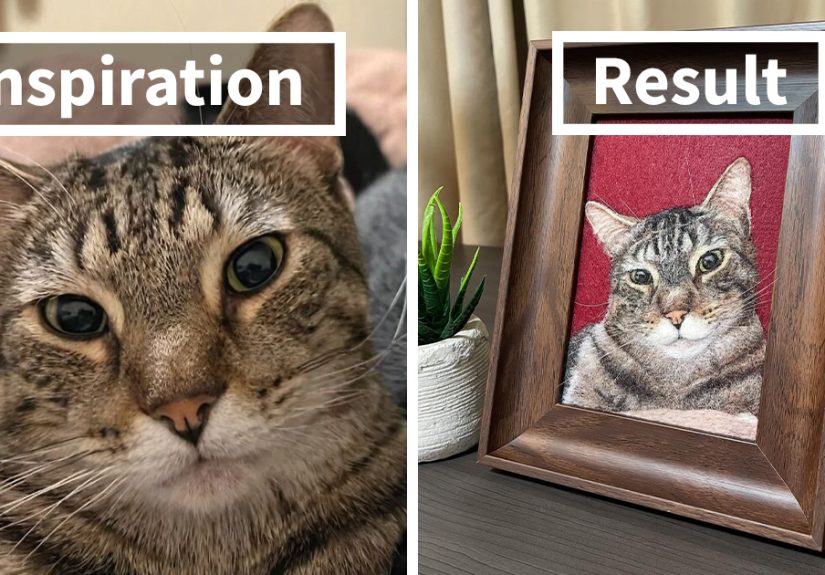
- The senior tabby with wise eyes. The artist catches the slightly heavy lids, the faded stripes, and that very specific “I have seen some things” cat energy.
- The tiny corgi with a full-size attitude. Short legs, alert ears, and a chest puff that somehow communicates confidence usually reserved for CEOs.
- The black cat that almost disappears into its own shadows. What makes it work is the layering of charcoal, espresso, and soft gray instead of one flat black blob.
- The floppy-eared doodle portrait. This one wins on texture alone, with loose curls around the muzzle and longer wool at the sides to mimic a freshly brushed coat.
- The Siamese with laser-focus eyes. Creamy body tones, darker points, and a face sculpted so precisely it feels like the cat might blink any second.
- The sleepy beagle in a shadow box. The droopy lids and caramel ears do all the emotional work, making the portrait feel cozy, sentimental, and quietly hilarious.
- The Persian cat with a cloud-like ruff. The fur is layered into a luxurious halo that looks expensive, dramatic, and slightly above your household budget.
- The husky with the icy stare. A realistic wool felt husky only needs those striking eyes and a clean facial mask pattern to become instantly recognizable.
- The orange tabby mid-squint. Somehow the artist captures both softness and mischief, as if this cat has just finished knocking a glass off a table.
- The long-haired dachshund with silky ears. The body stays compact while the ears and chest become the star attraction, flowing with carefully placed strands of wool.
- The rescue mutt that looks exactly right. Not a textbook breed, not a standard color pattern, just a one-of-a-kind face recreated with obvious affection.
- The Chihuahua with galaxy-sized confidence. Large eyes, fine muzzle, upright ears, and a pose that somehow announces, “I run this household now.”
- The Maine Coon with lion-level fluff. The trick here is balancing volume with structure so the fur looks rich and wild without swallowing the face.
- The bunny replica with velvet ears. A realistic felt rabbit leans hard on softness, but the nose and eye placement keep it from drifting into plush toy territory.
- The Shih Tzu with a perfect face frame. Long facial fur is arranged so carefully that the whole portrait feels like a grooming appointment and an art piece combined.
- The calico cat with painterly patches. Cream, rust, black, and subtle transition tones make this style especially impressive because every color shift has to feel natural.
- The French bulldog with side-eye. Those bat ears and compact muzzle make the breed easy to recognize, but it is the attitude that seals the deal.
- The white Samoyed that somehow still has definition. It is a masterclass in shadows, because all that fluffy brightness needs depth or it turns into a wool snowdrift.
- The border collie with working-dog intensity. The markings are crisp, the gaze is alert, and you can practically hear this felt pet waiting for instructions.
- The tiny Yorkie with impossible facial detail. The beard, brows, and silky coat demand patience, and when it works, the result is absurdly convincing.
- The one-eyed rescue portrait. These pieces often hit hardest emotionally because they celebrate the pet exactly as it was, with no polishing or pretending.
- The curled-up sleeping cat. No dramatic pose needed. Just a tucked paw, a folded tail, and a shape so peaceful it makes viewers lower their voice for no reason.
- The boxer with a wrinkled forehead. Expression is everything here, and those little forehead folds do the heavy lifting like character actors in a great movie.
- The cockatiel or parakeet cameo. Not every wool felt pet has fur. Feather texture in felt form can be downright sneaky when color placement is handled well.
- The schnauzer with legendary eyebrows. The beard and brows are the visual headline, but the best versions also catch the sturdy, square shape of the face.
- The tortoiseshell cat with fiery little flecks. Good luck making this look flat. The beauty is in the chaos, and the chaos takes real control to pull off.
- The pet memorial portrait with a name tag. A small plaque or charm beneath the bust instantly shifts the piece from impressive craft to treasured keepsake.
- The spaniel with glossy, soulful eyes. Long ears drape softly while the face stays compact and expressive, which is a classic recipe for instant double takes.
- The poodle with sculpted curls. This one is all about restraint. Too much fluff and it gets cartoonish. Just enough shaping and it looks astonishingly real.
- The gray cat with green eyes that pop off the frame. Neutral fur tones make room for intense eye color, and the contrast is impossible to ignore.
- The pug portrait with tiny forehead folds. Every wrinkle matters. When artists place them carefully, the whole face comes alive with comic dignity.
- The ragdoll cat with soft contrast coloring. Subtle cream, taupe, and chocolate tones create a dreamy, elegant look that feels almost too pretty to be real.
- The shepherd mix with heroic posture. Upright ears, alert expression, and a strong chest silhouette make this style read as loyal, smart, and beautifully grounded.
- The little hamster or guinea pig cameo. Small pets can be some of the most surprising because scale alone makes the level of detail feel ridiculous in the best way.
- The brindle dog that required 800 shades of patience. Brindle is a color challenge, but when the striping and mottling are blended right, the realism is jaw-dropping.
- The cat with one bent ear. Imperfections make pieces memorable. A quirky ear, uneven marking, or scar often gives the portrait its emotional center.
- The Labrador with “please throw the ball” face. Friendly eyes, broad muzzle, and short dense fur textures create a portrait that feels immediately familiar.
- The custom framed pet bust that makes people gasp. This is the grand finale version: sculpted head, layered fur, dimensional chest, and a presentation so polished it fools the room.
Why People Fall Hard for Needle Felted Pet Portraits
Part of the charm is simple admiration. People love seeing handmade work pushed to an almost ridiculous level of detail. But realistic felt pets go beyond technical respect. They trigger recognition. Owners know the exact angle of their dog’s nose. They know the fur swirl near the shoulder, the one ear that never sits right, the expression their cat makes before knocking pens off the desk. When a felt artist captures those quirks, the piece stops being decorative and starts feeling intimate.
That is also why these works have become popular as gifts and memorials. A realistic wool felt pet replica can preserve the visual memory of an animal in a tactile, dimensional way. It does not replace the pet, of course, but it can hold onto something meaningful: the face everyone misses, the posture that made the animal unmistakable, the softness people still remember in their hands.
What New Makers Can Learn from These Lifelike Creations
If you are studying this trend as a crafter, the lesson is not “be perfect immediately.” It is “observe more closely.” The strongest wool felt artists do not simply make dogs and cats. They study references with near-detective energy. They look for color shifts around the eyes, the direction of fur under the chin, the width of the bridge of the nose, and the way light changes the edges of white fur. Realism comes from attention, not speed.
There is also a useful creative reminder here: handmade does not have to mean rough. It can mean refined, specific, and deeply polished. Realistic needle felting proves that fiber art can be soft without being vague, sentimental without being cheesy, and playful without losing sophistication.
The Experience of Seeing Realistic Wool Felt Pets Up Close
There is a very particular kind of surprise that happens when someone encounters a realistic wool felt pet for the first time. From a distance, the brain usually makes a quick guess. It assumes the piece is a photograph, or maybe a printed portrait with a lot of texture. Then the viewer steps closer and the illusion starts to wobble in the most delightful way. The fur has dimension. The nose is sculpted. The whiskers sit slightly off the surface. Suddenly the viewer is no longer just looking at an image of a pet. They are looking at thousands of tiny decisions made by hand.
That experience tends to unfold in stages. First comes curiosity. Then disbelief. Then, almost always, a grin. People lean in. They tilt their heads. They point out details to whoever is standing next to them. “Look at the ears.” “Wait, the eyes are wool too?” “No way, that chest fluff is felted.” Realistic wool felt pets invite close looking in a way many objects do not. They reward attention. The longer you stare, the more the craftsmanship reveals itself.
There is also something unexpectedly emotional about the scale of these pieces. A felted pet portrait is often small enough to fit in your hands, which somehow makes the work feel even more personal. Instead of a large dramatic artwork that commands the room, it feels like a quiet treasure. You do not just notice it; you want to protect it. That small scale creates intimacy. It says this is not generic wall art. This is somebody’s dog. Somebody’s cat. Somebody’s rabbit with the funny ear and the permanent expression of mild confusion.
For pet owners, the reaction can be even stronger. The experience is not just visual. It is memory-driven. A realistic felt portrait can bring back the shape of a pet’s face faster than words do. It revives habits and personality. A slight head tilt may remind someone how their dog waited by the door. A certain squint may bring back the cat who always looked mildly offended by breakfast service. The realism matters because it reconnects people to specific moments, not just a general idea of a beloved animal.
Even for viewers who are not commissioning one for themselves, these pieces tend to spark respect for fiber art as a whole. People who once thought of felting as a beginner craft or a cute hobby suddenly see its full expressive range. They realize wool can do far more than make simple ornaments or cozy decorations. In skilled hands, it can imitate softness, motion, anatomy, and even emotion. That shift in perception is part of the magic. Realistic wool felt pets do not just impress people because they resemble animals. They impress people because they change what viewers think handmade art can do.
And maybe that is why these creations keep spreading online. They combine technical skill, tactile beauty, emotional meaning, and a little bit of visual trickery. They make people pause in the middle of endless scrolling and actually look. In today’s internet economy, that may be the most realistic miracle of all.
Conclusion
Realistic wool felt pets are more than a passing craft obsession. They are proof that soft materials can create sharp impact. The best examples do not rely on cuteness alone. They succeed because they capture anatomy, texture, expression, and personality with astonishing control. Whether the subject is a fluffy Persian, a goofy Lab, a one-of-a-kind rescue mix, or a memorial portrait of a much-missed companion, the effect is the same: people stop, stare, and smile.
That is the real charm of the trend. It is not only about fooling the eye. It is about honoring the details that make pets unforgettable. When artists get those details right, the result feels part sculpture, part portrait, part memory, and all heart.