Table of Contents >> Show >> Hide
- A quick “Liters Ladder” cheat sheet
- Method 1: Use geometry formulas, then convert to liters
- Method 2: Convert from other units (especially U.S. customary) into liters
- Method 3: Use water displacement for irregular objects
- Method 4: Use mass and density to back-calculate volume
- Which method should you use?
- Common mistakes (and how to avoid them)
- Conclusion
- Real-world experiences: 4 ways to calculate liters actually show up everywhere (yes, even at home)
“Litres” may be the spelling you grew up with, but in the U.S. you’ll usually see “liters.”
Same unit, same reality: a liter is a tidy metric way to describe how much three-dimensional space something holds.
If you cook, keep an aquarium, mix cleaning solutions, brew coffee like a scientist, or just own a suspiciously large water bottle,
knowing how to calculate volume in liters is a ridiculously practical life skill.
The trick is that “volume” shows up in different disguises. Sometimes you’re measuring a neat shape (a tank, a box, a pipe).
Sometimes you’re converting from U.S. customary units (gallons, quarts, fluid ounces).
Sometimes the object is an irregular chaos-goblin (looking at you, decorative rock collection).
And sometimes you only know the mass and the density, which is like volume calculation wearing a lab coat.
Below are four reliable methodseach with examplesso you can pick the fastest path to liters without guessing, squinting, or starting a feud with your calculator.
A quick “Liters Ladder” cheat sheet
Keep these relationships handy and most volume problems become plug-and-play:
- 1 liter (L) = 1 cubic decimeter (dm³) = 1,000 milliliters (mL) = 1,000 cubic centimeters (cm³)
- 1 cubic meter (m³) = 1,000 liters (L)
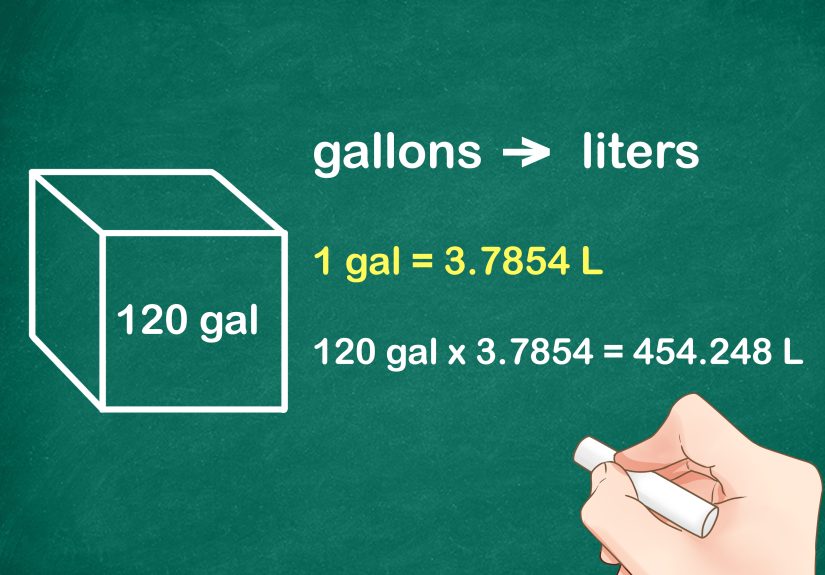
- 1 U.S. liquid gallon (gal) = 3.785411784 L (not the Imperial gallon)
- 1 U.S. liquid quart (qt) = 0.946352946 L
- 1 U.S. fluid ounce (fl oz) = 29.5735295625 mL
- 1 cubic inch (in³) = 16.387064 mL
- 1 cubic foot (ft³) = 28.316846592 L
Pro tip: do your math first, then round once at the end. Rounding early is how perfectly good numbers go to school and come back… a little different.
Method 1: Use geometry formulas, then convert to liters
If the container or object is a “nice” shape (box, cylinder, sphere-ish), geometry is the cleanest method.
You measure dimensions, compute volume in cubic units, then convert to liters using the cheat sheet.
Step-by-step approach
- Measure the dimensions in a metric unit if possible (cm or m).
- Use the correct volume formula to get a result in cm³ or m³.
- Convert:
- cm³ to liters: L = cm³ ÷ 1,000
- m³ to liters: L = m³ × 1,000
Common shapes and formulas
- Rectangular prism (box): V = length × width × height
- Cube: V = side³
- Cylinder: V = πr²h
- Cone: V = (1/3)πr²h
- Sphere: V = (4/3)πr³
Example A: Calculate a tank’s volume in liters (rectangular prism)
Say you have a small aquarium that measures 60 cm × 30 cm × 40 cm (internal dimensions).
- Volume in cubic centimeters: V = 60 × 30 × 40 = 72,000 cm³
- Convert to liters: 72,000 ÷ 1,000 = 72 L
If you’re filling it with water, you’ll typically leave headspace (and decorations steal volume), so the “real fill” might be a bit less.
But the math gives you the baseline capacity.
Example B: Cylinder volume in liters (a canister or pipe)
A cylindrical container has a radius of 7.5 cm and a height of 18 cm.
- Compute volume: V = πr²h = π × (7.5²) × 18 = π × 56.25 × 18 = π × 1,012.5 ≈ 3,180.9 cm³
- Convert to liters: 3,180.9 ÷ 1,000 ≈ 3.18 L
Watch the classic mistake: radius is half the diameter. If you accidentally use the diameter as the radius, your answer balloons by a factor of four.
Your container did not magically grow. Your input did.
Method 2: Convert from other units (especially U.S. customary) into liters
In the United States, volume often shows up in gallons, quarts, pints, cups, and fluid ounces.
If the measurement is already a “capacity” unit, you don’t need geometryjust conversion.
How to convert (the simple formula)
Volume in liters = volume in original units × (liters per unit)
Example A: 5-gallon bucket to liters
You have a standard 5 U.S. gallon bucket.
- Convert: 5 × 3.785411784 = 18.92705892 L
- Rounded for practical use: 18.93 L (or about 19 L if you’re not doing lab work)
Example B: 12 fluid ounces to liters
A drink is labeled 12 fl oz.
- Convert to mL: 12 × 29.5735295625 = 354.88235475 mL
- Convert to liters: 354.882… ÷ 1,000 = 0.3549 L (about 0.355 L)
When conversions get sneaky
- U.S. vs. Imperial gallon: They are not the same. If you’re using U.S. gallons, stick to the U.S. factor.
- Fluid ounces vs. ounces (weight): “fl oz” is volume; “oz” can mean mass. Labels can be chaoticdouble-check.
- Temperature and packaging: Some products settle, foam, or leave headspace. Conversions are exact; real containers can be messy.
Method 3: Use water displacement for irregular objects
If an object doesn’t have a clean geometric formulalike a rock, a bolt, or that mystery “souvenir” that looks like modern artuse displacement.
The idea is simple: submerge the object, measure how much the water level rises, and that rise equals the object’s volume.
What you need
- A graduated cylinder (best) or a measuring container with marked volume
- Water
- The object (must be safe to submerge)
Steps
- Pour water into the cylinder and record the initial volume (read the bottom of the meniscus).
- Gently lower the object in (avoid splashes and bubbles).
- Record the final volume.
- Subtract: Object volume = final − initial
- Convert mL to liters if needed: L = mL ÷ 1,000
Example: Find volume in liters using displacement
Initial water level: 250 mL
Final water level after submerging the object: 315 mL
- Displaced volume: 315 − 250 = 65 mL
- Convert to liters: 65 ÷ 1,000 = 0.065 L
Displacement troubleshooting (because physics is petty)
- Floating object? Use a sinker (a small weight) and measure the sinker’s displacement separately, then subtract it out.
- Bubbles stuck to the object? Tap the container gently; bubbles “add” fake volume.
- Object absorbs water? Displacement becomes less reliable. Use another method if possible.
- Too big for a cylinder? Use an overflow container and collect displaced water, then measure that water’s volume.
Method 4: Use mass and density to back-calculate volume
When you can’t measure dimensions or displacement easily, but you do know mass and density, you can calculate volume with one equation:
Density (ρ) = mass (m) ÷ volume (V)
Rearrange to solve for volume:
V = m ÷ ρ
Unit sanity check
- If density is in g/mL, keep mass in g and you’ll get volume in mL.
- If density is in kg/m³, keep mass in kg and you’ll get volume in m³, then convert to liters (× 1,000).
- Water is often approximated as 1 g/mL, but density varies slightly with temperaturefine for everyday use, not fine for a precision lab.
Example A: Find liters from mass and density (everyday liquid)
You have 2.5 kg of a liquid with density 0.91 g/mL (a reasonable ballpark for some cooking oils).
- Convert mass to grams: 2.5 kg = 2,500 g
- Compute volume in mL: V = 2,500 ÷ 0.91 ≈ 2,747 mL
- Convert to liters: 2,747 ÷ 1,000 ≈ 2.75 L
Example B: Density in kg/m³ (engineering-style)
A material sample has mass 4 kg and density 800 kg/m³.
- Compute volume in m³: V = 4 ÷ 800 = 0.005 m³
- Convert to liters: 0.005 × 1,000 = 5 L
Which method should you use?
Here’s a quick decision guide so you don’t overcomplicate your own life:
| Situation | Best method | Why it works |
|---|---|---|
| Box, tank, room, rectangular container | Method 1 (geometry) | Fast, accurate, uses easy measurements |
| Pipe, canister, cup, any cylinder-ish shape | Method 1 (geometry) | One formula plus a simple conversion |
| Label shows gallons/quarts/fl oz | Method 2 (conversion) | No geometry neededjust multiply |
| Weird-shaped solid that can be submerged | Method 3 (displacement) | Measures volume directly, shape doesn’t matter |
| You know mass and density (but not dimensions) | Method 4 (density) | Back-calculates volume using a universal physics relationship |
Common mistakes (and how to avoid them)
- Mixing units: Don’t multiply inches by centimeters unless you enjoy nonsense. Convert first.
- Using external dimensions for internal capacity: Wall thickness matters for containers (coolers, tanks, bottles).
- Confusing diameter and radius: The cylinder formula uses r. If you only have diameter, divide by 2.
- Rounding too soon: Keep extra digits during calculations; round at the end.
- Forgetting that “fl oz” is volume: Ounces (mass) and fluid ounces (volume) are not interchangeable without density.
Conclusion
Calculating volume in litres (liters) doesn’t have to be a math horror movie.
Use geometry for regular shapes, unit conversions for labeled containers,
water displacement for irregular solids, and density when mass is known but volume isn’t.
Once you’re comfortable moving between cubic units, milliliters, and liters, you’ll be able to estimate capacity accurately
and you’ll stop buying storage bins that are “definitely big enough” (spoiler: they never are).
Real-world experiences: 4 ways to calculate liters actually show up everywhere (yes, even at home)
The first time most people “do volume” outside school, it’s not in a textbook. It’s in a kitchen, a garage, or a pet store aisle,
staring at a container and thinking, “How much does this hold… and will it ruin my day if I guess wrong?”
Over time, you start building volume instinctsand these four methods are basically the tools that keep those instincts honest.
Geometry sneaks into daily life the moment you buy anything rectangular: storage bins, coolers, mini-fridges,
even a raised garden bed. If you’ve ever tried to plan how much soil you need, you’ve done volume math.
The garden bed looks innocent until you realize soil is sold by the bag, bags list liters, and your bed’s dimensions are in inches.
That’s when you learn the value of converting everything to a single system (metric saves time and sanity), calculating cubic volume,
then translating it into liters so you can buy the right number of bags without hauling “just one more” back to the car.
Conversions are the bilingual dictionary of measurement. If you’ve ever brewed coffee, mixed sports drink powder,
or diluted a cleaning concentrate, you’ve probably faced a label that speaks in ounces while your measuring pitcher speaks in liters.
A classic example is a “makes 2 gallons” drink mix when you only have a 2-liter bottle.
Converting gallons to liters instantly tells you whether you’re making a full batch, a half batch, or a mysterious third batch
that tastes like regret. Conversions also matter when you travel: water bottles, fuel additives, and cooking measurements jump between systems
faster than your brain can adapt.
Displacement is the hero for awkward objects. People discover it when they need the volume of something that refuses to be measured:
a stone for an aquarium, a piece of metal for a science project, or a random hardware part that’s “about yay big.”
The “aha” moment is watching water level rise and realizing, “Oh. The object is telling me its volume.”
It feels like a magic trick, but it’s just honest measurement. The biggest lesson from real life?
Go slowly. Bubbles cling. Water splashes. And if you drop something into a graduated cylinder like a tiny cannonball,
your volume reading becomes a weather event.
Density-based volume shows up when you’re measuring by weight. This is surprisingly common in cooking and DIY.
Many people weigh ingredients because it’s faster and more consistent than using measuring cups.
But then you need a volume estimate: how many liters of liquid do you have for a recipe, a soap batch, or a fermentation vessel?
If you know (or can look up) density, V = m ÷ ρ becomes your shortcut.
The real-world “gotcha” is temperature: density changes, especially for liquids. In most home scenarios, it’s close enough.
In precision scenarios (like calibrations or lab work), you’d want a more exact density for the current temperature.
After a few projectsfilling a fish tank without flooding the stand, mixing a correct-strength solution, or buying the right-size container
you start to appreciate that volume in liters isn’t just math. It’s a practical way to avoid waste, save money, and prevent small household disasters.
And honestly? Anything that reduces the number of surprise trips to the store is a personal victory.