Table of Contents >> Show >> Hide
- Before You Paint: The Quick Rules That Save Your Sanity
- 15 Painted Brick Fireplace Makeovers (Before & After Styles)
- 1) Classic Bright White: “From Dated Red to Clean and Airy”
- 2) Soft Warm White: “White, But Not Blinding”
- 3) Matte Black Statement: “Hello, Modern Drama”
- 4) Charcoal Gray: “The Softer Black”
- 5) Greige & Taupe: “Neutral That Plays Nice With Everything”
- 6) Moody Blue: “Coastal, Classic, and Unexpected”
- 7) Teal or Robin’s Egg: “Retro Fun (But Make It Intentional)”
- 8) Earthy Green: “Organic Modern Upgrade”
- 9) Two-Tone Brick: “Built-In Dimension Without Extra Construction”
- 10) Painted Brick + Updated Mantel: “The Glow-Up Duo”
- 11) Limewash Look: “Old-World Texture, Lighter Vibe”
- 12) Whitewash: “Lighten the Brick Without Hiding It”
- 13) “German Schmear” Style: “Texture That Looks Like It’s Been There Forever”
- 14) Painted Brick + Painted Surround Wall: “The Fireplace as a Feature Wall”
- 15) The “Budget Refresh” Makeover: “Paint + Hardware + Styling = Instant After”
- How to Choose Your “After” Look (Without Regretting It)
- Real-Life Experience: What Painting a Brick Fireplace Actually Feels Like (500+ Words)
- Conclusion: The “After” You’ll Actually Love
There are two types of brick fireplaces in this world: the kind you lovingly decorate with stockings… and the kind you accidentally decorate with your eyes by staring at it thinking, “Why is it so orange?” If your fireplace falls into the second category, welcome. You’re among friends (and people who own rollers with suspiciously crusty handles).
The good news: painting brick is one of the highest-impact, relatively low-cost upgrades you can do in a living room. The tricky news: brick is thirsty, textured, and about as subtle as a marching band, so the “right way” matters. In this guide, you’ll get 15 makeover styleseach with a clear “before” problem, an “after” vibe, and practical notes you can actually use when it’s time to open the paint can.
Before You Paint: The Quick Rules That Save Your Sanity
1) Clean like you mean it
Dust, soot, and mystery grime will sabotage adhesion. Most reputable how-tos agree that a thorough cleaning (and letting it dry completely) is non-negotiableespecially around the opening where residue likes to linger.
2) Prime porous brick (yes, even if you’re “in a rush”)
Brick is absorbent, and primer helps lock down the surface so your finish looks even and lasts. Masonry or bonding primers are commonly recommended for bare brick, while specialty guidance often emphasizes durability and adhesion on textured surfaces.
3) Use the right paint in the right places
Many guides recommend quality interior acrylic paints for the surround and face, but caution that the firebox (where flames and direct heat live) is a different beast and may require heat-rated coatingsor be left alone depending on your setup. Always follow product labels and local code requirements.
4) Tools that help: angled brush + “nappy” roller
A thick-nap roller reaches into brick texture, while an angled brush gets into mortar joints and little pockmarks you didn’t know existed until you started painting.
15 Painted Brick Fireplace Makeovers (Before & After Styles)
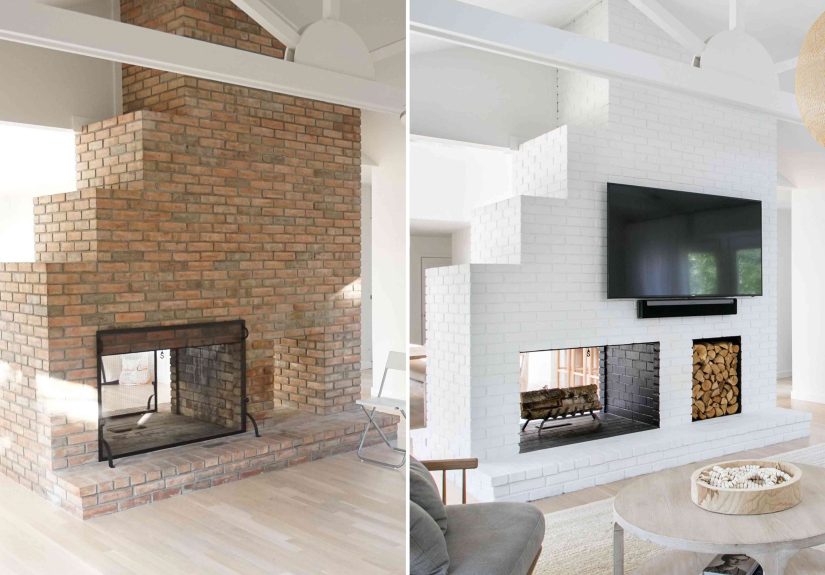
1) Classic Bright White: “From Dated Red to Clean and Airy”
Before: Traditional red/orange brick dominates the room and fights every décor choice you’ve ever made.
After: Crisp white brick turns the fireplace into an architectural feature instead of a visual shout.
Why it works: White reflects light, makes the room feel larger, and pairs with everything from farmhouse to modern.
Pro move: Choose a washable finish (often satin or eggshell on surrounds) if you expect fingerprints, soot, or curious pets.
2) Soft Warm White: “White, But Not Blinding”
Before: The brick is heavy and the room feels a bit cave-like.
After: A warm white or creamy neutral keeps the brightening effect without looking stark.
Best for: Traditional homes, cozy spaces, and anyone whose décor includes beige, linen, oak, or warm metals.
Design tip: Add a wood mantel in a natural tone for balancepainted brick + warm wood is basically a personality trait now.
3) Matte Black Statement: “Hello, Modern Drama”
Before: A busy brick pattern distracts from the rest of the room.
After: Matte black simplifies the texture and turns the fireplace into a clean focal point.
Why it works: Black visually “edits” brick while adding contrast, especially in light rooms.
Style pairing: White walls, light rugs, and a simple mirror or art piece above the mantel.
4) Charcoal Gray: “The Softer Black”
Before: Red brick feels stuck in another decade.
After: Charcoal gives a tailored look without the full intensity of black.
Best for: Transitional spaceswhere you want modern polish but still want the room to feel warm.
Bonus: Charcoal is forgiving with ash smudges and minor scuffs.
5) Greige & Taupe: “Neutral That Plays Nice With Everything”
Before: Brick clashes with flooring, furniture, or wall color.
After: Greige/taupe tones bridge warm and cool palettes, creating harmony.
Where it shines: Open-concept spaces where the fireplace needs to coordinate with adjacent rooms.
Tip: Test paint samples in daylight and lamplightgreige can shift moods like it’s auditioning for a soap opera.
6) Moody Blue: “Coastal, Classic, and Unexpected”
Before: The fireplace is visually loud but not in a good way.
After: A deep navy or slate blue adds color with sophistication.
Best for: Rooms with warm woods, brass accents, or creamy textiles.
Make it pop: Keep the mantel simple and let the color do the talking.
7) Teal or Robin’s Egg: “Retro Fun (But Make It Intentional)”
Before: Brick feels bulky and datedlike it’s trying to block your Wi-Fi signal.
After: Teal or robin’s egg turns the fireplace into a cheerful centerpiece.
Best for: Eclectic homes, midcentury-inspired rooms, or anyone ready for a confident color choice.
Tip: Tie the color into the room with one or two accents (pillows, art, vase) so it feels curatednot accidental.
8) Earthy Green: “Organic Modern Upgrade”
Before: Brick reads “rustic” when you’re aiming for calm and modern.
After: Olive, sage, or deep forest green creates a grounded, nature-forward look.
Pairs well with: White oak, black hardware, woven textures, and lots of plants that you promise you’ll water.
9) Two-Tone Brick: “Built-In Dimension Without Extra Construction”
Before: Everything is one brick color, one brick texture, one brick mood.
After: Paint the surround one color and the chimney breast another, or make the hearth a contrasting shade.
Why it works: It visually “frames” the fireplace and adds intentionality.
Easy combo: White brick + charcoal hearth for a crisp, grounded look.
10) Painted Brick + Updated Mantel: “The Glow-Up Duo”
Before: Even painted brick can look unfinished if the mantel is undersized or dated.
After: A thicker wood mantel (or a boxed beam look) makes the whole fireplace feel custom.
Design note: If you paint the brick light, a natural wood mantel adds warmth. If you paint the brick dark, a lighter mantel can keep things balanced.
11) Limewash Look: “Old-World Texture, Lighter Vibe”
Before: The brick is too orange, too busy, too much.
After: A limewash-style finish softens color while keeping texture and variation.
Why it works: It looks layered and intentionallike a European cottage, not a hasty weekend project.
Good to know: Limewash techniques and “washy” finishes vary; always test a small area to confirm the opacity you want.
12) Whitewash: “Lighten the Brick Without Hiding It”
Before: Red brick feels overpowering but you don’t want it to disappear completely.
After: A diluted paint wash brightens while allowing undertones to peek through.
Best for: Rustic, farmhouse, cottage, or anyone who wants “softened” not “sealed.”
13) “German Schmear” Style: “Texture That Looks Like It’s Been There Forever”
Before: Brick is damaged, inconsistent, or just not your style.
After: A schmear-style treatment adds thick, imperfect, old-world character.
Why it works: It hides imperfections and adds depthespecially in cozy rooms with warm lighting.
Heads-up: This look is deliberately messy. If you like crisp lines, this is not your soulmate technique.
14) Painted Brick + Painted Surround Wall: “The Fireplace as a Feature Wall”
Before: Fireplace feels like a random brick rectangle dropped into a room.
After: Painting the brick and the surrounding wall the same color turns it into a bold, cohesive statement.
Best for: Modern spaces, minimal rooms, and anyone who loves a “designed” look.
Smart styling: Keep décor on the mantel minimallet the color carry the moment.
15) The “Budget Refresh” Makeover: “Paint + Hardware + Styling = Instant After”
Before: The fireplace isn’t terrible… it’s just tired.
After: Paint the brick, update the screen/toolset, add a new grate, and style the mantel with a mirror + a few layered pieces.
Why it works: Small upgrades read as a full renovation when the fireplace is already the room’s focal point.
Tip: If your hearth is stained or dated, consider painting it too (with products appropriate for the surface and use).
How to Choose Your “After” Look (Without Regretting It)
Match the makeover to your room’s personality
- Love bright and airy? White, warm white, or whitewash.
- Want modern contrast? Matte black or charcoal.
- Craving color? Navy, teal, or green.
- Texture fan? Limewash look or schmear-style finishes.
Consider maintenance and real life
If you burn wood often, soot happens. If you have kids, fingerprints happen. If you have pets, somehow everything happens at once. Slightly darker colors and more washable finishes are often easier to live with, while super-white can be stunning but may need occasional touch-ups.
Don’t skip the “tiny test patch”
Brick undertones can shift a paint color. A quick test patch helps you confirm that your “soft warm white” doesn’t turn into “surprise peach” at sunset.
Real-Life Experience: What Painting a Brick Fireplace Actually Feels Like (500+ Words)
Let’s talk about the part most “after” photos don’t show: the middle. The middle is where you discover that brick has more texture than a karaoke singer’s emotional backstory. The middle is where you realize you own exactly one drop cloth and it is, tragically, not large enough. And the middle is where you learn the difference between “this will take an afternoon” and “why am I still doing this on Sunday night?”
First, there’s the prep optimism phase. You look at your fireplace and think, “I’ll just wipe it down.” Then you wipe it down and the rag comes away gray, then black, then gray again, like the brick is politely handing you its résumé of every winter it has ever survived. You’ll probably do a second cleaning passespecially around the openingbecause paint and soot have a complicated relationship, and it’s mostly “we should not be together.” Once you’re finally satisfied, you wait for it to dry, which sounds simple until you remember that impatience is your strongest personality trait.
Next comes the primer reality check. The first coat looks patchy. This is not the universe punishing you; it’s just porous masonry doing porous masonry things. Brick drinks primer. It guzzles it. It slurps it like iced coffee in July. The good news is that primer is doing its job: giving your paint a surface it can bond to so you don’t end up with peeling edges later. The bad news is that you will, at some point, stare at the patchiness and whisper, “Was this a mistake?” It was not. Keep going.
Then you enter the roller-and-brush choreography. The roller gets the broad strokes, but the brush becomes your sidekick for mortar joints and little craters. It’s oddly satisfying… until you realize there are approximately nine million mortar lines. If you’re painting white, you’ll notice every missed spot from across the room. If you’re painting dark, you’ll notice every speck of lint from your roller. Either way, you’ll develop a new respect for anyone who paints brick for a livingand you may briefly consider sending them a fruit basket.
The most surprising part is how much the fireplace changes the entire room’s lighting and mood. A white or warm-white fireplace can make a space feel brighter even without changing the walls. A black fireplace can make a room feel more intentional and “designed,” like you hired someone who says words like “negative space” without laughing. Colors like navy, teal, or green can turn your fireplace into a signature featuresomething guests comment on before they even sit down. (They will also ask what color you used. Prepare a confident answer, even if your truth is, “I panicked and bought whatever was in stock.”)
Finally, there’s the styling phase, where the makeover becomes a makeover. Once the paint cures, adding a new mantel, swapping in a modern screen, or styling with a mirror and a few layered objects makes the “after” feel finished. This is where you get that moment of satisfaction: the fireplace isn’t fighting the room anymoreit’s supporting it. And yes, you will probably take a photo and stare at it for a weirdly long time. That’s normal. That’s science.
Conclusion: The “After” You’ll Actually Love
A painted brick fireplace makeover isn’t just about covering up red brickit’s about giving your room a focal point that matches how you live now. Whether you go classic white, moody black, nature-inspired green, or a textured limewash look, the best makeovers have three things in common: solid prep, the right products, and a finish that fits the home’s style. Choose your “after” with intention, take the time to prime, and remember: brick has textureso your process can have a little texture too.