Table of Contents >> Show >> Hide
- Before you start: a 15-minute reset that makes every tip work better
- 1) Create “zones” by job, not by brand
- 2) Use a portable cleaning caddy like a shopping basket for chores
- 3) Go vertical with a door-mounted organizer (your closet door is a free wall)
- 4) Install broom-and-mop clips so handles stop face-planting
- 5) Add a tension rod for spray bottles (yes, like a tiny curtain rod)
- 6) Corral loose stuff with clear bins and “open-top” baskets
- 7) Store chemicals safely: separate, stable, and in original containers
- 8) Use a lazy Susan for small bottles and refills
- 9) Add shelf risers to double your “stacking” space
- 10) Give trash bags, liners, and cloths a “file cabinet” system
- 11) Use wall-mounted bins for sprays and awkward bottles
- 12) Build a “restock and retire” routine (so the closet stays organized)
- A quick layout that works in almost any cleaning closet
- Conclusion: your closet should help you clean, not test your reflexes
- Experiences: what people learn after organizing a cleaning closet (the fun way)
- SEO Tags
Some closets open with a satisfying click. A cleaning closet often opens with a dramatic whooshas a mop handle tries to escape and a mystery sponge tumbles to freedom. If yours has become a tiny supply tornado, you’re not messy. You’re just running a busy home in a closet-sized space.
The good news: you don’t need a renovation, a label maker that costs more than your vacuum, or a new personality. With a few smart storage moves (and one very honest trash bag), you can turn your cleaning closet into a grab-and-go command center where everything has a “home,” nothing topples, and you can find the glass cleaner without doing an archaeological dig.
Before you start: a 15-minute reset that makes every tip work better
- Empty it out. Yes, all of it. Closets lie when they’re full.
- Sort into simple piles: “Keep,” “Recycle/Trash,” “Donate,” and “Relocate.” (Relocate = things that have no business living here, like holiday ribbon from 2019.)
- Check safety basics: keep products in their original containers, cap them tightly, and toss anything leaking, unlabeled, or expired.
- Measure once. Shelf width, depth, and door clearance. A bin that doesn’t fit is just an expensive mistake with handles.
Now, let’s build your organized cleaning closetone genius tweak at a time.
1) Create “zones” by job, not by brand
Instead of lining up 14 spray bottles like they’re auditioning for a marching band, organize by where or what they clean: kitchen, bathroom, floors, laundry, glass, and “miscellaneous.” When supplies are grouped by purpose, you stop buying duplicates because you can actually see what you already own.
Make it work
- Dedicate one shelf (or one bin) per zone.
- Keep the “daily drivers” at eye level; put rarely used products higher or lower.
- If you share cleaning duties, label zones in plain English: “Bathroom,” not “Aqueous Sanitizing Solutions.”
2) Use a portable cleaning caddy like a shopping basket for chores
A cleaning caddy is the difference between “I’ll wipe the bathroom quickly” and “I made 11 trips to the closet and now I live here.” Set up one sturdy caddy for your most common routine (usually bathroom or kitchen), then refill it from the closet like you’re restocking a tiny store.
What to put inside
- One all-purpose cleaner
- Microfiber cloths
- Scrub brush
- Gloves
- Optional: a small disinfectant for high-touch areas
3) Go vertical with a door-mounted organizer (your closet door is a free wall)
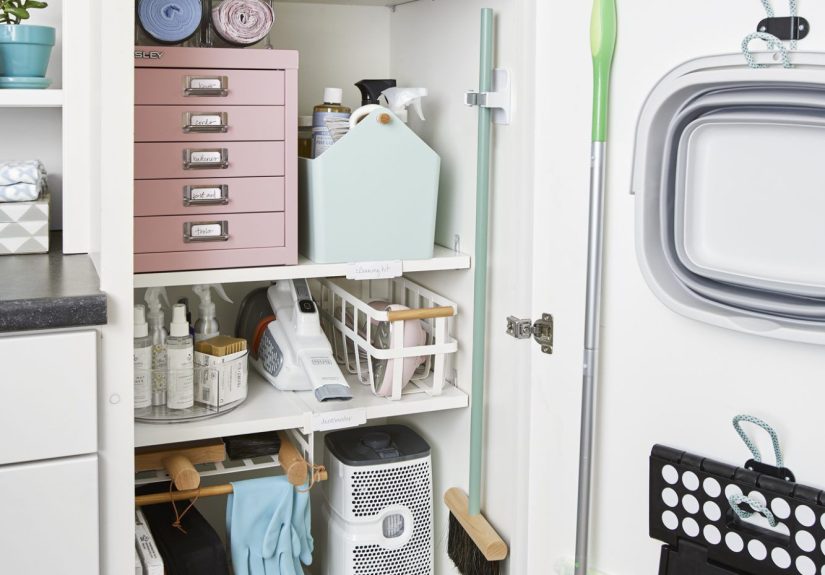
The back of the door is prime real estate. An over-the-door rack, hanging pocket organizer, or slim wire system can hold lightweight items like sponges, dusters, gloves, and refillswithout stealing shelf space.
Best uses
- Cleaning cloths and replacement heads
- Small brushes and grout tools
- Trash bags and reusable gloves
- Pet-cleanup essentials (in their own pocket, please)
Pro tip: Keep heavy liquids off the door if it makes the door sag or slam. A door should not feel like a gym workout.
4) Install broom-and-mop clips so handles stop face-planting
If your closet contains a mop pile that looks like it lost a fight, clips are your new best friend. Wall-mounted tool holders, spring-loaded clips, or a rail system keeps brooms, mops, and dusters upright and off the floor. Your future self will thank you every time you open the door and nothing attacks.
Small-space hack
Use one clip for the dustpan, toobecause a dustpan on the floor is basically a banana peel for adults.
5) Add a tension rod for spray bottles (yes, like a tiny curtain rod)
Spray bottles are awkward: too tall for drawers, too unstable for stacking, and always ready to tip. A simple tension rod across the closet (or under a shelf) creates a hanging bar where you can hook bottle triggers and keep them lined up neatly.
Why it’s genius
- Frees shelf space for bulkier items
- Prevents bottles from falling over and leaking
- Makes it obvious when you’re running low
6) Corral loose stuff with clear bins and “open-top” baskets
Cleaning closets collect tiny things: magic erasers, grout brushes, extra sponges, vacuum attachments, and that one screwdriver you swear you’ll return to the garage. Bins give those orphans a home. Clear bins help you see what’s inside; open-top baskets are faster for daily grab-and-go items.
Labeling that actually gets used
- Use short labels: “Wipes,” “Dusting,” “Vacuum,” “Refills.”
- Label the front and the top if bins are stacked.
- Skip perfection. A crooked label still works.
7) Store chemicals safely: separate, stable, and in original containers
This is the un-fun tip that prevents very un-fun problems. Keep cleaning products in their original, labeled containers, store them upright, and separate incompatible items (for example, bleach away from ammonia-based products). If you have kids or pets, consider a child-proof latch or placing chemicals on a higher shelf.
Quick safety rules
- Don’t transfer chemicals into drink bottles or “cute” dispenserslabels matter for first aid and safe use.
- Don’t mix cleaners unless the label says it’s safe. (Some combinations can create toxic fumes.)
- Keep flammables (like certain aerosols) away from heat sources.
8) Use a lazy Susan for small bottles and refills
Deep shelves turn into black holes. A turntable (lazy Susan) lets you spin your way to the thing you need without pulling out half the closet. It’s especially helpful for smaller bottles, stain treatments, and dishwasher or laundry additives.
Make it extra functional
- Choose one with a rim so items don’t fly off during a dramatic spin.
- Group by category: “Laundry,” “Bathroom,” or “Spot Treatments.”
9) Add shelf risers to double your “stacking” space
If you have one tall shelf, you can turn it into two levels with a simple riser. It’s perfect for paper towels, toilet paper, bulk sponges, and backup productsanything that’s bulky but light.
Where risers shine
- Under-shelf space for shorter items (wipes, small tubs)
- Top level for tall items (paper towel rolls, refills)
10) Give trash bags, liners, and cloths a “file cabinet” system
Nothing gets messier faster than soft goods. If trash bags and microfiber cloths live in an unstructured pile, they become a fuzzy avalanche. Store them verticallylike filesin magazine holders, narrow bins, or divided baskets so you can pull one stack out without disturbing the rest.
Easy set-up
- One slot for kitchen bags
- One slot for bathroom bags
- One slot for specialty liners (if you must)
- One slot for clean cloths, one for “needs washing”
11) Use wall-mounted bins for sprays and awkward bottles
If shelves are scarce, mount narrow metal bins (the kind used for mail or magazines) to the inside wall. They hold spray bottles surprisingly well and keep tall items from tipping. You can dedicate bins by room (kitchen, bath) or by task (glass, disinfecting).
Tip for renters
If you can’t drill, use heavy-duty removable mounting strips rated for the weightthen keep the bins for lightweight items only. No one wants a surprise “clang” at 2 a.m.
12) Build a “restock and retire” routine (so the closet stays organized)
The secret to a consistently organized cleaning closet isn’t superhuman disciplineit’s a tiny routine that keeps clutter from growing back. Pick a simple system:
- Monthly: wipe shelves, check for leaks, toss empty bottles, and put refills behind the current bottle (first in, first out).
- Seasonally: donate or discard duplicates you don’t use, and reassess what you actually reach for.
- After each cleaning: return items to their zone. (Think: “don’t put it down, put it away.”)
A quick layout that works in almost any cleaning closet
- Top shelf: backup supplies, paper goods, rarely used items
- Eye-level shelf: daily cleaners and your portable caddy
- Lower shelf/floor: heavier items (detergent, bulk refills) in a spill-proof bin
- Wall/door: tools, cloths, lightweight accessories
Conclusion: your closet should help you clean, not test your reflexes
An organized cleaning closet is less about matching bins and more about friction-free habits. When zones are clear, tools are vertical, and small items are contained, cleaning gets fasterand you stop buying “another bottle of the same thing” because you can’t find the first one.
Start with one upgrade today: add a caddy, mount a tool holder, or label two bins. Small wins stack upunlike the mop handles. Soon your cleaning closet won’t be a place you dread opening. It’ll be the little command center that makes your whole house feel easier.
Experiences: what people learn after organizing a cleaning closet (the fun way)
Most people don’t “organize a cleaning closet” so much as they survive ituntil the day the door won’t close, a bottle leaks, or they buy their fifth roll of trash bags because the other four are hiding behind a mop. The best lessons tend to show up in real life, not in perfect Pinterest photos. Here are a few common experiences that keep repeating in different homes, from small apartments to busy family houses.
The renter’s revelation: In a compact city apartment, the cleaning closet is often a skinny cabinet with one shelf and big dreams. People usually start by trying to fit everything inside, then discover the closet works better when it stores tools and one set of go-to products, not every cleaner ever invented. The “aha” moment is using a door organizer for lightweight items and a caddy for the essentialssuddenly the closet feels twice as big, even though it’s the same size. The second revelation? Keeping duplicates somewhere else (or not buying them at all) is the fastest way to get breathing room.
The family home reality check: In homes with kids, the cleaning closet becomes a weird mix of necessary and dangerous. A common experience is realizing that “up high” isn’t always “safe” if the shelves are accessible or if the door is left open during cleaning. Many families end up using a simple latch and moving the most hazardous products to the back of a top shelf, while keeping safer items (like microfiber cloths) within easy reach. Parents also discover that clear labels reduce chaos when multiple people pitch inbecause “the blue spray” is not a universal language.
The pet-owner plot twist: Households with pets tend to have a special category: “accidents happen.” People often keep enzyme cleaners, paper towels, gloves, and a small trash bag stash together in one clearly labeled bin. The experience here is pure practicality: when you’re cleaning up a mess, you don’t want to rummage. A dedicated “pet cleanup” kit is one of the most underrated storage wins, and it prevents cross-contamination (and the emotional damage of touching the wrong cloth).
The ‘I tried decanting’ cautionary tale: A lot of folks try the aesthetic routepouring detergents or cleaners into pretty, unlabeled containers. The real-world experience is that it looks great… right up until someone can’t tell what’s inside, the instructions disappear, or the container leaks because it wasn’t meant for that chemical. Many people end up switching back to original packaging (or at least labeling aggressively), because safety and clarity beat vibes when chemicals are involved.
The maintenance win: The most successful closets aren’t the ones that look like a showroom; they’re the ones that are easy to reset. People who keep it organized long-term usually adopt one tiny habit: a two-minute “put it back” rule after cleaning. They also do quick monthly checks for empty bottles and mystery sponges. The experience is reassuring: you don’t need to reorganize the whole closet every time. You just need a system that makes the right choice the easy choice.
If there’s one takeaway from all these experiences, it’s this: your cleaning closet should match your life. A good system feels boring in the best waybecause you always know where things are, nothing falls out, and the closet quietly does its job… unlike that one broom that used to jump-scare you.